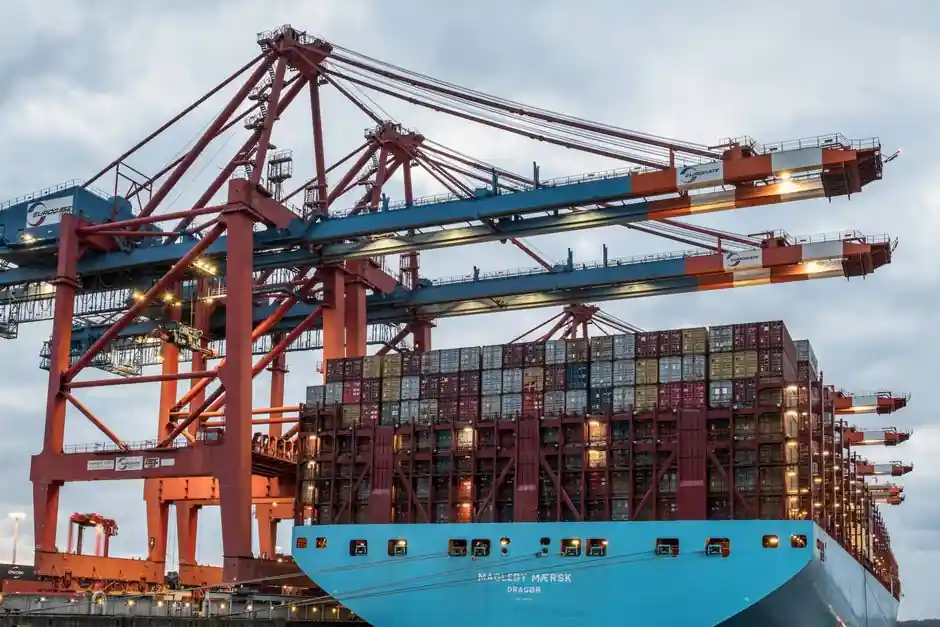
Storage rack layouts in container terminals are dictated upstream by ship-to-shore (STS) crane geometry, where lifting capacity spans 30-75 t per cycle and operating rates exceed 40 moves per hour on modern automated gantries [S2].
The downstream effect is direct: any storage rack or pallet rack inside a port-side warehouse, MRO store, or empty-container depot must be dimensioned to the container ISO 20 ft / 40 ft module and the RTG/RMG stacking window it feeds [S2].
Why STS and RTG Crane Geometry Drives Rack Specs
STS cranes reach 70 m operating radius and over 50 m lift height, handling 24,000+ TEU vessels with deck stacks above 10 container layers [S2]. Rubber-tyred gantry (RTG) cranes for yard stacking lift up to 70 t on rubber tires with no fixed rail, while rail-mounted gantry (RMG) cranes run on ground rails with higher automation, precise positioning, and stable operation across the full container yard span [S2]. For any indoor store that receives spare parts or empty pallets from the yard, the storage handling envelope must be a sub-multiple of the ISO 20 ft / 40 ft container footprint, otherwise transfer time from quay to rack blows the crane-rate budget [S2].
Selection Criteria for Port-Side Storage Racks
Four criteria separate a usable port rack from a costly retrofit. First, base-plate and anchor protocol: rack columns in marine exposure are typically hot-dip galvanized to ISO 1461 or equivalent, with chemical-anchor bolts sized for the local seismic and wind zone. Second, bay width and clear height: bays should match 1,200 x 800 mm or 1,200 x 1,000 mm pallet footprints in multiples, with clearances for the straddle carrier or forklift that actually feeds the rack from the yard. Third, deck load and frame stiffness: dynamic loads from container-handling traffic adjacent to the rack line require moment frames rated for the prevailing wind and crane-surge zone. Fourth, hazardous-area zoning: any rack within 1-2 m of a fuel-dispense or battery-charging bay must be bonded, grounded, and paired with lighting equipment and electric lamps certified to ATEX 2014/34/EU or IECEx for Zone 1/2 exposure. [S3]
Use Cases: MRO Stores, Empty Container Depots, Driver Check-In Adjacencies

Three concrete use cases dominate the port spec sheet. MRO and spare-parts stores sit close to the crane maintenance bays and typically use selective pallet rack with 3-4 levels, 2.5-3.0 t per bay, and 1,200 mm fork openings to accept standard EUR-pallet returns from the yard. Empty container depots use cantilever-style or stacking-frame racks sized to ISO 20/40 corner-castings, with 6-8 t per position to match the 30-75 t STS lift envelope [S2]. Driver check-in and dispatch office adjacencies use light-duty storage rack with shelf capacities around 100-200 kg per shelf for paperwork, PPE, and radio gear, often inside a modified container booth as built by US port-yard fabricators [S3]. The Mod Shop's port/logistics line, for example, ships gatehouses, driver check-in stations, and parts rooms with sealed penetrations, protected fixtures, and all-shift HVAC, designed for 24/7 yard exposure [S3].
Comparative Map of Rack Types for Port/terminal Duty
Selective pallet rack, drive-in/drive-through rack, cantilever rack, and stack-frames each map to a different port duty cycle, and the choice is dictated by SKU velocity and yard-crane interface, not by floor area. Selective racks offer 100% SKU access but lower density, suiting the MRO and bonded-store case. Drive-in racks raise density to roughly 60-75% of the floor area but drop access to last-in/first-out, a fit for slow-moving export empties. Cantilever racks handle long loads (pipes, timber, structural spares) and accept fork access from three sides, matching the open yard of an RMG-served facility. Stack-frames, sized to ISO corner castings, take empty containers stacked 4-6 high and match the STS 30-75 t lift band [S2]. For yard-side battery and fuel storage, a 4-bay chemical-store rack with sump pallets and ATEX-rated lighting equipment and electric lamps is the conservative baseline.
Failure Modes and Constraints in the Marine Environment

Three failure modes dominate the warranty data on port-side rack installations. Chloride-induced corrosion at the column base and base-plate weld is the leading structural failure; hot-dip galvanizing to ISO 1461 with a minimum 85-100 micrometre zinc coating is the standard mitigation, and any welded-on accessory must be re-galvanized or coated to the same thickness. Forklift impact at the end-frame is the second mode; column guards with 6 mm wall thickness and concrete-anchor footings are the typical fix. The third is hazardous-area non-compliance near fuel and battery bays, where non-ATEX luminaires and switches inside the rack line are a recurring audit finding; specifiers should require ATEX 2014/34/EU or IECEx marking on every electrical device within the Zone 1/2 boundary, not only on the visible luminaires. [S3]
Sourcing, Standards, and 2026 Vendor Signals
The 2026 sourcing picture is split between yard-crane OEMs bundling rack and storage handling layouts, and independent rack manufacturers serving retrofit MRO rooms. WNS (now part of Capgemini) is promoting AI-driven shared-services and yard-planning support for terminal operators, targeting 20-30% onsite shared-service cost reduction through RPA, intelligent document processing, and agentic AI workflows, a signal that planning-side automation is now part of the rack-layout brief [S1]. For US East Coast port yards, the modular container office and parts-store segment is served by specialized fabricators such as The Mod Shop, whose Monroe, NJ facility delivers modified containers with glazing, transaction windows, and HVAC pre-engineered for 24/7 yard exposure [S3]. For related spec-first reading on yard material handling, the electric pallet truck spec map for port logistics covers the 1.5-3.0 t capacity band that feeds these racks, and the UHMWPE selection guide for construction covers the wear-strip and liner materials that show up on rack column guards and yard bumpers.
Track these next signals: revised ATEX 2014/34/EU guidance for Zone 1/2 luminaire retrofit in existing terminals, and the rollout cadence of automated RMG yards, where sub-3 cm position accuracy will tighten rack bay tolerances downstream.