
Single girder EOT cranes are the default pick for urban-infrastructure workshops and yards where the load stays under roughly 20 t, the span holds under about 25 m, and the building has limited headroom: the single main girder pairs with an under-hung or top-running electric hoist and cuts the self-weight that hits the runway beam [S1][S3].
For transit depots, utility pump stations, water-treatment halls, precast yards and small substations, that profile is the common case, so procurement teams in 2026 are specifying single girder units as the baseline and only escalating to double girder when capacity, span or FEM duty class forces it [S1][S2].
When Single Girder Fits: Capacity, Span and Duty Boundaries
Single girder overhead travelling cranes are specified for light to medium duty service, with a compact structure, low wheel load on the runway, and a lighter self-weight than a comparable double girder unit [S1][S3].
The practical selection window that OEM documentation keeps returning to is: lifting capacity up to about 20 t, span up to roughly 25 m, and FEM duty classes that map to A3-A5 (ISO M3-M5) for general workshop and yard service [S1][S2].
Two physical arrangements dominate. In an under-hung configuration the end trucks ride on the bottom flange of an existing runway I-beam, which preserves building headroom and avoids new roof steel. In a top-running configuration the end trucks sit on top of the runway, giving higher hoist lift and better hook coverage for new-build halls with a planned runway [S1].
Decision Criteria: Single Girder vs Double Girder vs Gantry
The first pass filter is capacity and span: under 20 t and under 25 m, single girder overhead is usually correct; above those numbers, double girder overhead is the right move because two girders spread the bending load and let you mount a heavier double-rail hoist trolley [S1].
The second filter is the building, not the crane. If the structure is an open yard, a precast laydown area, or a temporary site with no runway beam, a single girder gantry crane on ground rails replaces the overhead runway entirely and removes the need for a workshop roof structure [S2].
The third filter is headroom. A single girder crane keeps the hoist body tucked under or close to the main beam, so usable hook height is maximised in low-clearance urban halls; a double girder eats more vertical space but lets a crab-style trolley sit between the girders, which matters once you cross into the heavy-duty class [S1][S3].
Hoist Pairing, Controls and Safety Stack
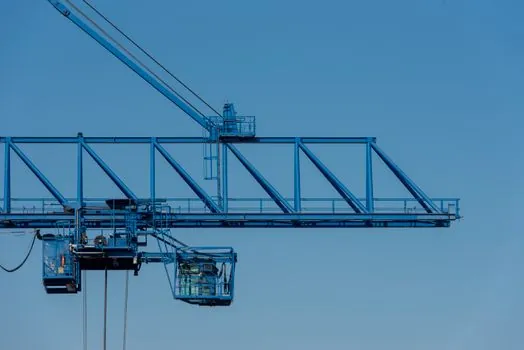
Single girder cranes are commonly equipped with an electric wire rope hoist or an electric chain hoist, with the choice driven by lift height, duty cycle and noise limits; wire rope hoists dominate for urban-infrastructure service because of higher travel life and better heat dissipation [S2].
Control options on 2026 spec sheets typically include pendant, wireless radio remote, and cabin control, with variable frequency drives (VFD) on both long and cross travel plus hoisting for smooth start/stop and reduced load swing, which directly improves safety around crews working in busy urban yards [S2].
Safety stacks for urban-infrastructure tenders normally layer overload limiter, upper/lower limit switches, travel limit switches on both axes, phase-failure relay, and an emergency stop on the pendant or remote; for indoor service a buffer or rail-end stopper is added on the runway, and for outdoor gantry service rail clamps and wind-speed interlocks are added [S2].
Urban-Infrastructure Use Cases: Depots, Treatment Plants, Precast Yards
Bus and metro depots use single girder EOT cranes for engine pull, bogie change and HVAC unit lift, where the typical load sits in the 5-10 t band and the runway follows the building column grid, not the other way around [S1][S3].
Water and wastewater treatment halls run single girder units rated 3-10 t for pump, valve and screen handling, often in a corrosive damp environment that pushes procurement toward epoxy-primed girders, hot-dip galvanised end trucks and IP55 hoist enclosures [S1][S2].
Precast concrete yards and rebar stores frequently use gantry crane variants, including the MH type and box-girder single girder gantry, because they operate on ground rails without a building runway, which keeps the civil scope small and the relocation cost low if the yard layout changes [S2].
Limitations and Common Failure Modes to Spec Out

The first hard limit is wheel load: a single girder concentrates the reaction at two end trucks, so existing runway beams in old urban halls often need a check on local buckling and fatigue before a retrofit is approved, and underslung runways are particularly sensitive to the end-truck wheel spacing [S1].
The second limit is duty class. Specifying a single girder on a job that really runs at FEM A6 / ISO M6 (continuous or near-continuous heavy lifts) burns through hoist motors and wire ropes fast; for those sites, either step to a double girder crane or specify a heavier FEM class hoist (M5 or M6) on the same girder [S1][S2].
The third limit is outdoor exposure. Light single girder gantries without truss-girder options and without proper corrosion protection struggle in coastal or high-humidity urban sites; truss-girder construction reduces wind load on the boom and is a common call for open sites, while box-girder construction is preferred where rigidity and reduced deflection are needed for precision lifts [S2].
Sourcing, Standards and Procurement Checks
Buyers in 2026 typically run a sourcing shortlist of three to five manufacturers, request FEM duty classification documentation alongside the GA drawing, and verify the FEM/CMAA duty class with a load spectrum rather than a single maximum-load figure [S1][S2].
Design and manufacturing standards to ask for by name on the data sheet include FEM 1.001 / 9.341 for European duty classification, CMAA 70 / 74 for North American classes, ISO 4301 for duty grading, and EN 15011 for crane safety; electrical panels should reference IEC 60204-32 for hoists and cranes, with IP ratings and insulation class stated for the motor [S1][S2].
Two procurement signals worth tracking: (1) more 2026 urban-infrastructure tenders are now asking for VFD on all motions, not just hoist, because urban sites have tighter noise and load-swing constraints; (2) more specifiers are pre-checking runway beam fatigue on retrofit jobs before approving any single girder retrofit, rather than treating the runway as out of scope. Reference points for cross-comparison: the single girder crane encyclopedia entry and the quarry-focused spec piece Single Girder Crane Selection for Quarrying: Bulk-Grab and Mobile RTG Specs Compared make the contrast between light urban single-girder service and heavy bulk-handling RTG service explicit.
For the relevant spec sheets and selection criteria, see crane scale.