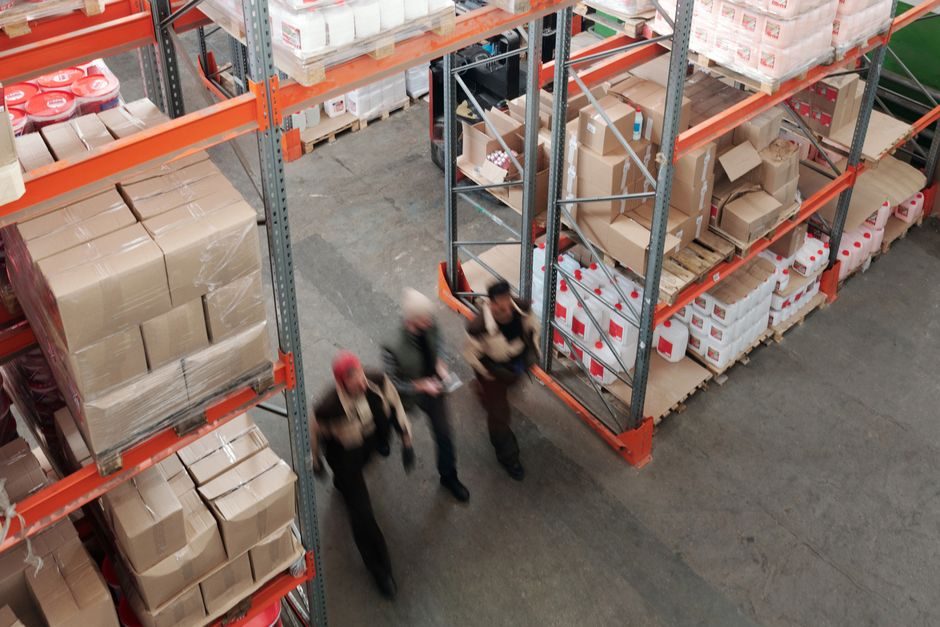
Storage rack selection in 2026 still resolves around four hard gates — unit load, beam-to-column engagement, base-plate anchorage, and the seismic/wind zone of the building — before any quote is issued. Selective pallet racks dominate general warehouse installations, while cantilever racks own the long-goods segment, and drive-in/drive-through racks enter the spec only when SKU count is low and pallet depth is high [S3][S4].
Specification discipline matters because rack collapse is a documented industrial-fatality vector, and most failures trace to either column deflection, missing or undersized floor anchors, or beam-dislodgement under fork-truck impact. Treat the rack like a structural member, not a shelf, and the decision tree becomes manageable [S3].
Load Class and Beam Capacity as the First Filter
Unit load in kilograms per pallet position is the first number to lock, because beam capacity ratings are stamped per pair of beams across a defined bay length, not per frame. Heavy-duty listings on sourcing platforms in 2026 typically sort capacity bands in 1000 kg, 2000 kg, 3000 kg and 4000 kg-per-pair tiers, and a 4-beam level at 1000 mm face will not be cross-compatible with a 2700 mm face even at the same rated load [S4].
Frame capacity is governed by column section, bracing pattern, and base-plate design. Teardrop-style roll-formed columns remain the dominant connection geometry in North American spec, while bolted moment-resisting frames are common in European seismic-zone projects. The selection page on the warehouse supplier side lists both styles with matching load tables, so the choice is rarely a hardware question and almost always a load-plus-zone question [S3].
Selective Pallet Rack vs Cantilever vs Drive-In: Decision Comparison
Three rack families cover roughly 90 percent of industrial spec, and the choice falls on SKU velocity, pallet depth, and product length. Selective racks give 100 percent SKU access at the cost of aisle width; drive-in racks trade access for density; cantilever racks are the only viable pick for lumber, pipe, or bar stock over 2.4 m [S3][S4].
For a regional distribution centre holding 800+ SKUs in pallet form, selective rack is the only rational pick; for a mill storing 12 m structural tube, cantilever is the only rack that physically accepts the load geometry [S3].
Seismic Zone, Anchoring, and Frame Geometry

Base-plate anchoring is a documented failure initiator, and the spec must carry the anchor count, embedment depth, and concrete compressive strength on the drawing. In high-seismic zones, cross-aisle bracing and frame-to-frame tie patterns shift from standard X-bracing to K-bracing or moment-resisting frames, and the column gauge steps up by one wall thickness class [S3].
Column protection — post guards, end-of-aisle guards, and frame-side deflectors — is not optional in any active fork-truck environment. Yellow high-visibility bollards and welded base protectors are industry-default at the load-bearing corners, and the 2026 supplier listings explicitly call these out as accessory lines rather than integrated features [S3][S4].
Standards Compliance and the Audit Trail
Any serious rack quotation in 2026 should be accompanied by documented compliance to the Rack Manufacturers Institute (RMI) ANSI MH16.1 specification, which governs the cyclic load testing protocol and the design factor of 1.92 against yield. The European equivalent is EN 15635 for use and EN 15512 for design, and any European spec without those references should be rejected at quotation stage. A rack carrying the RMI compliance mark has passed a verified cycle test, not a static load claim, and the difference matters in service-life projection [S3].
For seismic projects, AISC 341 and the IBC seismic-design category will dictate frame selection, and the seismic-force-resisting system is the rack frame itself in most low-rise warehouse builds. Storage rack structures are explicitly classified as non-building structures in IBC, which puts the responsibility on the engineer of record to map the zone to the connection detail, not on the rack supplier to guess [S3].
Operational Constraints: Fork Truck, Floor Flatness, and Aisle Width

Aisle width is set by truck turning radius, and any rack layout that ignores the truck spec will generate a chronic end-of-aisle impact problem. Counter-balanced lift trucks need roughly 3.5–4.0 m for a 1200 mm deep pallet at 90-degree stack, while reach trucks collapse that to 2.6–2.9 m and turret trucks to 1.8–2.2 m, which is the operational driver for very-narrow-aisle (VNA) selective rack spec [S3].
Floor flatness governs the levelness tolerance, and the Fmin numbers from ACI 360 must be met before the first frame is plumbed. A rack frame installed on out-of-tolerance slab will pre-load the bracing and cut design factor before the first pallet lands, which is one of the most common latent-defect findings in third-party rack audits. Floor flatness survey data should travel with the rack PO, not arrive afterwards [S3].
Application Fit: Who a Pallet Rack Is For, and Who It Is Not
For a 3PL operator with high SKU turnover, a mixed selective rack with wire-decking and 2.7 m frame height is the correct entry-level investment. For a steel service centre with bar stock and structural section, a double-sided cantilever rack with 6 m column height is the matching tool. For a cold-store with high cube, high-density, low-SKU holding, drive-in or push-back racks are the only geometry that makes the cube economics work [S3][S4].
Storage racks are not the correct tool for seismic battery racks, mezzanine storage on upper floors without engineered framing, or any application where point loads exceed the pallet footprint. If the spec looks like a shelf with high capacity, it is not a rack — it is an accident waiting for a fork truck. Engineering scope crosses into broader material-handling decisions like the single girder crane vs storage rack function split discussed in the sourcebook, where the two systems cover overlapping but distinct duties.
2026 Sourcing Realities and Lead-Time Signals
Made-in-China 2026 listings show 6,361 heavy-duty storage-rack suppliers and 159,039 active SKUs as of May 2026, with boltless and selective styles dominating the volume and cantilever holding a steady long-tail share. Lead times for stock selective racks out of regional fabricators in Malaysia and China run 2–4 weeks for standard sizes, 6–10 weeks for engineered seismic frames, and 12+ weeks for hot-rolled cantilever with custom arm spacing [S3][S4].
Warranty and post-installation audit clauses are diverging between regional markets — North American RMI members offer 5-year bumper-to-bumper coverage with impact exclusions, and several tier-1 Asian fabricators now publish EN 15512 test certificates with each shipment. Track the audit cycle and the inspector qualifications on the supplier side; these are the two signals that predict whether a rack will be standing in 10 years, not the catalogue photo [S1][S3].
For component-level specifications, see storage rack, pallet rack, and storage cage.