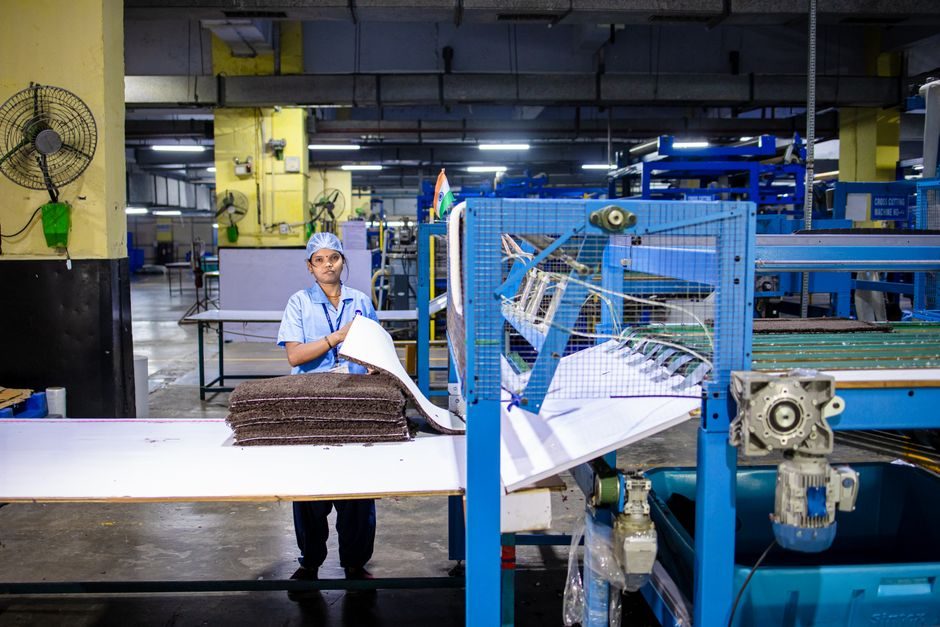
A strapping machine tensions a polymer or steel band around a load, fuses or clips the joint, and cuts the strap in a single cycle — automatic models in the Strapack line such as the RQ-8Y, JK-5000 and IQ-400 hit 30-65 cycles/min on corrugated cases [S4].
A shrink wrapping machine collates product inside a polyolefin or LDPE sleeve, heat-seals the film, and routes the pack through a shrink tunnel where 120-180 °C air drives 30-60% film shrink for skin-tight pallet or tray containment [S1][S2].
Mechanism and Cycle Definition
Strapping cycle time is dominated by strap feed, tensioning and the seal/cut step. The Strapack RQ-8IR2 architecture, for example, combines a heater plate seal with auto strap ejection for 1.5-2.5 s/cycle on PP band [S4]. Seal joint strength on PP strap is typically 60-75% of parent strap tensile; PET strap with a notched weld or serrated clip reaches 70-85%.
Shrink wrapping cycle is dominated by film handling and tunnel dwell. YUPACK's ST-6040A+BSE6040A stack-sleeve line runs film feed, seal-and-cut and tunnel shrink as separate servo steps, with shrink-tunnel dwell of 6-12 s at tunnel air temperature setpoint 150-180 °C [S5]. The Shenzhen Xinzhong bottle line runs 40 packs/min at 1,000-4,000 mm pack width, 2,500-4,600 mm length, fed by a PLC-controlled bottle conveyor [S1].
Selection Criteria: Load Geometry, Strap vs Film
Specify strapping machine when the unit load is a regular, flat-faced carton or stacked pallet with parallel compression surfaces. PP strap (band width 9-15.5 mm, thickness 0.4-0.8 mm) suits loads under 800 kg; PET strap (12-19 mm, 0.5-1.0 mm) covers 800-2,000 kg pallet loads; woven cord or steel strap is reserved for >2 t or sharp-edge loads. [S1]
Specify shrink wrapping machine when the load is irregular, multi-component, or sensitive to compression. Shrink film, primarily LDPE 50-100 µm or cross-linked polyolefin 15-30 µm, conforms to bottle clusters, printed cartons, door-and-window sets, and book stacks where rigid strap would crush or skip [S1][S5]. The film-and-tunnel envelope protects against dust and minor scuff during transit — a containment function that strap cannot match.
Throughput and Footprint Comparison
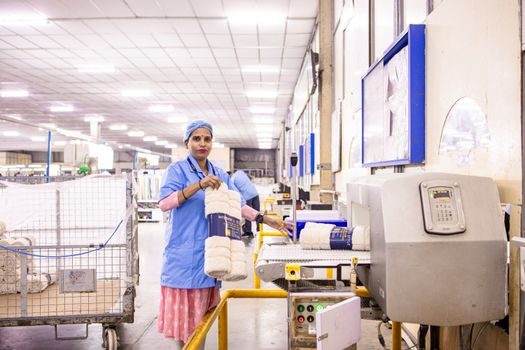
Mid-range automatic strappers such as the Strapack JK-5000 (heavy-duty side-seal) and IQ-400 (high-arch) deliver 25-65 cycles/min with a 1.5-3.0 m machine footprint and 0.6-0.8 m arch clearance for pallet-pass lines [S4].
Inline shrink wrappers in the YUPACK and Shenzhen Xinzhong ranges cluster at 30-60 packs/min on 4-7 m integrated lines, with the heat tunnel alone drawing 8-25 kW and the seal frame drawing 1-3 kW, per OEM datasheets [S1][S5]. YCTD beverage lines reach 130,000 USD per set for high-speed 6,000-9,000 bottle/hr shrink wrap modules — a different cost class than a 1,000-3,000 USD semi-automatic strapper.
Decision Matrix: 4 Criteria Side-by-Side
Strap and shrink answer different duty cycles. The compressed comparison below lines up the four decision variables that hit spec sheets most often: [S2]
1. Load containment: strap provides point-load compression (40-200 N/cm² strap tension); shrink provides uniform surface skin (no compression). 2. Throughput per operator: strap 25-65 cycles/min on one operator; shrink 30-60 packs/min with one operator plus a film-reel tender. 3. Consumable cost per unit: PP strap 0.02-0.05 USD/m, PET strap 0.06-0.12 USD/m, LDPE shrink film 0.03-0.08 USD/m² [S6]. 4. Capital cost: semi-automatic strapper 1,000-3,000 USD; fully-automatic strapper 8,000-25,000 USD; inline shrink wrap line 25,000-130,000 USD depending on speed [S1].
Who Strap is FOR, Who Shrink is NOT For
Strap is the correct pick for warehouse-distribution cartons (Qualipack Engineering-class semi-auto units at 335 USD MOQ for small packers), sawn timber, brick and bagged-cement pallets, and any unit load that must stack under 1-2 t compression in a rack. Strap is the wrong pick for irregular bottle clusters, books, magazine bundles, and door sets — these need the conforming film envelope that only shrink or stretch can deliver. [S3]
Shrink is the correct pick for bottled water and beverage collations (YCTD 6,000-9,000 bottle/hr class), pharmaceutical and cosmetic cartons that need tamper-evident dust seals, and printed-paper packs sensitive to compression marking. Shrink is the wrong pick for heavy 1-2 t pallet loads (film bursts at 30-50 kg/pack on heavy pallet formats) and for any pack where a heated tunnel would damage the product — chocolate, heat-sensitive adhesives, or waxed surfaces [S5].
Integration with Conveyors, Coding and Cores
Both equipment families sit downstream of a wrapping machine or carton sealer and upstream of a coding machine for batch and date marks. A typical integrated line for a Sumda Packaging Equipment-class shipper includes a carton sealer, an automatic strapper, and a sleeve shrink wrapper on one conveyor loop [S3][S6]. The Surendra Kumar / Fitpack range links strapper, shrink tunnel and coding head on a single PLC — a configuration common in Indian and Southeast Asian FMCG lines.
Pallet exit often feeds a core machine or stretch-wrapper if the pack is going to a final pallet pattern; in that case shrink becomes the inner secondary pack and stretch is the outer load containment. Strapping band selection (PP vs PET) follows the same load-weight gate the strapper must respect: <800 kg PP, 800-2,000 kg PET, >2,000 kg composite or steel.
Standards, Failure Modes and Trackable Signals
Strap joint integrity on heat-seal strappers depends on heater-plate temperature (typical 280-380 °C for PP, 380-450 °C for PET), dwell time (1.0-2.5 s), and seal pressure — running PET at PP temperatures is a documented mis-set that produces a cold-weld joint under 50% strength. Shrink tunnel failures cluster around film pinholes from excessive tunnel temperature (>200 °C air), film drag from mis-set conveyor speed, and dog-ears from a worn sealing wire — all visible on a 10-pack startup audit [S1][S5].
Two trackable signals for the next buying cycle: the Strapack RQ-8Y / RQ-8A / RQ-8IR2 generation and the YCTD 130,000 USD-class beverage shrink wrap line both appear in distributor catalogs dated 2026 [S4]. The Qualipack semi-auto at 335 USD MOQ is the price floor for entry-level box strapping as of March 2026. Watch for revised PP-strap tension specs on JK-5000-class arch machines in the next Strapack datasheet revision, and for polyolefin film price moves — Alibaba's PP/PET/PE-Film supplier mix in mid-2026 puts PE Stretch Banding Film on the same sourcing lane as shrink film, which is a signal to bundle procurement if both shrink and stretch are on the spec [S6].
For related coverage, see Floor Grinder vs Concrete Vibrator: 2026 Spec Cut and Application Boundary.