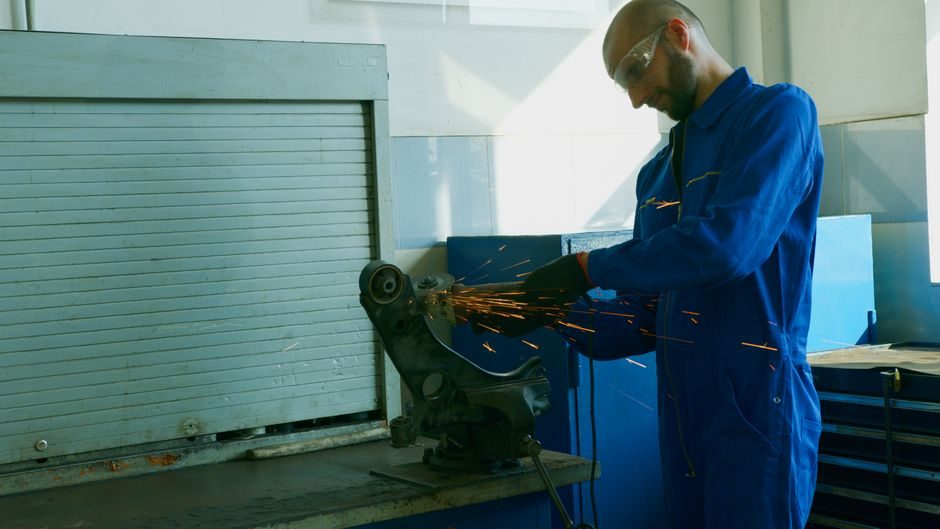
A floor grinder removes material from a hardened slab using diamond-bonded discs or shoes running at 400–1800 rpm, whereas a concrete vibrator uses an eccentric internal shaft at typically 3,000–12,000 vpm to fluidise fresh concrete during the pour [S1][S9].
The two machine classes never meet on the same jobsite step: vibrators are engaged minutes after the mix leaves the chute, and grinders show up 7–28 days later when the slab has cured. Mixing the two roles in a single RFQ is a common 2026 buying error for first-time concrete contractors sourcing from Chinese OEM catalogues [S2][S9].
Operating Principle and Where Each Tool Sits in the Slab Timeline
An internal concrete vibrator (poker / immersion type) plunges a 25–70 mm diameter steel head into the wet mix, displacing trapped air and settling aggregate around rebar; OEM supply ability from Chinese factories such as those indexed on ECVV and Made-in-China is reported at 50 sets/month for compact grinders and 1,000 sets/month for combined floor-prep lines, illustrating that vibrator and grinder capacity move on separate production tracks [S2][S9].
Grinding is a dry or wet abrasion process: a rotating disc carrier fitted with 9-inch diamond blocks (grit 30/40 for stock removal, 80/120 for polishing) presses against cured concrete at 80–250 g/cm² contact pressure, with typical 220 V / 380 V multi-function units such as the FFG-300E, FFG-600X and FFG-650X platforms exported from Fujian and Shandong [S4][S5][S7].
Power, Voltage and Head Geometry Compared
Walk-behind floor grinders in the 2026 export catalogues cluster in three power bands: 2.2 kW (220 V single-phase, 50/60 Hz) for edge work and small rooms, 4–5.5 kW (380 V three-phase) for production grinding, and 7.5–15 kW (380 V three-phase) for industrial overlay removal; motor speed commonly lands at 280–1800 rpm at the disc carrier [S4][S6].
Concrete vibrators split into two sub-types: internal pokers driven by 0.75–2.5 kW electric or 1.6–3.0 hp Honda petrol backpack motors spinning an eccentric at 3,000–12,000 vpm, and external formwork vibrators rated 0.5–4 kW clamped to shuttering at 3,000–6,000 rpm. Head diameters run 25–70 mm (poker) and formwork clamps suit 100–300 mm bracket centres [S9].
Tooling, Consumables and Diamond Specification
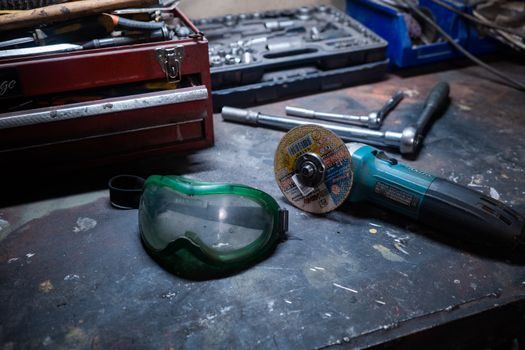
Floor grinder consumables are diamond segments bonded with metal or resin; 9-inch (230 mm) wheel patterns with 30/40 grit metal-bond diamonds dominate the eBay / aftermarket channel at US$78–95 per wheel as of February 2025, while resin-bond polishing pads for the same platform run US$25–60 [S5][S7].
Concrete vibrator consumables are limited to shaft bearings, eccentric weights, and rubber end caps; no abrasive media is consumed, which is why lifetime tooling cost per cubic metre of slab is an order of magnitude lower for vibrators than for grinders. A typical 9-segment 30/40 grit block wears at roughly 0.5–1.5 mm of diamond height per 200–400 m² of soft concrete, versus zero measurable wear on a vibrator head over the same pour [S5][S7].
Application Boundary: When to Spec Which, and What to Avoid
Spec a vibrator on every slab pour above 100 mm thickness: ACI 309-style consolidation calls for 25–40 mm immersion head spacing of 1.5× the head diameter, and any slab over 150 mm with >20% rebar congestion by volume cannot be hand-rodded — pokers are non-optional. Skip the vibrator only on self-compacting concrete (SCC) mixes verified to EFNARC spread and passing the J-ring test, and only for slab thicknesses below 120 mm [S1][S9].
Spec a floor grinder on existing slabs requiring coating removal, lippage reduction, polishing to a specified gloss reading, or profile preparation to CSP 3–7 per the ICRI concrete surface profile scale. For new-pour preparation, do not specify a grinder as a finishing tool — a power trowel, not a grinder, is the correct final-step machine on fresh concrete. A common misuse documented in OEM manuals is running a diamond grinder on a green slab under 7 days old, which pulls aggregate and burns the matrix [S1][S4].
Comparison Table: Decision Criteria Side by Side

On four decision criteria — process stage, primary wear part, dust output, and operator skill — the two tool classes diverge cleanly. Process stage: vibrator = wet/green (0–24 h), grinder = cured (7–28+ days). Primary wear part: vibrator = eccentric bearing (replace every 600–1,200 h), grinder = diamond segment (replace every 200–400 m²). Dust output: vibrator = none, grinder = 5–25 g/m³ at the shroud without a M-class or higher vacuum (HEPA H13 typical for grinding epoxies and coatings containing crystalline silica). Operator skill: vibrator = low (one-button immersion), grinder = medium-high (overlap pattern, RPM, and down-pressure control) [S1][S4][S6].
For buyers cross-referencing related floor-prep equipment, the Floor Grinder Buying Guide 2026 covers disc geometry, dust extraction and sourcing in detail, and the Concrete Groove Cutter Price 2026 guide covers the related cutting machine used after grinding for control-joint work [S4].
Dust Extraction, Safety and Regulatory Constraints
Grinding hardened concrete that may contain crystalline silica is regulated as a respirable-crystalline-silica (RCS) hazard task; the IEDC 2017/2398 / OSHA respirable crystalline silica standard obliges M-class or H-class vacuum extraction with HEPA H13 final stage when diamond grinding coatings, epoxies or concrete older than 1990 in commercial jurisdictions. Vacuums matched to 220 V / 380 V grinders in the FFG series are commonly rated 2.4–3.6 kW suction with auto-clean filter pulses [S4][S6].
Vibrators carry no airborne-particulate hazard but produce hand-arm vibration (HAV) exposure; typical 8-hour HAV action value is 2.5 m/s² and the limit value is 5.0 m/s², so operators should rotate tasks or use anti-vibration gloves. Electric vibrators must be protected by 30 mA RCD on 220 V supplies, and three-phase 380 V units should be fed via a phase-failure relay and thermal overload matched to the 0.75–2.5 kW motor nameplate [S1][S9].
Sourcing Levers: Where 2026 Export Channels Cluster
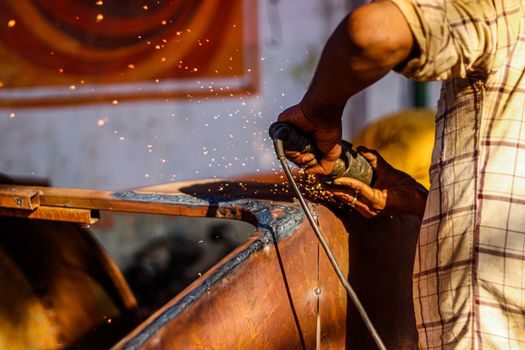
Floor grinder supply chains in 2026 cluster in Fujian (Xingyi Polishing Machine Co., the FFG-300E / FFG-600X / FFG-650X platforms) and Shandong (OUKE, OK-300 entry model at US$860/pc FOB Qingdao); MOQ 1 set is standard, payment terms T/T or Western Union, lead time 15–30 days for stock platforms [S2][S3][S4][S9].
Concrete vibrator export channels are broader, with Jining, Shandong, accounting for much of the volume; FOB Qingdao pricing on backpack pokers sits at US$80–250 per unit, and combined concrete-prep lines bundling grinder + vibrator + power trowel are listed at US$810–850 per set on 3+ piece orders as of the August 2018 reference pricing — indicative only, as 2026 quotes move with copper and steel index [S9].
Common 2026 Buying Mistakes and How to Avoid Them
Three recurring errors show up in tender documents: (1) Specifying a 220 V single-phase grinder on a 380 V three-phase site supply, which burns the motor within 30 minutes; (2) ordering a vibrator head too large for the rebar spacing (a 70 mm head will not fit through 80 mm rebar gaps in a 150 mm slab), and (3) buying a grinder without a matched dust extractor, which fails silica compliance in EU and North American jurisdictions. Each error is preventable by a 10-minute spec cross-check of voltage, head size and dust class against the jobsite survey [S1][S4][S6].
For procurement teams consolidating spend across floor-prep categories, the Hydraulic Smart Manufacturing 2026 feature on pumping and IIoT manifolds is unrelated to concrete finishing but is a useful cross-reference when sourcing motor-driven industrial equipment in 2026. Buyers comparing grinding attachments to cutting attachments should also review the Carbon Fiber Selection guide for how material spec discipline transfers between industrial categories [S2][S4].
Trackable signals for the rest of 2026: (a) the EU silica regulatory update expected under IEDC 2017/2398 amendment review, which may tighten the H-class extraction rule for all floor-grinding work above 50 m² shift volume; (b) Chinese OEM 380 V platform rollouts extending motor power above 15 kW for industrial overlay removal, with FFG-series vendors flagging new SKUs in Q3 2026 catalogues; (c) the lithium-ion backpack vibrator trial running in EU and Japanese markets, replacing 1.6–3.0 hp petrol units on indoor pours where exhaust is not permitted.
For component-level specifications, see angle grinder.