
A stud welder datasheet resolves to four load-bearing numbers: welding current band (typically 300-3000 A), stud diameter capacity (M3 to M24 and beyond), duty cycle at rated current, and stored energy on capacitor-discharge models. Anything else on the sheet either supports those four or describes ergonomics [S1].
Two process families dominate the market. Drawn-arc stud welding (DAW) uses a transformer or inverter power source delivering hundreds of amps at low voltage, welds studs from roughly M6 upward, and is the default for structural and shear-load connections. Capacitor-discharge (CD) stud welding dumps a charged bank across the stud-plate gap, limiting stud size to roughly M3-M10 but producing clean cosmetic joints without ceramic ferrule marking [S1][S2].
Welding Current, Open-Circuit Voltage and Stud Diameter Bands
Drawn-arc units from mainstream UK and Chinese suppliers cluster into three current bands: light (300-800 A) for studs up to M10, mid (800-1600 A) covering M10-M16, and heavy (1600-3000 A and above) for M16-M24 plus concrete-anchor applications [S1][S2]. Open-circuit voltage on DAW power sources sits in the 70-110 V DC range after the contactor closes, with arc voltage collapsing to the typical 18-30 V welding arc once the stud lifts and strikes [S1].
Capacitor-discharge welders are spec'd by stored energy in watt-seconds (Ws) or joules rather than current. Entry CD units store 500-2000 Ws and handle M3-M6 studs; mid-range 2000-6000 Ws covers M6-M10; high-energy CD banks above 10000 Ws reach M12 with gap-arc instead of initial-contact discharge [S1]. Studfast and Jinda both market across these bands, with Chinese suppliers explicitly positioning CD and DAW ranges against US and German reference designs [S1][S2].
Duty Cycle, Cooling and Continuous-Production Reality
Duty cycle at rated welding current is the number that separates an honest datasheet from a marketing brochure. Continuous-production buyers must derate current or accept a longer weld-to-pause ratio.
Cooling method follows from duty cycle. Air-cooled DAW cabinets with finned transformer stacks are standard below roughly 1500 A. Liquid-cooled torch cables and water-cooled secondary loops appear above 2000 A and are mandatory on the heavy M20-M24 concrete-anchor class [S1][S2]. Internal capacitor banks on CD welders self-limit repetition rate by recharge time, usually 0.5-3 seconds per stud depending on stored energy and supply impedance [S1].
Stud Diameter, Material and Weld Time Selection Gates

Stud diameter sets weld time and current together. M6 drawn-arc stud welding typically runs 100-150 ms of arc time at 400-600 A; M12 jumps to 300-500 ms at 900-1300 A; M20 sits at 600-1000 ms and 1500-2000 A; M24 and beyond exceed 1000 ms and approach the upper current limit of the power source [S1]. A datasheet that does not publish a current-vs-diameter table is a red flag for high-end work.
Stud material broadens the spec. Mild steel studs (ISO 13918 property class 4.8) are the easiest to weld and use the lowest current. Stainless steel (A2-50, A4-80) needs 10-15% more current and tighter time control to avoid porosity. Aluminum studs require DC-only supplies with reverse-polarity option and a shielding gas adapter on DAW; the Jinda range, like the Western references it cites, lists aluminum-specific modes as separate line items rather than built-in defaults [S1][S2].
Process Modes: Drawn-Arc, Capacitor-Discharge, Short-Cycle and Gap-Arc
Drawn-arc with ceramic ferrule (the "ferrule" or "CF" mode) is the structural default and gives the deepest weld nugget, with the ferrule containing the arc and shielding the molten pool. Drawn-arc without ferrule ("NF" mode) is used for through-deck welding and special geometries. Short-cycle drawn-arc compresses arc time below 100 ms and runs smaller studs up to M10 cleanly. Capacitor-discharge splits into initial-contact CD (lift 0.5-1.5 mm, used for M3-M8) and gap-arc CD (gap 1-2 mm, used for M8-M12 and slightly larger diameters) [S1].
Compared on four gates, CD is the choice when cosmetic finish, thin-gauge sheet, or small stud diameter (M3-M8) dominates the job, because there is no reverse-side marking and minimal heat tint. DAW is the choice when stud diameter exceeds M10, when shear load is structural, or when the base plate is thicker than 2 mm, because deeper penetration is required. A facility welding both ranges typically keeps one CD and one DAW source rather than one compromise machine [S1][S2].
Power Supply, Chiller Sizing and Site Requirements
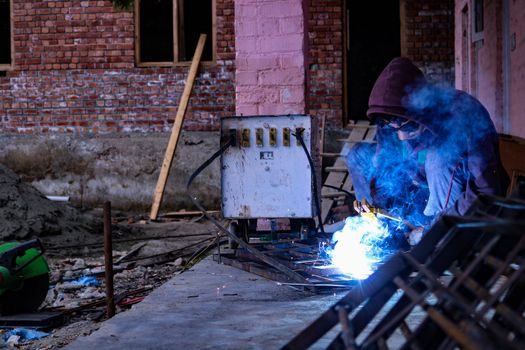
Three-phase 400-415 V at 50 Hz or 460 V at 60 Hz is the standard DAW supply; single-phase 230 V CD units are common in light fabricators and auto-body shops. A 2000 A DAW source draws 60-100 A from the three-phase feed at full load, so site supply cabling and breaker sizing must be specified by the datasheet's kVA figure, not by its welding current alone [S1].
Chiller sizing on liquid-cooled heavy DAW follows the published thermal loss: roughly 4-8 kW of waste heat at 50% duty, so a chiller rated 10 kW minimum with 20% headroom is a safe baseline for M16-M24 continuous work. Studfast's UK product set and Jinda's Chinese export set both publish recommended chiller and cable cross-section figures in the operator manual rather than the headline datasheet, which is where procurement usually has to look twice [S1][S2].
Standards, Ferrule Selection and Quality Acceptance
ISO 13918 covers stud geometry and mechanical property classes for welding studs, while ISO 14555 defines the process and quality requirements for stud welding. AWS D1.1 structural welding code and AWS C5.4 cover stud welding acceptance on structural jobs in North America, including bend-test methods for production sampling [S1]. A datasheet that references ISO 13918 stud property class on the matching-ferrule table is a more reliable procurement document than one that lists studs by generic "size".
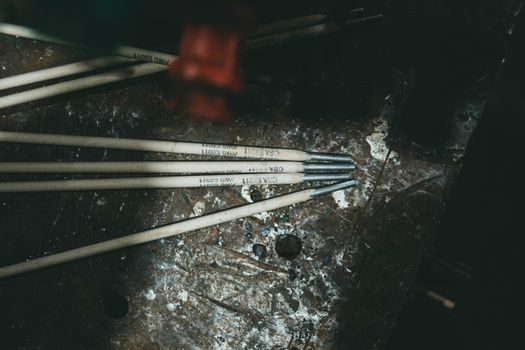
Ceramic ferrules are consumables, not part of the welder, but they appear on every stud diameter selection. Ferrule part number is keyed to stud diameter and head style (threaded, reduced-base, unthreaded, concrete anchor); wrong ferrule size causes porosity and undercut even when current and time are dialed correctly. Production buyers should stock ferrules by stud-PN, not by stud-diameter alone [S1].
Comparing the Three Main Process Options
On four decision criteria, drawn-arc (with ferrule) handles M6-M24 stud diameters, delivers 10-30 kN single-shear capacity depending on base metal, runs 10-20% duty at full current, and produces visible reverse-side marking through the arc. Capacitor-discharge handles M3-M10, delivers 3-8 kN single-shear, runs near-100% duty on small studs, and leaves no reverse-side mark. Short-cycle drawn-arc covers M6-M10, sits between CD and DAW on shear capacity, runs higher duty than full DAW because of the compressed arc time, and leaves a smaller HAZ than full drawn-arc [S1][S2].
For the buyer choosing between suppliers like Studfast, Jinda, and the US/German names they reference, the tiebreaker after current and duty cycle is usually the controller: programmable weld counters, current ramp profiles, fault logging, and ISO 14555 traceability records are where OEM datasheets diverge most. Spec the controller feature list to the same depth as the current/diameter table, and the procurement decision becomes mechanical [S1][S2].
Next, drill into the stud-ferrule cross-reference table and the controller's weld-log file format before signing a PO; both are where ISO 14555 acceptance evidence is generated or lost. Confirm the chiller kVA and the three-phase feeder amp draw on the site electrical drawing, and verify the duty-cycle derating curve at the actual ambient temperature the cell will sit in.
For component-level specifications, see stud welder, arc welder, and tig welder.
For related coverage, see China SPC Flooring Suppliers 2026: Cluster Map, Spec Bands and Sourcing Anchors.