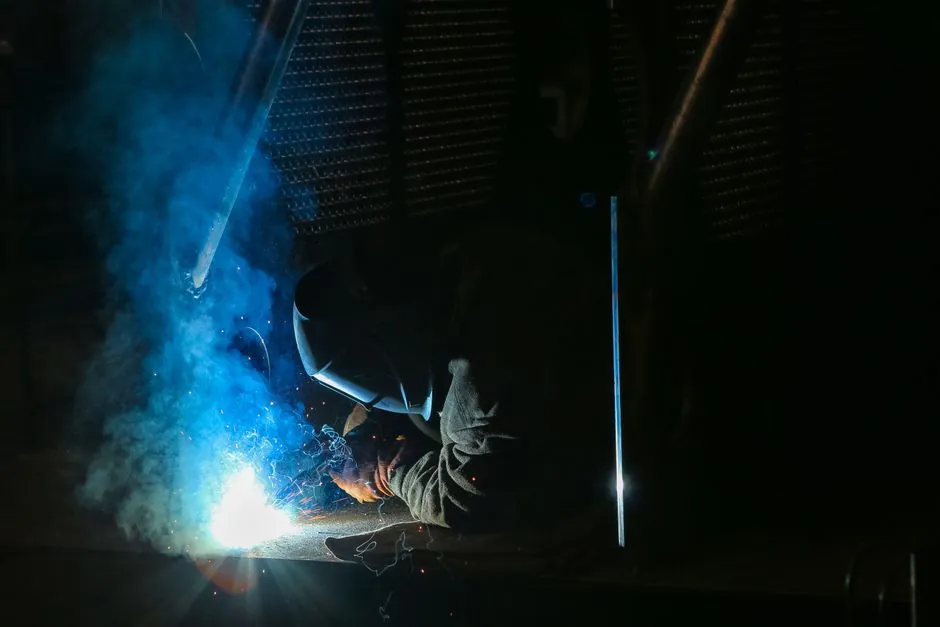
For demolition crews working thick steel plate, beam, and concrete-embedded rebar, the practical stud welder is a drawn-arc unit fed by a portable inverter power source, with capacitor discharge (CD) reserved for thin-gauge sheeting and temporary sign-off points. Drawn-arc stud welding is the dominant process for structural shear connectors, anchor studs, and bridge-deck shear studs, because arc time is short, heat input is localized, and the operator only needs access to one side of the joint [S3].
The standard stud diameter envelope for structural demolition and temporary-attachment work is 3/8 inch (M10) up to about 1 inch (M24) for drawn-arc, and roughly 1/8 to 3/8 inch (M3 to M10) for CD. The trade-off is direct: CD minimizes heat input and protects thin substrates, while drawn-arc produces deeper fusion and tolerates heavier base metal, with arc times measured in tens to hundreds of milliseconds rather than seconds [S3][S5].
Drawn-Arc vs Capacitor Discharge for Demolition Conditions
On a demolition site the base material is rarely clean: it is often painted, mildly rusted, or covered in mill scale, which rules out finicky setups. Drawn-arc stud welding is widely specified for connecting shear studs to steel beams and through-deck welding in composite construction, because the process tolerates the surface conditions typical of structural steel salvage and bridge-deck work [S3]. CD stud welders, by contrast, are built for thin-gauge assemblies and clean substrates, and use stored capacitor energy to fuse the stud in a single rapid discharge [S1][S2].
The decision rule is straightforward: pick drawn-arc when base metal is over roughly 1/8 inch (3 mm) thick, the stud is 3/8 inch or larger, or the joint is loaded in shear. Pick CD when base metal is 24 gauge up to about 1/8 inch, the stud is under 3/8 inch, and cosmetic backside appearance matters. Both processes are single-sided, meaning the operator does not have to access the back of the plate, which is the key reason stud welding displaces through-bolted or welded-nut fastening on tight structural tie-ins [S1][S3][S5].
Stud Material Limits and Base-Metal Compatibility
Carbon and stainless steels are the workhorses of stud welding, and both drawn-arc and CD processes handle them well, but high-carbon steels above 0.25% carbon need preheating and tighter procedure control to avoid HAZ cracking. Drawn-arc stud welding also accommodates mild steel, stainless steel, and aluminum studs across a wide diameter range when matched to the correct power source and weld cycle [S1][S3].
Studs are commonly threaded, unthreaded, or tapped fasteners fused directly to the base metal without filler wire, which is one of the reasons the process is faster than MIG or TIG on repetitive fastener attachment. For demolition and refit crews, this means a single operator can place hundreds of shear connectors or temporary lifting lugs per shift, with welds measured in milliseconds rather than the seconds or minutes that arc stud welding's slower cousins (TIG, MIG) require [S3][S5]. Practical base-metal prep is light: a clean, conductive surface, with paint, heavy rust, and oil removed in the immediate weld zone. On painted structural steel, the standard remediation is to grind back to bright metal in a small radius around the stud location, then set the stud through the lift.
Power Source, Portability, and Site Setup
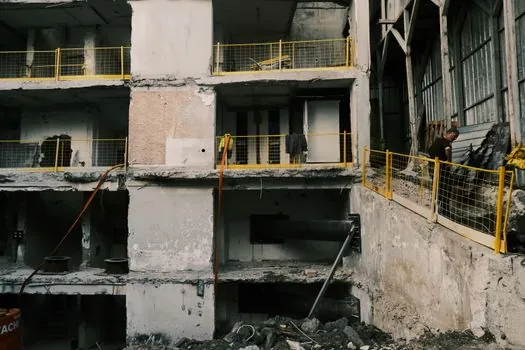
Modern stud welding equipment splits into two practical groups: capacitor discharge units for thin metals and light-duty work, and ARC systems for larger diameters and structural fastening. Compact portable units allow operators to complete welds in tight spaces, elevated positions, and high-temperature zones, which fits demolition conditions where mobility and controlled performance directly support safe installation [S1][S2].
CD systems complete welds with minimal heat input, protecting delicate substrates during fabrication, while ARC stud welders deliver deep fusion for anchors, structural plates, shear connectors, and high-strength refractory hardware. For demolition sites, the meaningful variables are input power (single-phase 230 V or three-phase 460 V), gun weight (a handheld drawn-arc gun with cable typically runs 2 to 4 kg before stud), duty cycle at the chosen stud diameter, and stud-alloy compatibility with the base metal [S1][S2][S4]. Crews running arc welder generators in the field will already have the right three-phase feed for a portable drawn-arc stud power source, and shared cable sets and grounds simplify rigging.
Selection Criteria for Demolition and Bridge-Repair Work
For demolition contractors, the four deciding criteria are stud diameter, base-metal thickness, site power, and positional access. Drawn-arc handles the largest studs (3/8 to 1 inch) and the thickest base metal (1/4 inch and up), at the cost of heavier gun and higher current draw. CD handles small-diameter, thin-base work, at the cost of lower shear capacity. The five specification values a buyer should compare on a data sheet are: stud diameter range, base-metal thickness range, input voltage and phase, welding time or capacitor energy (for CD), and weight of the gun plus cable [S1][S2][S4].
One often-overlooked selection point is stud-alloy compatibility. Mild steel and stainless steel are standard; specialty alloys for high-temperature or corrosive service need matched power curves. Drawn-arc systems are favored for refractory and high-temperature alloy applications because the deeper arc penetration and longer weld cycle support the metallurgical bond, while CD is reserved for thin-gauge assemblies where minimal heat input protects the substrate [S1][S2].
Failure Modes and On-Site Procedure Pitfalls
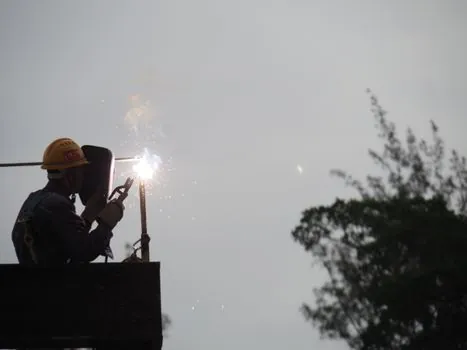
The most common stud-welding failures on demolition work are poor fusion, porosity, and stud lean, all of which trace back to dirty base metal, incorrect lift (the gap between stud tip and base), or a mis-matched weld schedule. A stud that is set through a thick paint layer will blow gas through the arc and produce a porous, under-fused weld; the fix is to grind bright in a 1 to 1.5 stud-diameter radius, or to specify a process designed for painted surfaces, which most portable drawn-arc systems are not [S3][S5].
Another pitfall is positional access. Stud welding is single-sided, so the operator only needs access to one side of the joint, which is the reason it is widely used in composite construction, bridge construction, and rebar-stud reinforcement where the back of the plate is inaccessible. Even so, overhead and vertical-down positions change the lift and arc time, and the weld schedule on the power source must be re-verified, not assumed from a flat-position bench setting [S1][S3][S5]. For crews moving between bridge-deck shear-stud replacement, structural-steel demolition, and concrete reinforcement, the practical guidance is to qualify the procedure on a sample of the actual site steel before production welding starts, especially when the steel is above 0.25% carbon or of unknown origin.
Standards, Documentation, and What to Verify Before Buying
American Welding Society AWS D1.1 Structural Welding Code, AWS D1.5 Bridge Welding Code, and AWS C5.4 Recommended Practices for Stud Welding cover the major structural and bridge applications most demolition and refit crews will run into. Stud welding in composite construction is governed by procedures that call out stud diameter, base-metal thickness range, lift, arc time, and current, with a pre-production test plate required before production welds start. For bridge shear connectors and rebar-stud reinforcement, the same procedure-qualification logic applies, with the additional requirement that concrete-side composite action depends on the stud being fully fused through the deck [S3][S5].
On the equipment side, the buyer should look for a data sheet that lists stud-diameter range, base-metal thickness range, input voltage and phase, welding time in milliseconds (drawn-arc) or stored energy in watt-seconds (CD), duty cycle at rated output, gun weight, and cooling method. CD stud welders from manufacturers such as IWT, Tru-Weld, Sunbelt, and Delta are typically sold as integrated power source plus gun packages, and rental channels exist for short-term demolition work [S2][S4]. For crews who already use related on-site tools, the cross-reference to a demolition hammer and to a portable arc welder is straightforward: same three-phase feed, same grounding philosophy, and the same procedure-qualification discipline applied to the steel-prep step before the stud is set [S1][S2][S4].
Track these signals before purchase: a published stud-diameter range that covers 3/8 to 1 inch for drawn-arc or up to 3/8 inch for CD, a duty cycle of at least 30% at the rated stud diameter on a 10-minute basis, an input voltage that matches site power (230 V single-phase or 460 V three-phase), and a procedure-qualification record (PQR) traceable to AWS D1.1 or AWS D1.5 for the specific stud-and-base-metal combination the crew will run. For thinner and lighter work, including temporary signage and non-structural attachments during a demolition phase, an arc welder drawing from the same site power is a faster route than dragging a CD stud welder into a one-off job.
The underlying component specifications are covered under stud welder.
See also our earlier report, Hydrostatic vs Laser Level: Spec-Level Decision Map for Process Tanks and Silos.