
A Super Dump trailing axle stretches the truck's outer bridge 11 to 13 feet behind the rear tandem and adds a single 13,000-lb load-bearing axle, taking gross vehicle weight to roughly 80,000 lb and payload to 26 short tons or more on a six-axle rigid [S3][S5]. A quad-axle dump with lift axles keeps the standard tandem wheelbase, drops one or two liftable pushers or tag axles under load, and carries about 14 to 20 cubic yards or 16 to 26 tons on four to five axles [S2].
For a fleet or contractor weighing purchase or dispatch, the two configurations answer the same regulatory puzzle (axle weight, Bridge Formula, state length limit) with different mechanical strategies, and the right call depends on the route, the gate, and the dump site, not on raw tonnage alone. Federal Bridge Formula math and the liftable-axle concept are the same lever both trucks pull; the difference is how far each spreads the load [S2][S3].
How Each Truck Spreads Weight Under the Bridge Formula
The federal Bridge Formula caps weight by axle group and by the distance from the first to the last axle, so adding either an axle or a span raises the legal gross weight [S3][S5]. A Super Dump's trailing axle, the Strong Arm being the most documented example, mounts 11 to 13 feet behind the rear tandem and can increase allowable weight by as much as seven tons compared with a pusher or belly-axle retrofit on the same chassis [S5]. The trailing axle is load-bearing up to 13,000 lb and rotates up on hydraulic arms when the body is empty, so the truck then handles and steers like a tandem [S3][S5].
A quad-axle dump truck with lift axles achieves its weight gain differently: by adding a fourth, or in some configurations a fifth, liftable axle ahead of or behind the rear tandem rather than by extending the wheelbase [S2]. Under load the lift axles drop and share weight; empty, they rise to save tires and tolls and to keep the turning radius short [S2]. The mechanism that converts each added axle into legal payload is the same on both trucks, but the Super Dump's longer outer bridge, first axle to last axle, earns it a higher place on the Bridge Formula curve than a quad's tighter span can reach [S2][S3].
Payload, Volume, and Axle Count Side by Side
A Super Dump is rated up to 80,000 lb GVW and carries 26 short tons (about 23.6 t) of payload or more, which places it between a conventional tandem and a dump trailer in both capacity and footprint [S3]. A quad-axle with lift axles is sized at 14 to 20 cubic yards and 16 to 26 tons, with the tri-axle at the low end and the quad at the top of that envelope, and it dumps in place on sites a combination cannot enter [S2]. Reference payload figures for a dump truck on the same job site therefore diverge once the load exceeds what a tandem can carry legally.
The key comparison for spec-driven selection: Super Dump = 1 trailing axle at 13,000 lb, 11 to 13 ft of added bridge, up to 80,000 lb GVW, 26+ short tons payload, longer wheelbase, designed for high-volume long-haul and jobs that a dump trailer would otherwise take [S3][S5]. Quad-axle with lift axles = 1 to 2 additional liftable axles on a tandem chassis, 4 to 5 total axles, 14 to 20 cu yd / 16 to 26 tons, short rigid wheelbase, designed for in-place dumping and access-tight urban or staged sites [S2]. A pusher or tag retrofit on a tandem generally does not match a trailing axle's Bridge Formula gain and is sometimes discouraged on heavy dump bodies because of how load transfers onto the rearmost axle [S4].
Steering, Lift Mechanism, and Empty-Road Behavior
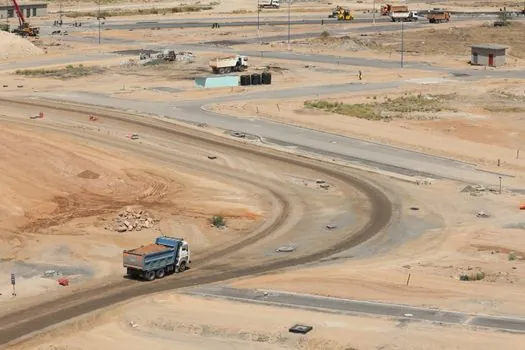
The Strong Arm trailing axle on a Super Dump uses steerable wheels, so the truck does not need to lift the trailing axle to navigate turns or grade changes on the way to the dump site; it only stows the axle when the body is empty [S5]. Hydraulic power with gas accumulators and a patented Secondary Lateral Suspension keep lift force constant across intersections, driveways, and railroad crossings, avoiding the pressure spikes typical of other trailing axle designs [S5]. For a mining dump truck class comparison, that consistent lift force is the same engineering priority seen in off-highway haul trucks, where empty-road maneuverability and loaded-stability have to coexist.
A quad-axle's lift axles are drop axles: they are lowered under load to spread weight and raised empty to save tires, reduce tolls, and tighten turning radius [S2]. Because they are pusher or tag style, they sit close to the tandem rather than far behind it, so the truck keeps a tandem-length wheelbase and the maneuverability of the original chassis [S2]. Empty, the quad steers and wears much like a tandem; loaded, the extra axles engage and push legal payload up by several thousand pounds per added axle [S2].
Site Access, Length Limits, and State Rules
Super Dumps are designed to work every job a short straight dump can work plus every job a long dump trailer can work, because the trailing axle stows out of the way at the dump site and the truck then dumps into pavers, transfers, or spreaders as if the extra axle were not there [S5]. The penalty is overall length when the trailing axle is deployed, so routes with short access roads, tight urban gates, or state length caps that bite at 40+ feet will push a fleet toward the shorter quad-axle configuration [S2][S5].
State rules further complicate the call. Florida's dump-truck exemption allows certain four-axle configurations to run at higher gross weights on specific routes, and Texas allows a TxDMV tolerance permit on state highways (not Interstates) that adds roughly 5 percent to gross and 10 percent per axle [S2][S6]. Operators therefore size load to route and permit, not to truck alone, and the Super Dump's 80,000 lb ceiling is only reachable where the route, the gate, and the state allow it [S2][S3].
When Each Configuration Pays Off
Pick the Super Dump trailing axle when the job needs 26+ short tons per trip on a route that allows 80,000 lb GVW and a 40+ foot wheelbase, and the site accepts a longer truck for in-place dumping or for spreading, windrowing, stockpiling, and asphalt paving work [S3][S5]. Pick the quad-axle with lift axles when the site still requires a rigid in-place dumper but a tandem's 12 yards would double the load count, and the route or gate cannot accept a Super Dump's length [S2]. For an aerial work truck style fleet where urban access dominates, the shorter quad profile is often the only legal option.
Reject the Super Dump on short urban hauls with tight gates and 35-foot length caps, where the trailing axle cannot deploy; reject the quad on long-haul high-volume work where Bridge Formula headroom from a longer bridge would have added several tons per trip [S2][S5]. A standard tandem remains the baseline for sub-12-yard loads, and a truck scale at the site should be used to confirm the loaded axle-group weights against the Bridge Formula and any state tolerance, since a partial load still ships as a load and overloading any axle group voids the productivity gain the extra axles were bought to deliver [S2].
Trackable signals to watch: state DOT moves on dump-truck length and tolerance permits (Texas, Florida, and surrounding states have shifted rules in the past 24 months) [S2][S6], and OEM releases of trailing-axle retrofit kits that target existing tandem fleets rather than new Super Dump builds, which would narrow the cost gap between the two configurations.
Related analysis: Seamless vs Welded Steel Pipe for High-Pressure Service: Spec-Driven Selection.