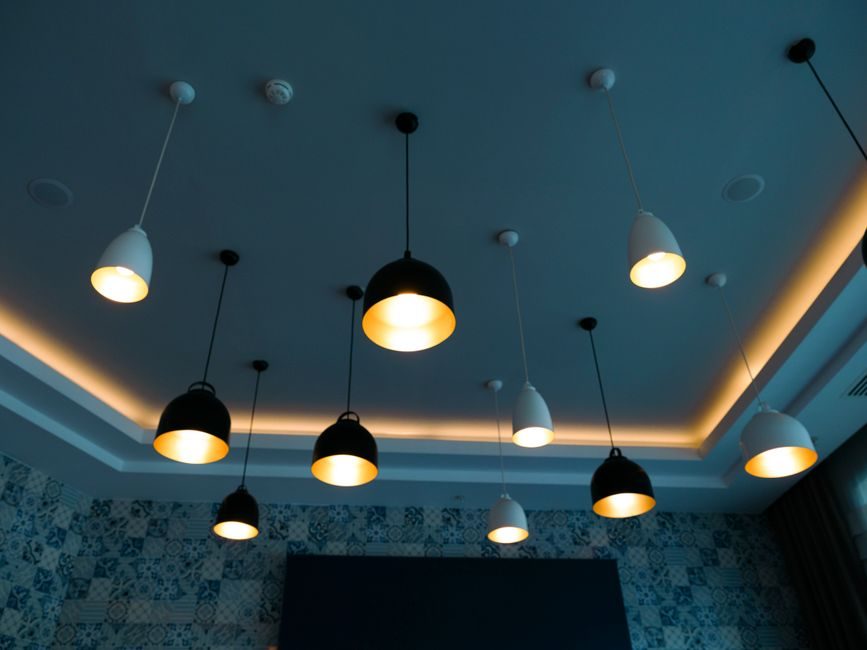
A suspended-ceiling buy in 2026 is decided by four numeric pass/fail criteria before any aesthetic or budget discussion: fire reaction class per EN 13501-1, weighted sound absorption αw or NRC, point-load capacity of the grid, and available plenum depth above the tees. The ArchiExpo insulating-ceiling category lists 15 manufacturers and 56 product lines as of 29 April 2026, with Knauf Ceiling Solutions (39 lines), Atena spa (64 acoustic lines) and Armstrong (52 acoustic lines) anchoring the supply side [S2][S4].
A first-time buyer should treat the suspended ceiling as a system of matched components — grid, tiles, hangers and edge profile — and not as a commodity tile. Module selection (600x600 mm versus 1200x600 mm versus 1200x1200 mm) cascades into the tee, the main runner spacing, the hanger count and the M&E coordination strategy, which is why the suspended ceiling specification levers guide treats the four dials as a single decision matrix rather than independent variables.
Definition and Scope of a Modern Suspended Ceiling
Per Chapter 24 of the 2016 Interior Construction reference, a suspended ceiling (or 'drop' or 'false') ceiling is a secondary ceiling hung below the structural soffit, whose functions are visual (colour, texture, pattern, shape), environmental (light diffusion, sound control) and service-related (concealment of ducts, cable trays, sprinklers, conduits) [S1]. In 2026 specification practice that 'concealment' function has expanded to active service integration — luminaires, wireless access points, smoke detectors, displacement diffusers and cleanroom HEPA terminations all sit within the same grid envelope.
Three structural types dominate 2026 orders: exposed-grid lay-in (T-bar, 24 mm or 15 mm flange), concealed-grid (clip-in or hook-on for security suites, healthcare and cleanrooms) and baffle/linear (open-cell metal or felt blades for data halls and atria). The ArchiExpo acoustic category explicitly separates 64 Atena, 39 Knauf, 52 Armstrong, 29 Integra and 13 ATY acoustic lines, reflecting that the acoustic line is now a parallel SKUs universe rather than a single product family [S4].
Selection Criteria: The Four Pass/Fail Dials
Dial 1 — fire class: tiles in commercial interiors are typically specified to EN 13501-1 A2-s1,d0 (limited combustible, low smoke, no flaming droplets) or B-s1,d0; concealed-grid healthcare and escape-route corridors frequently demand Class A2. Grid steel is non-combustible per EN 13501-1 A1 by definition, so the dial is dominated by the infill panel. Mineral-wool and glass-wool acoustic tiles from Knauf, Armstrong and Atena commonly achieve A2-s1,d0; standard laminated mineral-fibre tiles often sit at B-s1,d0 and must be confirmed tile-by-tile [S2][S4].
Dial 2 — acoustic: lab values are quoted as αw (0 to 1, EN ISO 11654) or NRC (0 to 1, ASTM C423). A standard 15–19 mm mineral-fibre tile typically delivers αw 0.50–0.65 / NRC 0.50–0.60; high-density 40 mm acoustic tiles (Atena, Knauf, artnovion) reach αw 0.90–1.00 / NRC 0.85–1.00. Open-cell metal baffles are quoted as equivalent absorption area per m² (e.g. 0.5–1.2 m² Sab per baffle at 1 m spacing) and are not directly comparable to a flat-tile NRC — keep one metric per line item [S2][S4].
Dial 3 — point load and load class: EN 13964 defines load classes 1–4 for suspended-ceiling kits, with class 1 ≈ 30 N point load and class 4 ≈ 250 N. Plenum service items (downlights, speakers, smoke detectors) typically fall into class 1; lay-in troffer luminaires with integral drivers push class 2–3; recessed projectors and heavier M&E boxes demand class 4 or an independent support back to structure. Mismatched load class is the single most common re-spec cause on 2026 retrofits [S1].
Dial 4 — plenum depth: minimum 100 mm for a flat lay-in with no service; 150–200 mm is the practical default for offices to clear M&E, sprinklers and flexible duct; cleanroom and theatre projects run 300–600 mm to allow for HEPA boots, displacement air diffusers and access. The 600x1200 module cuts hanger density roughly 30% versus a 600x600 in the same room and is the default 2026 choice for open-plan offices [S1][S2].
Who the Suspended Ceiling Is For — and Where It Fails
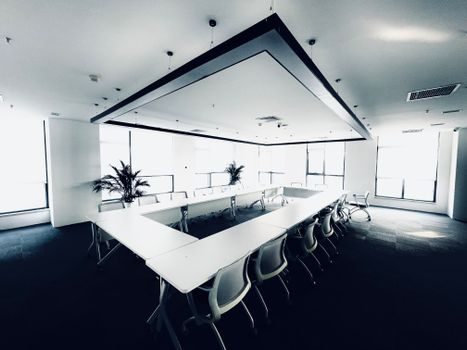
The system fits office, retail, education, healthcare (non-operating), data-hall cold-aisles and cleanroom support zones. It is poorly suited to operating theatres, MRI rooms and aggressive food-processing wash-down zones unless paired with a sealed clip-in grid and a hygienic-surface tile; in those rooms, a monolithic plaster or coated-metal soffit frequently beats a lay-in grid on lifecycle cost. For hazardous-area or explosive-atmosphere builds, ATEX/IECEx-rated luminaires and fixings must be selected to match the grid, not the other way around — see the crossed-roller guide for the same kind of 'sub-system drives the spec' reasoning in motion control. [S1]
For load-critical builds, the rule of thumb is: if any single plenum item exceeds 5 kg, plan an independent support to structure rather than relying on the grid; if the room has vibration sources (HVAC plant rooms, mezzanines), move to a heavier-gauge main runner (38 mm high) and check hanger spacing to EN 13964. Aesthetics-driven tile swaps are easy; load-driven retrofits are not, which is why a misstep on dial 3 is the most expensive spec error in 2026 [S1].
Comparison: 600x600 vs 600x1200 vs 1200x1200 Modules
On a 100 m² open-plan office with 250 mm plenum, 600x600 mm implies ≈278 tiles and ≈30 main runners at 600 mm centres, 600x1200 mm drops to ≈139 tiles and ≈15 main runners at 1200 mm centres, and 1200x1200 mm drops further to ≈69 tiles at 1200 mm centres.
On seismic and vibration tolerance, 600x600 has more joints, more load paths and better redistribution of point loads; 1200x1200 is the lightest per m² but concentrates load on each tee junction, so the engineer must upgrade to a class 2–3 grid when integrating troffers. 600x1200 is the 2026 office default — it balances hanger count, tile weight (~3–5 kg/m² for mineral fibre, ~8–12 kg/m² for high-density acoustic) and M&E cut-out flexibility, and it is the module most Atena, Knauf and Armstrong acoustic lines are stocked in [S2][S4].
Material, Standards and a One-Line Quotation
Per Chapter 24 of the Interior Construction reference, finish ceilings function to control diffusion of light and sound and to conceal the services above [S1]. A direct quote from the source: 'Visual — color, texture, pattern, shape; control diffusion of: light, sound' — the 2026 spec still has to satisfy these two functions regardless of the supplier [S1].
For an industrial buyer cross-spec'ing enclosures and building products, the same logic of matching grid to M&E mass that governs a linear guide carriage-to-rail pairing applies to grid-to-tile: do not pick the rail (or the grid) first, then the carriage (or tile). EN 13964 governs suspended-ceiling kits; EN 13501-1 governs reaction to fire; EN ISO 11654 governs the single-number acoustic rating; ASTM C423 is the US parallel for NRC. Stick to one metric system per project to avoid a 0.50 NRC tile being specified in place of a 0.50 αw tile on the same line [S1][S2][S4].
Sourcing, Supply Base and a 2026 Buying Sequence
The 2026 supply base for acoustic and insulating lines on ArchiExpo runs 15 manufacturers and 56 insulating lines plus hundreds of acoustic SKUs across Atena (64), Armstrong (52), Knauf (39), Integra (29), ATY (13), AUTEX, Bnced, Investwood, Italpannelli and KRAFT Deckensysteme [S2][S4]. For European projects the default shortlist is Knauf (mineral-wool, A2-s1,d0 standard), Atena (metal and felt baffles, high αw), Armstrong (broad module range, strong on Tegular/Vector edges) and artnovion (premium felt/wood-wool for high-end interiors). Lead time in Q2 2026 is 4–6 weeks for standard mineral-wool tiles and 10–14 weeks for high-density acoustic baffle lines; the bottleneck is the felt and wood-wool supply at artnovion and AUTEX, not the steel grid [S2][S4].
A defensible 2026 buy sequence: (1) lock the four pass/fail dials (fire class, acoustic metric, load class, plenum depth) on the room schedule, (2) pick module (600x600 / 600x1200 / 1200x1200) by load and M&E cut-out count, (3) shortlist tile SKUs by EN 13501-1 + EN ISO 11654 values, (4) match grid load class per EN 13964 to the heaviest single plenum item, (5) request three quotes with the same metric set and the same edge detail, (6) confirm humidity class (EN 13964 Annex F) for any pool, kitchen or coastal project. Buying on price before step 3 is the 2026 equivalent of picking a flange before the pressure class — the supplier, not the engineer, owns the spec. Tracking signals to watch through Q3 2026: any new A2-s1,d0 high-αw tile SKUs from Knauf or Armstrong, and any extension of the 600x1200 RH-plus range into cleanroom grades [S2][S4].