A Class A fire-rated suspended ceiling grid paired with mineral-fiber tile delivers a 0.50-0.70 Noise Reduction Coefficient over a 200-300 mm plenum, the configuration that dominates 2026 commercial-build specifications for office and healthcare interiors [S2].
Specifiers weigh four hard constraints — flame-spread index, NRC, point-load capacity and plenum depth — before touching cost. The "suspended ceiling" label covers both architectural lay-in systems and industrial suspended platforms, but only the architectural family falls under the fire/acoustic regime covered here; for heavy-load raised work platforms see the suspended platform reference [S1].
Fire Performance: ASTM E84 Class A or Nothing
ASTM E84 surface-burning classification remains the baseline metric, with Class A demanding flame-spread index 0-25 and smoke-developed index 0-450 for ceiling assemblies carrying fire-rated floor/roof decks above [S2].
Mineral-fiber acoustic tile routinely hits FSI 0-15 / SDI 0-50, while standard lay-in gypsum board scores FSI 10-25 / SDI 0-50. PVC-faced metal panel must be specified with an FR core to clear Class A; untreated vinyl film alone is rated Class C at best. For plenum assemblies that double as part of a fire-resistive floor/roof, the UL L-series design number (e.g. L-211, L-212) replaces the standalone E84 number, and ratings are stated in hours, not minutes. Healthcare specifiers should also cross-check NFPA 90A requirements for plenum fire-spread limitation, which constrains cable insulation and any loose-fill insulation in the same cavity.
Acoustic Targets: NRC 0.50-0.70 for Office, 0.70+ for Classroom
Open-plan offices specify NRC 0.50-0.70 mineral-fiber tile; classrooms and lecture halls step to NRC 0.70-0.90 with high-density (35-40 kg/m³) boards or 19-25 mm fissured panels [S2].
Three acoustic levers interact: tile density (kg/m³), panel thickness (mm), and surface fissuring. A 19 mm standard-density tile at 24 kg/m³ typically lands NRC 0.55; moving to 22 mm / 35 kg/m³ pushes NRC to 0.70; high-density 25 mm / 40 kg/m³ with a fine-fissure face reaches NRC 0.80-0.90. Ceiling Attenuation Class (CAC) 35-40 dB is the parallel metric for inter-room sound transmission through the plenum, often missed on spec sheets. For meeting rooms adjacent to noisy zones, specify CAC ≥ 35 dB in addition to NRC, otherwise the plenum acts as a speech channel.
Load Capacity: 12-25 kg/m² for Lay-In, Anchor Loads for Fixtures
Standard 24 mm T-bar grid (24×38 mm main runners, 600×600 mm module) carries 12-15 kg/m² distributed; heavy-duty 38 mm HD grid lifts that to 20-25 kg/m² [S2].
Point loads are a separate calculation. Recessed LED troffers at 8-12 kg each must hang from the main runner, not the cross-tee, and any fixture above 5 kg requires an independent suspension wire to structure. Sprinkler heads, exit signs and cable trays add 5-15 kg/m² incremental load that is rarely subtracted from the tile load budget. The structural T-bar must also be specified for seismic categories D/E/F using ASTM E580 bracing — a lay-in ceiling is not a finished product until it is positively attached to structure on all four walls and at the centreline.
Plenum Depth and Service Routing
Minimum 100-150 mm plenum is the practical floor for HVAC flex duct and 100 mm cable tray; 200-300 mm supports ducted return-air runs and adds margin for re-work [S2].
Plenum depth drives the spec more than the visible ceiling does. A 100 mm cavity can hold a single 75 mm flex duct and one tier of CAT6A cabling; anything tighter forces surface-mount conduit and abandons the lay-in access. The 25-40 mm clearance between the bottom of grid and the underside of services is the lay-in tile working space — anything under 25 mm and tiles must be edge-locked rather than simply lifted. For cleanroom and data-centre builds the plenum is pressurised, and the ceiling must carry a gel-sealed gasketed tile to maintain the pressure boundary; this doubles the unit cost and should be flagged in the BOQ.
Material Family Comparison: Mineral-Fiber, Metal, Gypsum, Wood
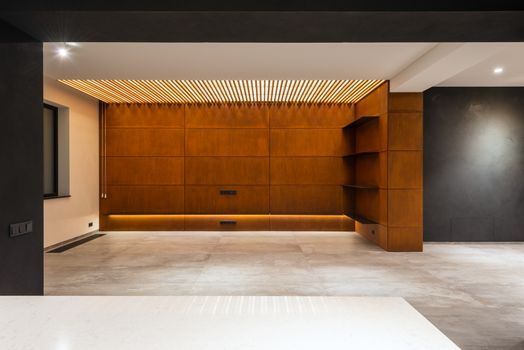
Mineral-fiber is the default for Class A + NRC ≥ 0.55 at the lowest cost per m²; metal panel is the default for cleanroom, food-grade and high-impact zones; gypsum is the default for fire-rated hour assemblies; wood and metal-veneer are reserved for feature ceilings where acoustic duty is secondary [S2].
Cross-check on four decision criteria: (1) Fire rating — mineral-fiber and gypsum both clear Class A stock; metal requires FR core; (2) NRC — mineral-fiber 0.55-0.90 dominates, metal 0.25-0.55 with acoustic inlay, gypsum 0.30-0.50, wood 0.15-0.30 with felt backing; (3) Impact/cleanability — metal > gypsum > mineral-fiber > wood; (4) Lead time — mineral-fiber 2-3 weeks ex-China, metal 3-5 weeks for perforated+coated, gypsum 1-2 weeks, engineered wood 6-10 weeks. Cost ordering: mineral-fiber < gypsum < metal < wood-veneer, with metal running 2-3× mineral-fiber and wood-veneer 3-5×.
What Suspended Ceiling Is NOT For
A lay-in suspended ceiling is not a structural floor, not an equipment platform, and not a fire-rated membrane on its own — it inherits the fire rating of the tested assembly, so a Class A tile in an unrated grid does not yield a Class A system [S1][S2].
Industrial work platforms at 200-1000 kg/m² are a different product family covered under suspended platform design, with hot-dip galvanised steel grating, kick plates and toe-boards. If the specifier needs both, treat the architectural ceiling as a finish and the platform as structure — the two do not share load paths. Likewise a lay-in ceiling is not a sealed plenum in a cleanroom without gasketed tile and captive grid, and it is not a security ceiling without anti-lift clips on each tile.
Sourcing and Lead-Time Signals (July 2026)
China-origin mineral-fiber tile leads the price band at USD 3-6/m² FOB for 600×600×15 mm Class A; metal panel 600×600×0.7 mm perforated sits at USD 12-22/m²; engineered wood baffles and veneer panels are the long-tail at USD 35-80/m². Specifiers should request mill test reports (E84 + NRC + density) per shipment, not catalogue claims, and lock the supply chain before locking the grid. [S1]
Adjacent spec work on facade claddings and steel fixings follows the same evidence-first logic — see the building stone buying guide and the stainless-steel sizing and selection reference for material-band reasoning that maps directly onto ceiling framing. Trackable signals for the next quarter: EN 13964 revised ceiling standard adoption by EU member states, and Chinese GB 50242 HVAC-supply interaction updates that affect plenum pressurisation rules.
For component-level specifications, see suspended ceiling, and pressure transmitter.