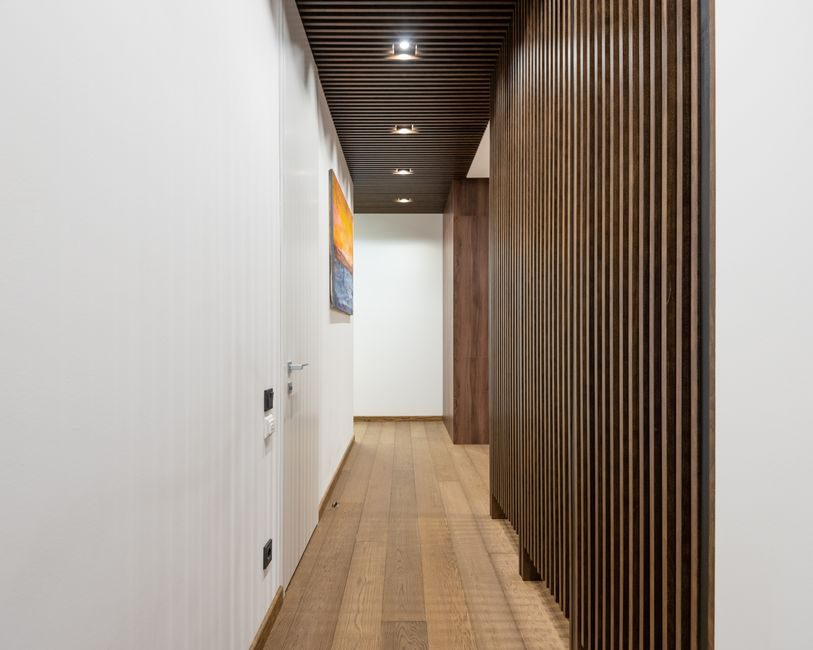
For non-load-bearing interior overhead finishes, a metal suspended ceiling grid using T-bar runners and lay-in tiles (300×300 mm to 600×1200 mm modules) is the default; an aluminum veneer panel in 5-8 mm gauge functions as a rigid cladding sheet, not a lay-in plane, and the two systems are not interchangeable [S1][S4].
The differentiating decision points are substrate behavior, span-to-deflection ratio, fire classification, and access frequency. Where plenum service routes change quarterly, a demountable tile ceiling is the right choice; where the wall is exposed to weather or impact, a fixed aluminum veneer panel assembly is the right choice [S2][S6].
Geometry, Module and Span: Why a Tile Grid Is Not a Cladding Sheet
Strip and lay-in ceilings are characterized by manufacturer catalogs as 45 suppliers offering 148 product variants under the "strip" filter set on ArchiExpo, with module sizes that align with the T-bar grid plan [S1]. The same ArchiExpo taxonomy lists panel, tile, floating, and strip sub-categories under insulating ceilings, with 44 panel, 29 tile, 3 floating, and 2 strip entries — confirming that "ceiling" and "panel" are parallel taxonomy nodes, not synonyms [S2].
Aluminum veneer panels on Okorder are specified at 5 mm, 6 mm, 7 mm, and 8 mm thickness with 10 cm width runs and an integrated ceiling-board function (mould-proof, fireproof, dust-proof) [S4]. The same vendor offers a "flush aluminum access panel suspended ceiling" that explicitly markets access through a rigid frame — a hybrid where the panel is the finish, not a lay-in element [S4]. Guangzhou Willstrong New Material lists aluminum veneer alongside aluminum ceiling panels as separate product families, both falling under the same aluminum cladding holding company, but sold into different specification slots [S6].
Material and Fire Behavior: Class A1 Non-Combustible Core vs Surface-Treated Coil
Suspended aluminum ceiling tile pricing in mid-2026 on Made-in-China starts at US$ 12.00 per 100 m² for a T-bar open-cell grid, indicating that the entry-level ceiling market is a high-volume, low-margin coil-coated product [S8]. The Talida listing for aluminum suspended silver mirror ceiling reports a 200,000 m²/month capacity and 1,000 m² MOQ, with a coil-anodized or mirror-finish surface treatment rather than a solid panel core [S7].
Aluminum veneer panels from Guangzhou Willstrong are positioned as architectural cladding with an aluminum alloy core; the spec path diverges because cladding panels must satisfy exterior-cladding wind-load and impact tests, while interior ceiling tiles only need reaction-to-fire per the local interior code [S6][S5]. Okorder's aluminum suspended ceiling board runs at 100,000 m²/month with a 1,000 m² MOQ and ships from Guangzhou, a pricing/lead-time benchmark for coil-coat ceilings [S9].
Cost and Sourcing Benchmarks Mid-2026
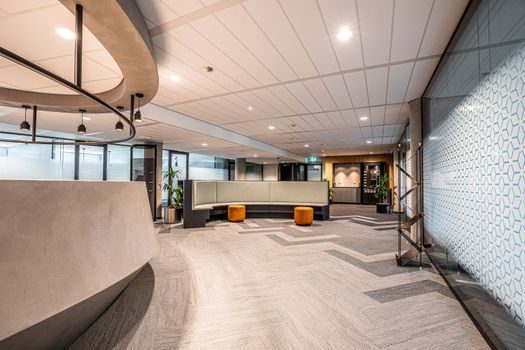
Aluminum suspended ceiling grid + tile: US$ 12.00 per 100 m² entry-level (T-bar open cell), with 1,000 m² MOQ and 100,000-200,000 m²/month capacity among the top Chinese suppliers [S8][S9][S7]. Pricing for premium mirror-finish or baffle ceilings rises substantially above that floor, and lead times are dominated by coil-coat color run setup rather than panel fabrication.
Aluminum veneer panel: typically priced per square meter for 5-8 mm gauges with PE or PVDF coating; Willstrong lists as a 9-year active member exporting from China with a 4,000 m²-class annual export volume [S6]. The cost spread between ceiling tile and cladding panel is roughly 2× to 4× per m² in normal procurement, with cladding carrying the higher fire-class certification and substrate engineering premium.
Comparison: Suspended Ceiling Grid vs Aluminum Veneer Panel
Selection criteria for specifiers on a 2026 project, against four decision axes: [S1]
1. Function (interior overhead vs wall/soffit cladding): Suspended ceiling — interior horizontal plane, demountable for plenum access [S1][S2]. Aluminum veneer — vertical or angled cladding, fixed fastening [S6].
2. Module vs sheet: Suspended ceiling — 300×300, 600×600, 600×1200 mm modules on T-bar; tile swap is the maintenance model [S1][S2]. Aluminum veneer — continuous sheet, joints are expansion gaps, not access panels [S4].
3. Thickness: Suspended ceiling — coil-coat aluminum at sub-millimeter to 1.5 mm typical, suspended on a steel grid [S8]. Aluminum veneer — 5-8 mm rigid sheet per Okorder gauge table [S4].
4. Fire/acoustic path: Suspended ceiling — reaction-to-fire per interior code, plus optional acoustic inlay in the plenum [S2]. Aluminum veneer — Class A or A2-s1,d0 fire performance on the aluminum skin, with mineral-filled cores for higher rating; the spec path is closer to a wall-assembly fire test than a ceiling-tile test [S6][S4].
Who Each System Is For — And Who Should Not Use It
Specifiers for office fit-outs, healthcare corridors, clean rooms, retail floors, and data-hall cold-aisle ceilings should default to a suspended ceiling grid: 28 office and 20 clean-room variants appear in the ArchiExpo "insulating suspended ceiling" taxonomy, indicating where the system is mature [S2]. SCS Northern Ireland markets suspended ceilings alongside glass partitions and blinds as a coordinated interior package for commercial fit-out, a typical specification cluster [S3].
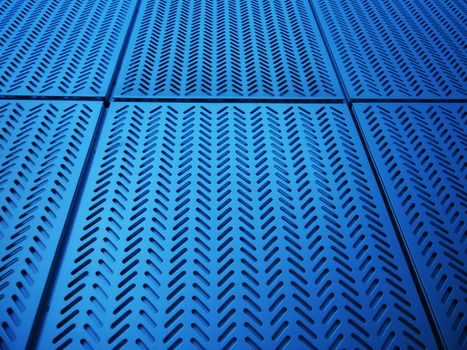
Specifiers for exterior curtain-wall feature panels, column covers, soffit returns, and any surface subject to wind load, impact, or direct weather should default to aluminum veneer panel: Willstrong lists aluminum veneer as the architectural-cladding product, with aluminum ceiling panels as a separate line — the marketing and engineering teams treat them as different [S6]. Do not specify a lay-in ceiling tile on an exterior wall, and do not specify a 5-8 mm veneer panel on a T-bar grid: the dead load of a solid aluminum panel at 5 mm is roughly 13.5 kg/m², which exceeds the 7-10 kg/m² limit typical of a standard-duty T-bar suspension [S4].
Failure Modes and Constraints Engineers Flag on Site
Suspended ceiling failure modes — grid sag from overlong spans, tile fallout during HVAC cycling, plenum dust loading on acoustic inlay, and tile discoloration under UV from clerestory glazing. The strip-ceiling catalog at 45 manufacturers / 148 products reflects the breadth of grid profiles engineered against these specific failure modes [S1]. Specifiers should also check the access-panel type: the Okorder "flush aluminum access panel suspended ceiling" uses a rigid frame insert, which is not the same as a demountable tile and should not be specified where the maintenance team needs hand access to the plenum on a weekly basis [S4].
Aluminum veneer panel failure modes — oil-canning on flat sheets wider than ~1.5 m without stiffeners, thermal bowing on dark PVDF finishes, and fastener staining on mill-finish edges. Willstrong's ACP-style product line is positioned for exterior cladding where these modes are codified into the wind-load and impact test sequence, not into a tile-swap access schedule [S6]. The aluminum alloy grade used in coil-coat ceiling tiles (commonly 3003/3105) is a different temper and gauge window than the alloy used in rigid veneer panels (commonly 3003/5005 in 1.5-3 mm skin over a core), so the two systems cannot share a submittal package even when sourced from the same vendor [S5][S6].
Standards Path and Sourcing Tracks to Watch
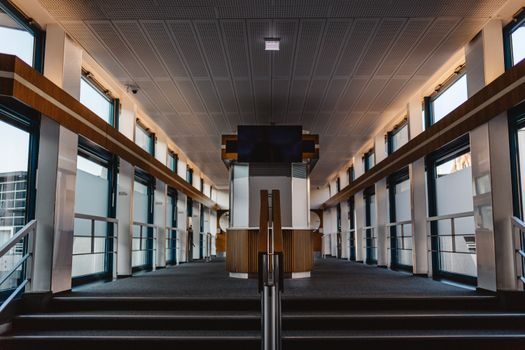
Suspended ceiling specifiers reference EN 13964 (suspended ceiling kits) for reaction-to-fire and load-bearing performance, and ASTM C635/C636 for grid systems in North American projects; aluminum veneer specifiers reference EN 13501-1 fire classification, AAMA 2604/2605 for PVDF coating, and ASHRAE 90.1 for wall-assembly U-value where the panel is part of the envelope. For aluminum window door and cladding integration, the same 6063-T5 or 6063-T6 extrusion alloy family is often co-specified, allowing a single alloy buy across the envelope package. [S2]
On the procurement side, three signal nodes to watch: (a) Guangzhou and Foshan cluster capacity at 100,000-200,000 m²/month for coil-coat ceilings, against an aggregated 1,000-4,000 m² export class for rigid veneer panels — ceiling tile supply remains roughly 25× larger by volume [S7][S9][S6]; (b) entry-level ceiling tile pricing at US$ 12.00 per 100 m² on Made-in-China, against the 2-4× premium cited for finished veneer [S8]; (c) the suspended ceiling spec levers and aluminum veneer panel cost guide referenced in the SourceBySpec 2026 set, which align with the same fire / acoustic / load / plenum decision tree.