
A swing check valve is a passive non-return valve with a disc hinged at the top of the body; the disc swings open with forward flow, then falls against the seat under gravity and reverse flow to block backflow, with only two moving parts (disc plus hinge pin) and no external actuator [S3]. Standard supply sizes span 1/2" to 36" (DN15–DN900), pressure ratings cover PN10/PN16 and ASME Class 150/300, and body materials include cast iron, ductile iron, WCB carbon steel, SS304, and SS316, with disc options in bronze, SS304/SS316, or Stellite-faced for erosive service [S3].
The design is governed by API 6D (pipeline valves), BS 1868 (steel swing check), and API 594 (check valve generic), and is typically flanged, wafer, or screwed-end [S3][S4]. For broader valve context in industrial systems, the check valve encyclopedia entry covers the wider family this part belongs to.
Working Principle and Key Components
The disc is suspended from a hinge pin at the top of the body cavity; forward flow pushes the disc open until it rests parallel to the flow path with a small cracking pressure (commonly on the order of 0.03–0.05 bar for water service), and reverse flow swings it back onto the seat ring to seal [S2][S4]. The closure action is purely gravity- and flow-driven, so the valve has no solenoid, spring, or pilot signal in its base form [S3][S4].
Standardised internals include body, bonnet, disc, hinge, hinge pin, and seat ring, and most OEM catalogues offer metal-to-metal seats (stainless/Stellite) for high-temperature duty above 200°C where elastomers fail, with resilient EPDM or NBR seats for water service [S3][S4]. Cast iron and ductile iron bodied valves are routinely used for pump discharge and potable water mains, while WCB and SS316 bodies dominate oil-and-gas and chemical service [S3]. The related swing check valve reference page covers variants in the same family, including tilting-disc and Y-pattern versions.
Selection Criteria: Size, Class, Material, End Connection
For water and HVAC, DN50–DN600 ductile iron bodies with PN16 flanged ends and EPDM resilient seats cover most pumping stations and building service risers, with same-day ex-stock supply available from Indian stockists for standard sizes [S3][S6]. For oil and gas, specify WCB or SS316 body, Stellite-faced disc and seat, and Class 150–300 flanges, with compliance to API 6D or BS 1868; sand-laden crude and produced water service typically requires the Stellite overlay because of erosion [S3].
For chemical process lines above 200°C or with aggressive media, drop the elastomer seat and select a full metal-to-metal seat; SS316 is the default for chlorides and most acids where carbon steel would corrode, while bronze discs remain common in clean water and steam ancillaries [S3][S4]. Wafer swing check bodies save face-to-face length and weight and are typical on compressor discharge and skid packages, but for larger diameters (12"–36") a flanged body is more common in municipal outfalls and sewage rising mains [S3][S9].
Where It Fits vs Where It Fails
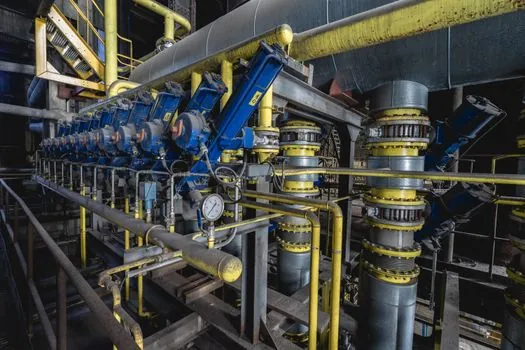
Use swing check valves on horizontal pipe runs or vertical-upward runs with steady, non-pulsating flow: pump discharge, water main service entries, firefighting risers, HVAC chiller plant flow, and oil-and-gas production manifolds [S3][S4][S10]. Do not install them in vertical-downward flow, because gravity holds the disc open and reverse flow passes through uncontrolled [S3].
Avoid swing checks on reciprocating pump or compressor discharge with significant pulsation, on systems with very low flow where the disc never fully lifts, or anywhere water hammer on pump trip would damage downstream equipment, because the disc only starts to close after forward velocity has dropped to near zero and can then slam against the seat [S3][S4]. In those services, a spring-assisted non-slam swing check, a dual-plate wafer check, or a silent (non-slam) check is the better choice [S3][S9].
Comparison: Swing vs Lift vs Wafer (Dual-Plate) vs Silent Non-Slam
Against the main alternatives, swing check valves offer the lowest pressure drop in fully-open position because the disc lays flat in the flow, but they trade that for slower closure and higher water-hammer risk than spring-loaded designs [S2][S3]. On a 2"–4" line, a swing check costs roughly ₹650–₹2,800 in cast iron or stainless steel in the Indian domestic market, while a dual-plate wafer check of the same class is typically lighter and shorter face-to-face [S4].
Selection at a glance across the four common options: Swing check fits horizontal/vertical-up service with clean steady flow and lowest ΔP, but has the highest slam risk and the largest face-to-face; Lift check fits vertical service only with fast closure and low water-hammer risk, but is not a horizontal-run option; Wafer (dual-plate) check fits both orientations with fast closure and short face-to-face, at a moderate ΔP cost; Silent (non-slam) check uses a spring-return disc for the lowest water-hammer risk and the broadest orientation tolerance, at higher unit cost and slightly higher ΔP than a swing check [S4][S9].
Failure Modes, Water Hammer, and Maintenance
The dominant failure mode is seat wear and disc seat impact damage from repeated slam on pump trip, which is why high-cycle services or long pipeline runs with high static head often need a spring-assisted or weighted disc to slow the closure arc [S3][S9]. Other recurring issues are hinge pin wear (especially with dirty or sand-laden water), seat erosion in two-phase or solids-bearing service, and seat leakage after thermal cycling that has deformed a soft seat [S3][S4].
Routine maintenance is straightforward: inspect the disc, hinge pin, and seat, and replace the resilient seat if the body is unchanged; AVK and other DIN-style suppliers note very easy access for maintenance and allow both horizontal and vertical installation with lever-and-weight or lever-and-spring options on DN50–DN600 [S6]. On a related note for fluid-system component selection, the construction machinery and equipment reference covers how non-return valves interact with hydraulic systems in heavy mobile plant. For process-line pump systems where valve selection is one of several cost drivers, the pinch valve TCO breakdown offers a useful comparison frame on slurry-service valve economics.
Standards, Sourcing, and Lead Time
Applicable standards are ASME B16.34 (valve design), API 6D (pipeline), API 594 (check valves generic), BS 1868 (steel swing check), and ASME B16.5 / DIN / IS 1538 for flange dimensions, with size coverage 1/2"–24" (DN15–DN600) at PN10–PN40 / Class 150–600 [S3][S4]. For a swing check installed on a Chinese-fabricated skid in line with water-treatment or oil-and-gas modules, specifiers usually pair API 6D body compliance with EPDM or Stellite seat and an SS316 disc as the default safe baseline [S3][S8].
Lead time is a useful decision input: standard CI/DI/WCB swing checks in PN16/Class 150 ship ex-stock or in 2–4 weeks, while exotic alloys and large-bore SS316 bodies (12"–36") commonly run 8–12 weeks [S3]. Domestic Indian pricing for 1"–6" cast iron or stainless units sits in the ₹350–₹5,000 band depending on size and material, which makes swing checks the cost leader against dual-plate and silent designs of the same class [S4]. The balancing valve reference covers the complementary throttling-control family used in the same HVAC and water-distribution piping networks where swing checks are typically installed.
Track on the next sourcing cycle whether your project falls in the PN16/Class 150 ex-stock band (same-day to 2–4 weeks) or in the SS316 large-bore band (8–12 weeks), and whether the service is steady flow or pulsating, because that single decision swings the choice between a plain swing check and a non-slam alternative. Also worth tracking: AVK-style DIN-pattern designs with lever-and-weight or lever-and-spring on DN50–DN600 remain the most common European municipal-water build, while API 6D WCB/SS316 units dominate export-spec oil-and-gas packages [S6][S8].