
A rotary tablet press is selected by aligning four engineering pairs — turret station count to compression tonnage, tooling material to formulation chemistry, machine class to duty cycle, and OEM spares logistics to maintenance windows — before any commercial comparison [S1][S3].
The 2026 buyer pool spans pharmaceutical, nutraceutical, water-treatment, detergent, catalyst, and shisha-charcoal lines, each pulling different duty cycles and tooling wear profiles; selection discipline matters more than headline price because a mis-sized press typically shows up as a yield or OEE problem inside 18 months of commissioning [S1][S3].
Pair 1 — Turret Stations vs Compression Tonnage
Stations and tonnage are the two numbers that gate every press selection: a higher station count raises throughput proportionally, but it also raises the pre-compression and main-compression forces the turret, cams, and punches must absorb per rotation [S1]. The Sentry tablet press, built around 19, 23, and 31 station configurations with up to 20 tons of compression force, illustrates the standard 3-tier layout used for pharmaceutical and nutraceutical production lines [S1]. A 31-station turret running at 60 rpm delivers roughly 1.86 million tablets per hour, versus about 0.69 million for a 19-station machine at the same speed — a 2.7x throughput delta that dictates the upstream granulation, blending, and feeding capacity the rest of the line must support.
For higher-tonnage chemistries — TCCA, SDIC, large anti-corrosive tablets in the 200-500 g range — press builders drop station count and grow punch diameter: the GZPK720-series high-speed automatic press is built for industrial detergent and chemical tablets where each die cavity holds a much larger fill volume than a 6 mm pharma tablet [S3]. Buyers should size tonnage first (target 10-15% margin above the maximum main-compression force required at the hardest formulation), then lock station count to the throughput target, never the reverse.
Pair 2 — Tooling Material vs Formulation Chemistry
Punch and die material selection is governed by the abrasive index and chemical reactivity of the formulation, not by the press brand: standard D2 tool-steel tooling handles most pharmaceutical and nutraceutical granules, but chlorinated isocyanurate (TCCA) and SDIC chemistries demand anti-corrosive punch tip treatments because free chlorine attacks bare tool steel within a few production shifts [S7]. Shanghai Tablet Press Machinery markets dedicated TCCA/SDIC large anti-corrosive tablet presses in 10 g, 20 g, 135 g, 200 g, 250 g, 300 g, 450 g, and 500 g fill-weight variants — each step in fill weight forces a different cup depth and a different punch/die material pairing [S3][S7].
Effervescent formulations sit at the other end of the material table: their low-density, sticky granulation needs polished punch tips and tight tolerance dies to keep ejection forces below the press's upper-decompression limit, which is why dedicated effervescent tablet presses with GZP420i-29i-class turrets and CE/GMP/ISO/cGMP certifications are sold as a separate machine class from standard rotary presses [S3][S9]. Spec the punch material to the most aggressive raw material in the formulation, not to the average; for cross-manufacturer tooling compatibility, buyers should also confirm the press accepts standard TSM or EU B-type tooling so third-party spares — for example from tablet press tooling specialists — remain an option throughout the press's life [S1][S3].
Pair 3 — Machine Class vs Formulation Duty
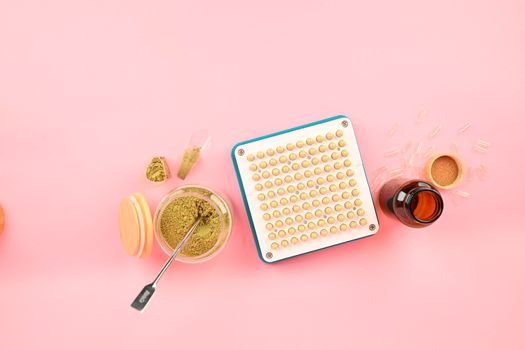
Tablet press buyers should not pick a generic rotary press for a non-standard duty: bilayer, effervescent, TCCA, R&D, and high-speed industrial presses are distinct machine classes with different feed-frame, pre-compression, and ejection geometries [S3]. Bilayer tablet presses add a second fill station and a second compaction roller to avoid layer delamination, so the turret and cam track are physically different from a single-layer press even when the station count and diameter look identical on the data sheet [S3].
For R&D and clinical-supply work, small rotary tablet presses with 4-8 stations and 1-5 ton compression forces let formulators run sub-kilogram batches with the same control architecture as production presses; for production, GZPK720-class machines at 60+ rpm and 20+ ton capacity handle industrial detergent, catalyst, and shisha-charcoal tablets where each die cavity holds grams rather than milligrams of powder [S3]. Food-press and bouillon-cube lines are a separate category again — Fette Compacting's P2020 platform, launched for industrial tablet production and capsule filling, is sold as an integrated solution with matched feeders, control panels, and containment upgrades rather than as a stand-alone press [S10].
Pair 4 — OEM Service Network vs Spares Lead Time
The press that wins the purchase order is usually the one whose spare turret, punch set, and feed-frame parts the buyer can get inside 14 days, not the one with the lowest sticker price; Scheu & Kniss's Louisville, Kentucky-based reverse-engineered parts operation explicitly targets this lead-time window by reproducing parts from OEM samples supplied by the customer [S1]. Fette Compacting, founded in 1908 and headquartered in Schwarzenbek near Hamburg, runs a global service network that buyers of P2020-class machines should map against their own plant locations before signing [S10].
For Chinese-built presses, the spares chain typically runs through the manufacturer or its domestic distributor, with regional stocking in Mumbai, São Paulo, and Eastern Europe varying widely; Fluidpack and Shanghai Tablet Press Machinery both publish export-clientele references that buyers should audit for installed-base density in their own region before locking the order [S3][S4]. A 23-station Ronchi AR 18 listed on the secondary market at EquipNet illustrates the resale value of well-supported European presses — a point worth pricing into a 15-year lifecycle model [S5].
Who Should NOT Pick a Mainstream Single-Layer Rotary
Single-layer rotary presses are the wrong choice for four buyer profiles: effervescent and high-sensitivity API formulators, who need polished-tip tooling and tight tolerance ejection control [S3][S9]; TCCA/SDIC and other chlorinated chemistry producers, who need anti-corrosive punch and die systems plus higher tonnage per station [S3][S7]; bilayer drug developers, who need a second fill station and pre-compression cam track to prevent layer separation [S3]; and process engineers running abrasive catalyst or shisha-charcoal tablets, who need heavy-duty feeders and dust-controlled enclosures beyond a standard pharma build [S3].
Buyers who fall into one of these four profiles and still try to standardise on a single-layer press typically see eject-pin scoring within 200 production hours, layer delamination above 5% of the batch, or tonnage saturations that force them to de-rate throughput by 30-40% — a hidden cost that wipes out the lower acquisition price within the first 18 months of operation [S3][S7].
Price Bands, Total Cost, and Where New Presses Sit in 2026
Quoted 2026 entry-level prices for Chinese-built single-station and small rotary presses sit in a US$15,000-30,000 per-piece band, mid-tier effervescent-class machines in the US$29,500-39,000 range, and high-speed industrial presses with multi-tonnage capability priced separately with negotiable FOB terms [S8][S9]. These figures are ex-works, do not include export crating, installation, or validated IQ/OQ documentation, and should be read against a typical 10-15 year amortisation window for a cGMP pharmaceutical press [S8][S9][S10].
Scheu & Kniss supplies reverse-engineered tablet press turrets and spare parts manufactured in Louisville, KY that fit OEM equipment, illustrating how aftermarket reverse-engineered parts suppliers operate as a parallel channel to OEM service contracts [S1]. Elizabeth (eliz.com, McKeesport, PA) and Scheu & Kniss both publish full-catalog tooling lines, giving buyers a second source for punch and die sets independent of the press OEM [S1][S6].
Shortlist Logic for a Spec-Driven Buyer

Run the four matching pairs in this order: (1) lock turret station count and tonnage to the worst-case formulation and target OEE; (2) specify punch/die material to the most aggressive raw material in the formula; (3) pick the machine class — single-layer, bilayer, effervescent, TCCA, R&D, or industrial — to match duty; (4) map the OEM or third-party spares chain to a 14-day lead time at the buyer's plant. Price comparison only enters at step 5, after these four pairs are quantified. [S1]
Buyers who follow this order typically shortlist 2-3 candidate presses, request matched data sheets with the same fill weight, hardness, and tonnage inputs, and benchmark the candidates on a documented test run with their own granulation — a workflow that aligns with how process engineers approach PLC control cabinet specification, industrial valve sizing, and flow meter selection across the rest of the solid-dose line.
Watch two signals over the next 6-12 months: the Fette Compacting P2020 platform's rollout into nutraceutical and chemical segments, and any new TCCA/SDIC anti-corrosive press models from Shanghai Tablet Press Machinery entering export channels with CE/UL certification documentation, since both shifts will reset the 2026 price-per-station benchmark for new buyers [S3][S10]. A sand mixer selection map for foundry duty shows the same four-pair discipline applied to a different process machine, and the structure transfers directly to tablet press buyers comparing multiple OEM shortlists.