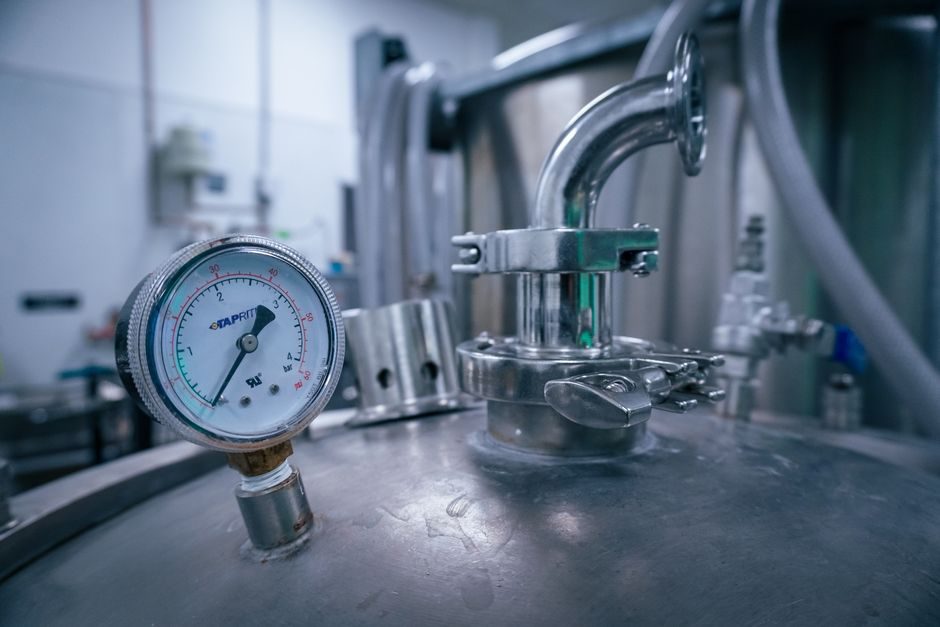
Industrial tank cleaning machines must simultaneously satisfy mechanical performance, hygienic design and zone-rated electrical safety, with rotary jet nozzles most commonly specified in the 3-50 bar operating-pressure window and high-pressure rotary heads reaching 500-1000 bar for heavy-residue service [S3].
Specifying engineers in chemical, food, pharma and offshore sectors need to align three separate compliance tracks: ASME BPE / EHEDG hygienic criteria for sanitary service, ATEX 2014/34/EU or IECEx for zone-rated drives, and material traceability to ASME B31.3 or FDA 21 CFR for the wetted path. Ultrasonic tank-cleaning transducers, an alternative to rotary jet heads, are now offered by at least eight industrial manufacturers with 25-40 kHz frequency options and high-temperature rod variants for reactor-vessel service [S1].
Operating-Pressure Windows and Mechanical Duty
Rotary spray-head cleaning machines are classified by the working-pressure band of the media they handle, and the published product range spans three distinct duty tiers [S3]. Low-pressure units operate at 3-20 bar with 6-12 minute cleaning cycles and 8-15 m spray diameters, suiting IBC and tote tanks where the minimum tank opening can be as small as 100 mm. Mid-pressure machines, typically rated 4-20 bar with spray reach up to 20 m, address road-tanker and rail-car cleaning where the larger throw distance compensates for off-centre nozzle placement. High-pressure rotary heads, specified at 500-1000 bar, are reserved for the most heavily fouled process vessels and reactor internals, and the minimum nozzle diameter (e.g. DG15) directly determines whether a head will pass through the manway [S3].
The minimum-tank-opening dimension is often the binding constraint on a retrofit, and Chinese OEM Wuxi Shengmei Environmental Technology supplies reactor-cleaning skids alongside crystal-pallet automatic cleaning systems as a single product family, indicating a trend toward integrated cleaning cells rather than standalone nozzles [S2]. This integration is most visible in pharma and crystal-growing plants where the cleaning step is bolted directly into the upstream slicing line.
Hygienic Design: ASME BPE, EHEDG and FDA Wetted-Path Rules
For food, beverage, dairy and biopharma duty, the wetted path of a tank cleaning machine must satisfy sanitary design codes regardless of the operating pressure: surface finish typically Ra ≤ 0.8 μm on product-contact surfaces, self-draining geometry, and 316L stainless as the default wetted material. Rotary jet heads from Chinese suppliers such as those listed on cleanspraying.com catalogue 316L stainless as standard, with 6-12 minute cycle times chosen specifically to meet validated clean-in-place (CIP) hold-time protocols rather than raw mechanical throughput [S3].
For pharmaceutical and biotech vessels, FDA 21 CFR and USP Class VI elastomer documentation are non-negotiable, and the cleaning head must be fully drainable in the installed orientation. Ultrasonic transducer options open a parallel hygiene route: 40 kHz rod transducers deliver short cleaning cycles that fit high-throughput aseptic lines, while 25 kHz and 30 kHz variants are quoted for higher-amplitude cavitation work on tenacious residues [S1]. The cleanroom-implication is that ultrasonic heads typically avoid the spray-aerosol plume that rotary jets generate, an important factor when cleaning open reactors inside an ISO-classified suite.
Explosion-Protection Certification: ATEX 2014/34/EU and IECEx

Any tank cleaning machine installed in a flammable-atmosphere service — solvent tanks, fuel storage, pharma solvent reactors — must carry ATEX 2014/34/EU or IECEx certification matched to the zoning of the tank interior. In European chemical plants, the typical default for in-tank electric drive heads is ATEX category 2 (zone 1 inside, zone 2 around) for the motor housing, with category 1 specified only where the head will be immersed during normal operation. Pneumatic or hydraulic drives avoid electrical certification entirely and remain the most common Ex-solution for rotary jet heads, with operating pressure governed by the on-plant air or hydraulic supply, not the cleaning mechanics. [S1]
For offshore and floating-roof service, ATEX/IECEx certification must be combined with the mechanical rating of the head, since the spray-impact reaction force on a 500-1000 bar high-pressure rotary head can exceed several hundred newtons and must be factored into the tank-shell nozzle reinforcement. Specifying engineers should request the Ex certificate number, the specific zone rating, and the ambient-temperature range from the OEM; ATEX/IECEx certificates are not interchangeable with North-American Class I Div 1 / Div 2 ratings under NEC 500/505, and a unit specified for IECEx zone 1 cannot be installed in a NEC Class I Div 1 location without a separate UL/cUL listing.
Material Selection: 316L, PTFE, and Compatibility with CIP Chemistry
The wetted material of a rotary tank cleaning machine is chosen as a trade-off between CIP-chemistry compatibility, mechanical wear life, and the standard's traceability chain. 316L stainless (EN 1.4404) is the default for aqueous CIP duty, with PTFE used for static seals and the nozzle bearing races on high-cycle machines. For strong-acid or strong-alkali CIP at elevated temperature, alloy upgrades to Hastelloy C-22 or duplex 2205 are common, though the duty cycle of 2-4 minutes shown in the low-pressure range demonstrates that modern heads are designed for repeated short cycles rather than continuous immersion [S3].
Material traceability back to ASME B31.3 or PED 2014/68/EU pressure-equipment requirements is essential when the cleaning machine is bolted to a pressure vessel rather than inserted through a manway. For a road-tanker or ISO tank container cleaning skid, the head interface flange is typically a 4-inch ANSI 150 coupling, and the bolt-pattern must be documented against the vessel's own PED/ASME data plate to avoid a mixed-certification installation that auditors will flag.
Comparison: Rotary Jet, High-Pressure Rotary, and Ultrasonic Heads
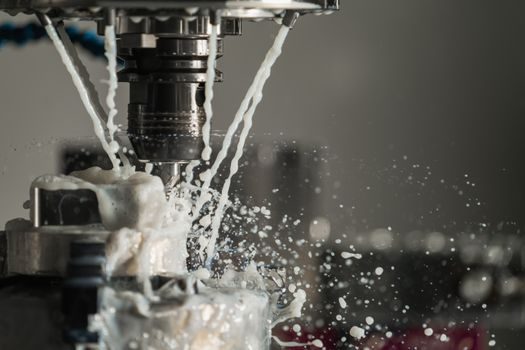
Three principal technologies compete for the same tank-cleaning duty, and the decision is driven by fouling severity, cycle-time target and Ex-zone constraint rather than by price alone. [S2]
Low-to-mid-pressure rotary jet heads (3-50 bar) are the default for IBC, road-tanker, and process-vessel CIP, with published cycle times of 2-12 minutes and minimum openings down to 100 mm [S3]. High-pressure rotary heads (500-1000 bar) address coke, polymer and pigment fouling, but require Ex-rated or hydraulic drives and a much heavier reaction-force bracket. Ultrasonic rod or submersible transducers (25-40 kHz) suit high-purity pharmaceutical and laboratory vessels where spray aerosol is unacceptable, with KKS Ultraschall, Best Technology, Guyson and others offering both standard and high-temperature rod variants [S1]. The Wuxi Shengmei product line illustrates a fourth pathway — fully automatic cleaning cells for crystal-pallet and crystal-bar lines — where the cleaning machine is integrated into a moving production conveyor rather than inserted into a static vessel [S2].
Sourcing, Lead-Time and Standards Documentation
Procurement engineers buying a tank cleaning machine should treat the standards dossier as a line item: Ex certificate (ATEX/IECEx/UL), hygienic-compliance statement (ASME BPE / EHEDG / FDA 21 CFR), material certificates to EN 10204 3.1 for wetted parts, and a PED 2014/68/EU conformity assessment when the head is pressure-bearing. Lead times on Chinese OEM rotary heads in the 3-50 bar range typically run 4-6 weeks ex-works, with the ultrasonic-transducer class running longer due to the smaller supplier base. For plants also rebuilding IBC tank fleets, the same OEM can usually supply both the cleaning head and the self-cleaning filter modules that sit upstream of the CIP loop, simplifying the spares inventory. [S3]
Track the next decision points: (1) the OEM's ability to deliver a 25 kHz, 30 kHz or 40 kHz rod transducer with full PED/ATEX paperwork, which the current supplier map shows is still concentrated in three or four European specialists [S1]; (2) any 2026 update to EHEDG Doc. 2 or ASME BPE-2024 on rotary-spray-head surface finish, which has historically shifted Ra limits; (3) the supply of DG15-class heads at minimum-opening 100 mm, where the listed OEM count suggests a competitive spot-buy market [S3].
For related coverage, see PV Supplier Map 2026: China Maker Tiers, Equipment Sources and Sourcing Levers.