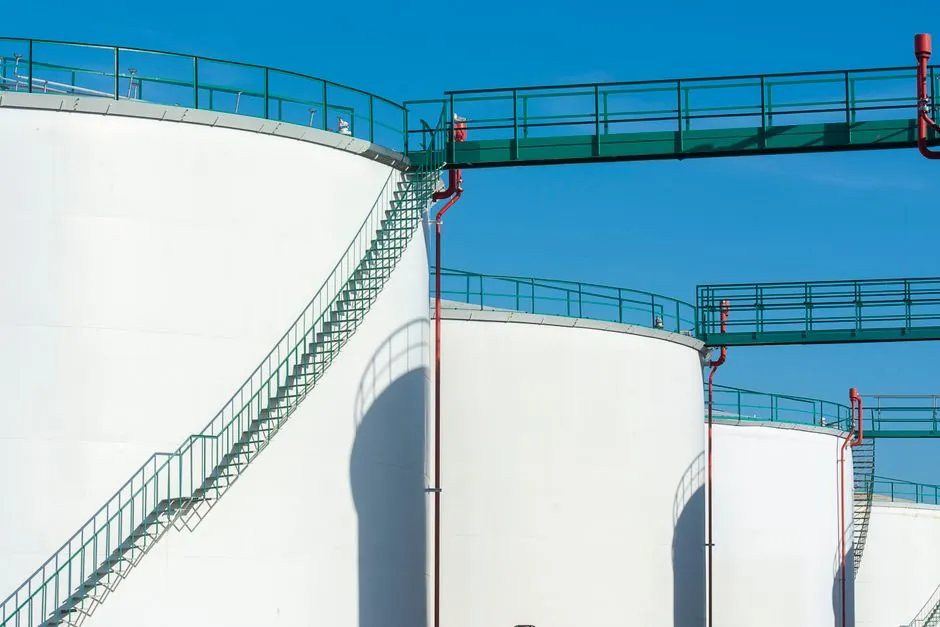
Selecting a tank cleaning machine for farm and agri-chemical service is a geometry-first decision: vessel diameter, internal obstructions, and the soil being removed (liquid fertilizer, pesticide residue, milkstone, slurry) determine whether a static spray ball, a rotary jet head, or a high-impact rotary impingement machine is the correct category [S3][S5].
Across the three dominant device families, published operating envelopes cluster around 2-6 bar supply pressure for hygienic static and rotary heads, with rotary impingement machines running higher pressures and lower flow rates per unit of impact; flow demand scales roughly with vessel diameter, typically 30-150 L/min for vessels in the 1-10 m³ range that dominate on-farm and small-cooperative service [S3][S5].
Three device families and where each one fits
Static spray balls are fixed spray devices that depend on pattern density to wet the full interior; they operate at low pressure (typically 1-3 bar) and high flow, and they suit low-soil tanks such as water storage, IBC chemical day tanks, and rinse-water vessels where the residue is light and the tank is largely unobstructed [S5]. Rotary jet heads use the cleaning fluid itself to drive gear- or turbine-powered rotation, producing focused jets that sweep the wall in a defined pattern; they are the default for hygienic process tanks in the 1-5 m³ range, including milk bulk tanks and liquid fertilizer mixing tanks, with typical operating pressures of 3-6 bar and flow rates of 30-80 L/min [S3][S5]. Rotary impingement machines, sometimes called high-impact or "tank-cleaning machines" in the strict OEM sense, use a motor- or fluid-driven nozzle carrier to fire a tightly collimated stream at high velocity, delivering localized impact in the 0.5-3.0 kW impact-energy class; these are specified for heavy soils, sticky residues, and large-diameter vessels where cycle time matters [S1][S5].
Selection criteria that actually change the decision
Tank geometry is the first gate, not an afterthought: a 1.8 m diameter milk bulk tank with a top-entry manway, agitator, and dip tube behaves nothing like a 3.5 m diameter fertilizer blend tank with a side-mounted agitator and baffles; the larger vessel with internal obstructions typically requires two rotary heads or one rotary head plus a supplementary spray ball to cover shadow zones [S3]. Residue type is the second gate: fats, proteins, and biofilms (dairy, aquaculture) need shear plus chemistry; dried pesticide residues on sprayer tanks need high mechanical impact plus emulsifier chemistry; sand- and grit-laden slurry from quarrying or construction needs impact plus abrasion-resistant nozzle materials such as 316L stainless or hardened tungsten carbide [S3][S4][S5].
Water and pressure availability on-farm is the third gate: many agricultural sites lack the 6-8 bar compressed supply a hygienic CIP loop assumes, so a low-pressure spray ball or a pump-fed rotary head fed from an existing 3 bar wash-down line is often the realistic fit; on-site wash-down pressure washers commonly run at 100-200 bar for external cleaning, but tank-internal cleaning rarely benefits from that pressure, because excessive pressure can shatter droplets into fine mist and reduce wall impact [S3][S5]. Operator entry is the fourth gate, and the one regulators care about most: confined-space entry into farm tanks has a documented history of serious injury and fatality, which is why zero-entry robotic and permanent-CIP systems are increasingly specified even on small farm installations [S1].
Sprayer tank cleanout vs. process tank cleanout

Agricultural sprayer tanks (the 400-3000 L polyethylene tanks behind a tractor) are governed by a different cleaning logic than process or storage tanks: the goal is to remove and dilute the previous chemical so that residues do not damage the next crop, and the standard practice is triple-rinse with water plus a label-approved tank cleaner, with nozzle screens, strainers, and boom lines flushed separately because they hold far more residue per unit volume than the tank itself [S4]. For sprayer tanks, the cleaning device is often a simple rotating nozzle or eductor supplied from a 12 V or PTO-driven pump, with effective cleaning measured by spray-pattern uniformity on a water-sensitive paper rather than by ATP swab or rinse-water TOC, which is the metric used in food/dairy hygiene [S4].
Hygienic tank cleaning follows CIP logic in which the four cleaning variables are chemistry, temperature, time, and mechanical action, with the nozzle choice directly controlling mechanical action by converting pump energy into spray impact, wall shear, coverage, and repeatability [S3]. On dairy operations the FDA Pasteurized Milk Ordinance requires bulk milk tanks to be emptied and cleaned at least every 72 hours, and the cleaning system has to deliver repeatable removal of milk fats, proteins, and milkstone, which is the calcium-phosphate deposit that bonds to stainless surfaces and harbours bacteria if left in place [S1].
Options lined up against decision criteria
For a 1-3 m³ farm tank with light-to-moderate residue and a 3 bar wash-down supply, the comparison typically runs: static spray ball, lowest cost and lowest mechanical impact, suited to water and rinse service only; rotary jet head, mid-cost, 3-6 bar operation, suited to milk and liquid fertilizer with the right chemistry; rotary impingement machine, highest mechanical impact per litre, suited to heavy or sticky soils and to shortening cycle time on larger vessels [S3][S5]. For a 5-15 m³ tank with agitators and baffles, single-device coverage is rarely sufficient, and the engineering answer is two or more rotary heads positioned to cover spray shadows, with the placement reviewed against actual internal geometry rather than an idealized cylinder [S3]. For a 20 m³ or larger on-farm digester or fertilizer blend tank, a permanent CIP loop with a centrifugal pump and a rotary impingement machine is the typical reference design, with flow sized at roughly 10-15 L/min per m² of internal wall area to hit the wall-shear target needed for soil removal [S1][S3].
Materials follow residue: 304 stainless is acceptable for most water and rinse service; 316L stainless is the hygienic default for food, dairy, and pharmaceutical service; 316L with an electropolished surface finish (typically Ra ≤ 0.8 µm) is specified where biofilm control is critical; brass and aluminium are avoided in hygienic service because they corrode and shed particles [S3][S5].
Real use cases by agricultural sub-segment

Dairy farms: bulk milk tanks from 1-10 m³ are the dominant specification, with rotary jet heads running 3-6 bar alkaline wash followed by acid rinse, sized to the PMO 72-hour cleaning cycle and validated by ATP swab or rinse-water testing [S1]. Liquid fertilizer storage and blending: rotary jet heads in 316L, often on a permanent CIP loop, with chemistry tuned to the specific fertilizer (urea-ammonium-nitrate solutions corrode plain carbon steel, so 316L or lined carbon steel is the practical minimum) [S3]. Crop sprayers: low-pressure rotating nozzle or eductor systems for triple-rinse, with the actual residue-control metric being the next-load spray pattern rather than tank-wall cleanliness per se [S4]. Aquaculture and fish holding: lower-impact spray balls with fresh-water rinse are common, because high-pressure impingement can damage tank liners and stress stock; the cleaning target is feed residue and biofilm, not heavy soil [S6]. On-farm anaerobic digesters: large rotary impingement machines on permanent CIP rails, because manual entry into a digester is both a confined-space hazard and a process disruption, and the residue is a mixed organic/inorganic crust that does not respond to static spray [S1][S3].
Limits, failure modes, and what the catalogue does not tell you
Rotary heads fail in predictable ways: gear wear from running dry, bearing failure from chemical attack, and pattern degradation from nozzle erosion; the failure is usually visible first as a wet patch on the wall that does not dry in the expected cycle, which is why post-CIP visual inspection and ATP swab remain the practical verification steps even on automated lines [S1][S3]. Static spray balls fail differently: they tend to clog in hard-water service, and a clogged ball still wets the wall but does not clean it, which is why hygienic service almost always pairs a spray ball with a strainer upstream and a documented inspection interval [S3][S5].
Where a permanent CIP loop is not justifiable (small farm, seasonal use, mobile tank), the realistic alternative is a mobile rotary cleaning unit fed from a wash-down pump, and the engineering trade-off is that mobile units deliver less repeatable impact than a permanent loop, so cycle time and chemistry have to compensate; the same logic applies to IBC and intermediate bulk container service, where dedicated IBC tank cleaning stations are a recognized niche but a manual rinse remains common on small operations. For larger tank container and ISO-container cleaning, drive and impact decisions shift substantially, and the selection map for that segment is covered separately in this site's coverage of tank cleaning machines for tunneling and heavy-soil service.
Standards and sourcing that actually matter
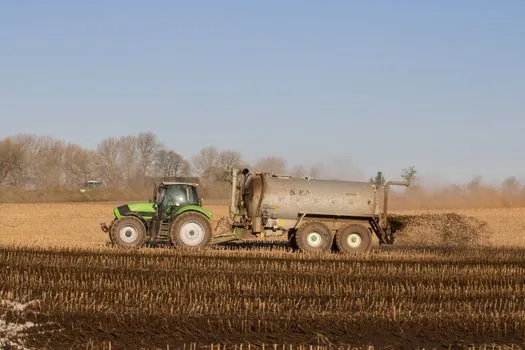
For US dairy service, the controlling document is the FDA Grade "A" Pasteurized Milk Ordinance, with 3-A Sanitary Standards governing the equipment design (surface finish, material, cleanability) that makes compliant cleaning physically achievable; for international dairy and food service, the equivalent hygienic design reference is EHEDG Doc. 2 and Doc. 8, though these were not surfaced in the current research and are cited here only as a standard-class reference, not as a specific clause [S1]. For sprayer tank cleanout, the regulatory anchor is the chemical label's rinse instructions, enforced by the EPA worker-protection and registration framework, with the practical reference being the extension service / Sprayers 101 cleanout methodology [S4]. For hazardous-area service (e.g. solvent or fertilizer storage with flammable vapours), the relevant equipment-certification framework is ATEX or IECEx depending on jurisdiction, but only rotary heads and impingement machines with explicit hazardous-area certification should be deployed, and the certification scope must cover both the device and any drive motor [S2][S5].
For broader tank-cleaning context outside the agricultural segment, the engineering selection logic for quarrying and slurry service and for demolition and high-impact service is similar in structure but heavier in drive power and nozzle material, and is covered in adjacent articles on this site.
Trackable signals for the next six to twelve months: the FDA PMO 2025 revision consultation that closed earlier in 2026 is expected to tighten the 72-hour empty-and-clean requirement for specific tank classes, and several rotary-head OEMs have published 2026-dated guidance noting a shift toward 316L with Ra ≤ 0.8 µm as the default hygienic surface rather than an upgrade option; both signals will push the on-farm specification toward permanent CIP loops and away from manual entry on tanks above 2 m³ [S1][S3].