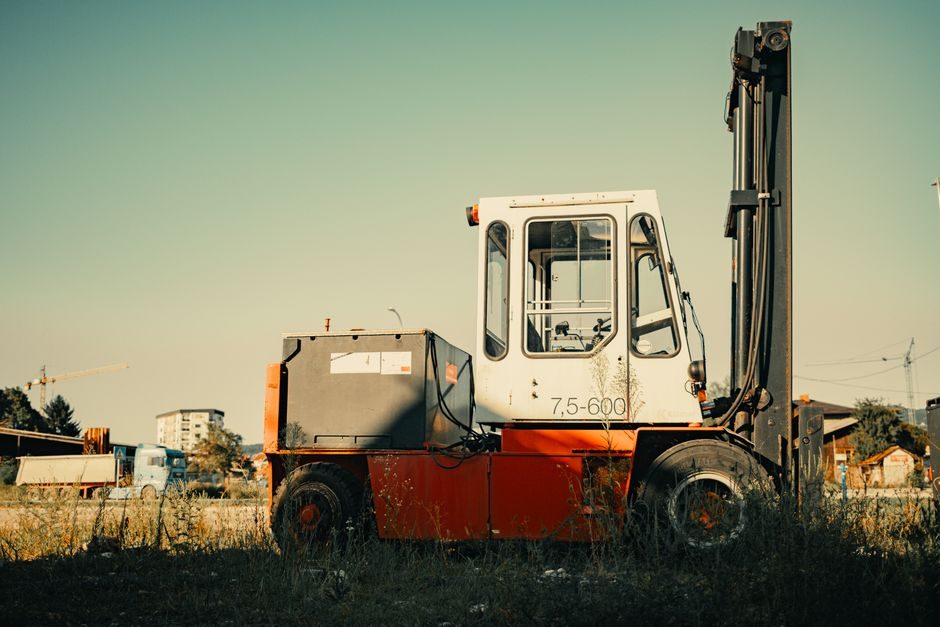
A 20ft ISO tank container carries roughly 21,000 to 26,000 L of bulk liquid; a 40ft unit stretches to about 35,000 L, per industry fleet data on the standard tank container frame [S3]. A rough terrain forklift typically lifts 1,000 to 3,500 kg on unmade ground, per the Agrimac UK product range published 2026-06-21 [S4].
The two product classes rarely compete on the same specification sheet. Tank containers are certified pressure vessels for road, rail and sea intermodal freight. Rough terrain forklifts are mobile lifting machines for construction, agricultural, and yard logistics. Comparing them side-by-side only makes sense when a procurement team must decide whether a site needs fluid storage/transport capacity, lifting capacity, or both.
What Each Product Class Actually Does
An ISO tank container is a stainless-steel cylindrical vessel mounted inside a 20ft or 40ft ISO 1496/1 frame, with manways, valves, pressure relief and a working pressure rating of typically 4 bar (some up to 6 bar) depending on the service [S3]. Suppliers such as ALP (UK) list food-grade, chemical, ammonia, LPG, bitumen/asphalt and cryogenic variants as distinct product lines [S3].
A rough terrain forklift is a four-wheel-drive counterbalanced truck with large lug tyres, high ground clearance and a 2- or 3-stage mast. Hangcha America's published 2026-06-07 rough-terrain line covers diesel-powered models in 2.0 t to 3.5 t classes for construction and timber-yard work [S2]. JCB positions its rough-terrain range as part of its construction equipment portfolio, distinct from industrial warehouse forklifts [S1].
Decision Criteria: When You Need One, the Other, or Both
If the cargo is liquid or gas in bulk, the equipment class is a tank container - end of selection. ISO tank containers are the dominant intermodal bulk-liquid format, and suppliers such as ALP advertise new and used stock for hazardous and non-hazardous service [S3]. For palletised loads, bagged goods, timber, brick bundles or steel stock on a soft or uneven surface, the equipment class is a rough terrain forklift, with typical lift capacities of 1,000-3,500 kg [S4].
Some sites genuinely need both: a chemical distributor handling ISO tank containers in a yard will usually pair a rough terrain forklift with a reach stacker or empty-handler to position the frame. Conversely, a fuel-storage depot receiving ISO tanks rarely requires rough-terrain lift trucks - a standard yard forklift on hardstand is enough. The line is drawn by ground condition, not by the cargo weight.
Side-by-Side Spec Comparison
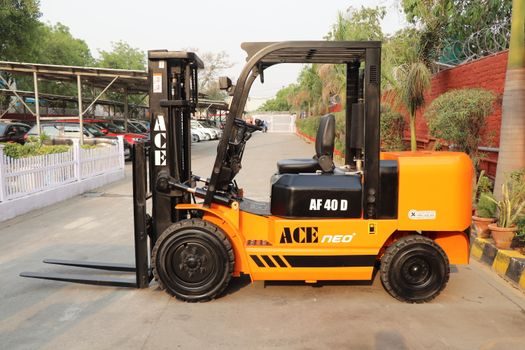
The table below lines up the two classes on the criteria procurement actually scores against: [S1]
Capacity - Tank container: 21,000-35,000 L liquid volume per ISO frame. Rough terrain forklift: 1,000-3,500 kg lift [S3][S4].
Working envelope - Tank container: stackable in ISO container slots, multimodal road/rail/sea, typically 4 bar working pressure for chemical service. Rough terrain forklift: outdoor unpaved sites, gradients typically up to ~35% depending on model, mast lift heights 3-6 m [S2][S4].
Standards regime - Tank container: ISO 1496/1 frame, IMO/IMDG for dangerous goods, ADR for road, RID for rail, plus tank-specific approvals (UN portable tank codes, ASME U-stamp for U.S. service, pressure-vessel PED/2014/68/EU for EU). Rough terrain forklift: EN 1459 (rough-terrain trucks safety), ISO 5053-1 (terminology), and the machinery directive 2006/42/EC in the EU.
Cost driver - Tank container: shell material (SS304 vs SS316L), lining (rubber/PTFE for acid service), and frame refurbishment cost. Rough terrain forklift: engine emission tier, mast configuration, tyre size, and 4WD versus 2WD.
These four axes are usually enough to rule one class in and the other out without further shortlisting.
Real Use Cases and Equipment Match
Food-grade liquid haulage - 20ft SS304 ISO tank container, steam-heating coil optional, operated on standard road-rail-sea lanes. ALP lists this as a stocked configuration [S3].
Agricultural bulk input - bitumen or liquid fertiliser delivered by 40ft ISO tank with thermal insulation, offloaded at a plant via pump, not a forklift.
Construction site pallet handling - 2.5 t diesel rough terrain forklift moving brick packs, timber bundles, and formwork on a gravel pad. Hangcha's published 2.0-3.5 t rough-terrain line targets this workload [S2].
Quarry or sawmill yard - higher-capacity 3.0-3.5 t rough terrain forklift with cab and load-guard, 4WD, single- or two-stage mast, matching the Agrimac published ceiling of 3,500 kg [S4].
For shippers weighing whether to buy or lease a tank container, the broader specification and cost factors are covered in the Tank Container Buying Guide 2026.
Limitations and Failure Modes
A tank container is useless without a chassis, a prime mover, a rail wagon, or a stacker-slot; it is not a self-propelled asset. Its pressure rating (typically 4 bar) is the upper limit for general chemical service; higher-pressure gases (chlorine, LPG above atmospheric) require dedicated T50 or T75 coded frames with relief valves set accordingly [S3]. Mis-specifying a frame for the cargo's UN number is a regulatory and safety failure, not a procurement mistake.
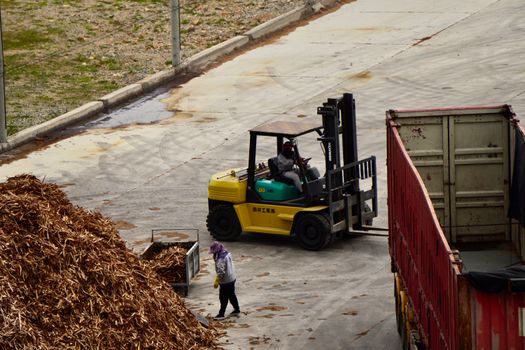
A rough terrain forklift cannot legally or safely operate inside a standard ISO tank container, and it is not a replacement for a reach stacker at an intermodal terminal. Overloading beyond the published 1,000-3,500 kg range, or operating on slopes steeper than the manufacturer's rating, are the two most common ways rough terrain trucks fail - both are documented as standard risk vectors in rough-terrain lift-truck safety guidance (EN 1459 family) and explicitly referenced in OEM operator manuals [S2][S4].
Sourcing, Standards, and Final Selection Logic
For tank containers, source against ISO 1496/1 (frame), the relevant UN portable tank code (T1-T75) for the cargo, and the regional carriage rules (ADR/RID/IMDG). For the EU, pressure-equipment compliance sits under 2014/68/EU. ALP publishes its product range against this stack [S3].
For rough terrain forklifts, source against EN 1459 (rough-terrain truck safety), the EU Machinery Directive 2006/42/EC, and the engine emissions tier applicable to the deployment region. Both JCB and Hangcha publish datasheets to these standards [S1][S2]. Agrimac UK publishes 12-36 month warranty terms and 4x2/4x4 model splits for the UK and Ireland market [S4].
Final selection rule: if the problem statement contains "litres" or "bar" as a unit, the answer is a tank container. If it contains "tonnes on gravel" or "pallets on dirt", the answer is a rough terrain forklift. Sites that genuinely need both should budget the two as separate lines in the capex table, because their standards regimes, service intervals, and operator-licensing requirements do not overlap.
Trackable signal to watch: the EU Machinery Directive revision cycle and any tightening of EN 1459 telematics requirements for rough terrain lift trucks, plus the next IMO/UN portable-tank code update affecting chemical-service ISO frames - both shape the next procurement refresh in this space.
For component-level specifications, see forklift.