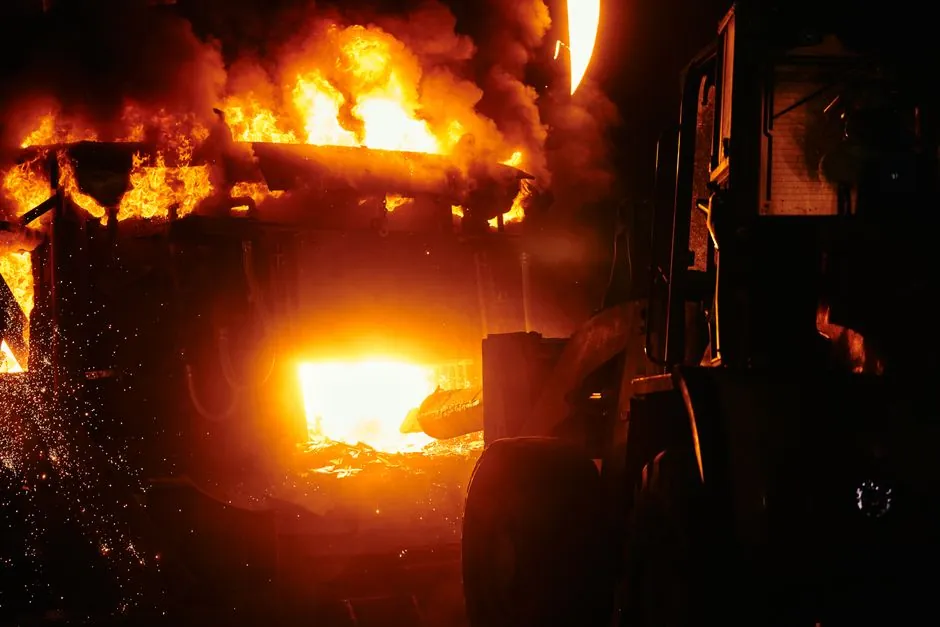
In steel foundries running 0.5 to 40 tonne pours, bottom-pour ladles with monoblock stoppers have been the workhorse for more than 30 years, delivering zero-slag pouring, direct sprue placement, and shorter cycle times compared with lip-pouring [S1].
Teapot ladles, by contrast, hold the line for steel investment casters below 500 kg, where stopper preheating is not feasible and small shot weight, not slag control, is the binding constraint [S1]. The crossover between the two is not a marketing line: it is set by ladle capacity, stopper length, and whether a preheating station is available on the foundry floor.
Capacity Bands and Stopper Choice in Steel Foundries
Bottom-pour ladles from 500 kg up to 40 tonnes use a stopper rod with either a monoblock (one-piece isopressed or extruded carbon-ceramic) head or an assembled (clay-graphite head, ceramic sleeves, metal bar) head, and ladles over 40 t normally switch to slide-gate systems for single large-pour castings [S1]. Monoblock stoppers are commercially limited to a maximum length of 2150 mm, so any ladle taller than that threshold forces the foundry to an assembled stopper, not a monoblock [S1]. Below 500 kg, simple hand control without any stopper mechanism is normal, and teapot ladles become the preferred hardware for steel investment casting cells [S1].
For a detailed look at how these vessels sit inside the broader pouring-equipment family, see the casting ladle reference page. The auxiliary gear, tilters, preheat stations, and stopper rods are catalogued separately on casting auxiliaries for foundries building a full pouring bay.
Slag Control, Stream Quality, and Mold Filling
Bottom pour lets the steel leave through a nozzle seated in clean metal below the slag layer, so the steel reaches the sprue without slag ingress, and the ladle can be placed directly over the sprue cup for a short, controlled stream [S1]. With a teapot ladle, metal exits over a weir at the rim, so the pour path is longer and slag skimming depends on the operator holding back the dross with a dam.
Foseco's glossary entry on bottom-pour ladles makes the same point quantitatively: the flow rate and exit velocity of the metal stream are governed by nozzle size and ferrostatic head (height of metal above the nozzle), so any change in ladle fill level or nozzle diameter shifts the casting time and the turbulence seen by the mold [S3]. A teapot spout has no such fixed orifice, and the stream is throttled by tilt angle and bath level, which is a major reason foundries running repeatable steel jobs migrated to stopper-and-nozzle hardware decades ago [S1].
Independent water-analogue work on bottom-pour, teapot, and quadrant ladles confirms that ladle geometry alone changes the air entrainment measured at the mold, so any process change to a different ladle type should be backed by a fill study before production release [S8]. The casting mold page covers the receiving end of that stream and what fill behaviour the mold geometry has to absorb.
Preheating Is Mandatory, Not Optional
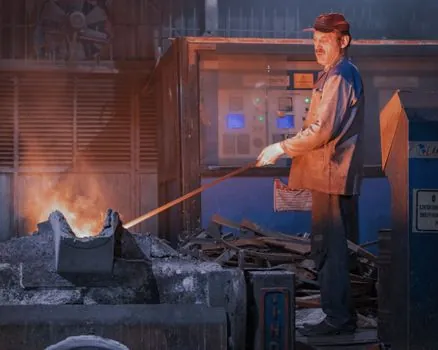
A monoblock stopper is dense-looking but still carries open porosity, so it absorbs atmospheric moisture; that moisture expands violently when the ladle fills with molten steel, and a non-preheated monoblock stopper can crack and fail [S1]. The fix is a preheating station (Figure 4 in the Vesuvius Foundry Practice brief) and a metallic stopper rod with a central vent hole so the migrating moisture can escape; an un-vented rod, or one whose vent is plugged with slag, traps the moisture and cracks the stopper the same way [S1].
Foundries that cannot install a preheating station or that run ladles taller than 2150 mm must use an assembled stopper with a clay-graphite head (for example ROTOLOK-style) and ceramic sleeves on a metal bar, joined with a high-temperature mortar [S1]. The decision tree is therefore: (1) is a preheat station available, (2) is the ladle shorter than 2150 mm, (3) is the shot weight below 500 kg. Two of the three pointing to monoblock, you buy a monoblock; otherwise, you go assembled or teapot.
Bullets and Small-Shop Reality: Where the Debate Started
Outside steel foundries, the same teapot-vs-bottom-pour question shows up at hobby scale for lead bullet casting, and the answer is geometry-driven, not marketing-driven. A bottom-pour furnace lets the caster hold a continuous stream, slide a multi-cavity mould under the nozzle, and pressure-fill the sprue plate by pressing the plate against the nozzle [S2]. A lead ladle (a teapot-style dip ladle in lead-casting parlance) holds a larger thermal mass, holds alloy temperature better, and is described as the more consistent pour once the operator masters the art of it [S5][S9].
Operator experience in those forums is consistent: bottom pour is faster, but it can clog with dross if the alloy pot is dirty, and any mould with a small sprue hole (the Saeco #221 plate for 22 cal 60 grain bullets is the named example) has to be either pressure-fed or ladle-poured, not free-streamed [S2]. Lyman and RCBS dip ladles, with their larger bowl mass, are preferred by casters chasing tight weight spreads on long, heavy boolits like the .45-70 535 grain design, where a small temperature drop at the spout changes fill-out [S5][S9].
Cost, Maintenance, and Skimming Behaviour
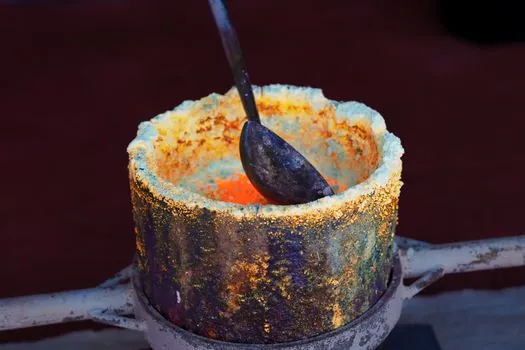
General casting ladles (teapot, lip-pour, dipper) are the lower-cost hardware class; bottom-pour ladles cost more because of the stopper rod, nozzle, and seat hardware, but they pay that back by being self-skimming, pouring clean metal from the bottom of the bowl [S6]. Vesuvius lists the maintenance delta in plain terms: bottom pour requires less maintenance than teapot ladles and allows pouring without slag ingress, with the additional benefits of gas-purging capability and direct placement over the sprue cup [S1].
The trade-off is capital and preheating infrastructure: a foundry converting from lip pour to bottom pour has to budget a preheating station, a stopper rod with a verified vent, and either monoblock or assembled spare stoppers sized to its ladle height [S1]. A teapot cell, by comparison, needs almost no infrastructure beyond a drying station for the refractory lining, which is why investment casters running small, high-mix steel jobs have not abandoned teapot hardware [S1].
Decision Matrix: Teapot vs Bottom Pour
Use this comparison to pick the ladle class before speccing a casting tooling package: [S1]
Capacity range: teapot (or simple lip pour) suits sub-500 kg steel jobs and most investment casting; bottom pour covers 500 kg to 40 t with a stopper, and above 40 t foundries move to slide gates [S1].
Slag control: teapot is operator-skimmed with a dam or skimmer rod, so slag risk tracks operator skill; bottom pour is self-skimming because the nozzle sits under the slag layer [S1][S6].
Preheating demand: teapot needs only a normal refractory dry-out; bottom pour with a monoblock stopper needs a dedicated preheating station and a vented metallic stopper rod, or an assembled stopper if no preheat station is available [S1].
Stream control: teapot stream is governed by tilt angle and bath level; bottom-pour stream is governed by nozzle diameter and ferrostatic head, which gives more repeatable fill times [S3].
Maintenance and capex: teapot is lower cost and lower infrastructure, but higher operator attention per pour; bottom pour is higher capex but lower maintenance and shorter cycle time [S1][S6].
For shops that also run high-pressure die casting or squeeze-pin work, the die casting die reference covers the receiving-end hardware, while the broader die casting page links the ladle decision to the rest of the cell.
Limits, Failure Modes, and Trackable Signals
Bottom-pour stoppers fail in two well-documented ways: thermal shock from moisture (prevented by preheating and a vented rod), and slag build-up on the nozzle seat, which is what the gas-purge capability of a stopper-equipped ladle is designed to clear [S1]. Teapot ladles do not have those failure modes but do carry dross inclusions when the operator's skim is poor, and they cannot be placed as close to the sprue cup because the spout geometry forces a longer free-fall distance.
A simple field check before each shift: confirm the stopper rod vent is open, confirm the ladle has been on preheat long enough to drive off stored moisture, and confirm the nozzle seat is free of solidified skull from the previous pour [S1]. For an adjacent process comparison relevant to refractory-lined vessels, the SS 310 V-anchor stud welding for refractory linings guide covers the stud-side hardware that holds the lining a teapot or bottom-pour ladle relies on.