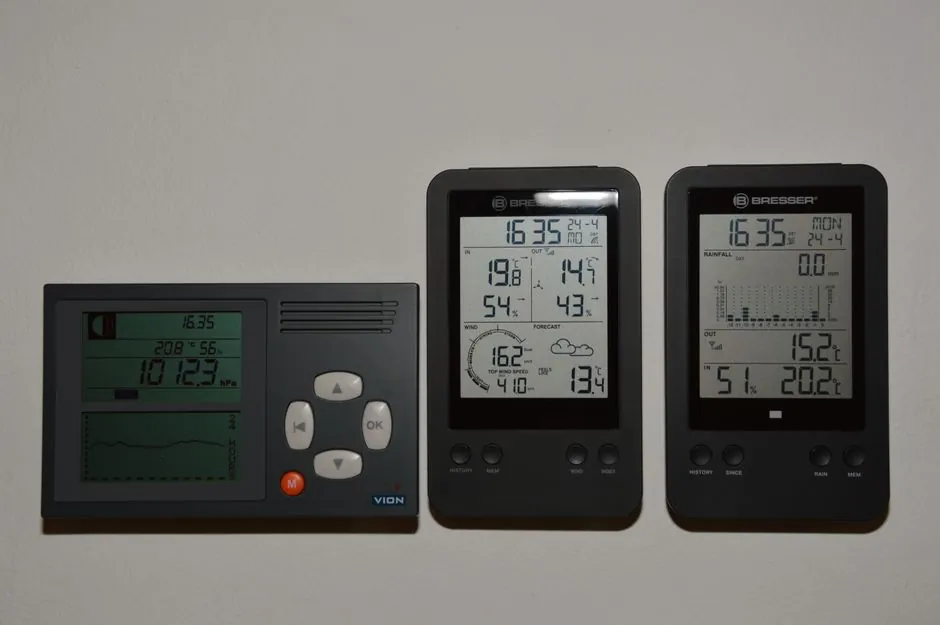
Pt100/Pt500 RTDs, NTC and PTC thermistors, and digital IC sensors cover almost every industrial and lab temperature duty from cryogenic storage at -200 °C to sterilization loops at +670 °C, and the right pick is driven by accuracy class, environmental exposure, and signal output [S1][S3].
Range alone does not pick the sensor. A Fluke-type 5698-25 SPRT spans -200 °C to +670 °C with self-heating under 0.002 °C at 1 mA, while a Govee H5051 WiFi hygrometer ships with ±0.3 °C accuracy over a 0–50 °C indoor band, so the application duty decides which technology is even in the running [S1][S5].
Sensor classes and where each one wins
RTDs use platinum elements whose resistance rises nearly linearly with temperature; Pt100 (100 Ω at 0 °C) and Pt500 (500 Ω at 0 °C) are the most common industrial grades, with Pt500 giving roughly five times the signal amplitude and better noise immunity on long cable runs [S1][S3]. PTC thermistors flip that curve and are used mainly as resettable fuses and limit switches rather than measurement devices [S3].
Digital IC sensors integrate the sensing element, ADC, and calibration on one die, with parts like the E+E Elektronik TEE501 covering -40 °C to +135 °C and the EE074 Modbus RTU probe covering -70 °C to +105 °C for climate and clean-room work, so a single bus drop replaces a separate transmitter [S1]. For laboratory flow and temperature teaching, PASCO's PS-2130 combines a flow rate and temperature channel in one PASPORT plug, illustrating the integrated multi-channel class used in education labs [S2].
Comparison of the four main options against decision criteria
Buyers usually narrow to one of four technology buckets; the table below lines them up against the criteria that drive a spec sheet [S1][S3][S5]:
Pt100/Pt500 RTD: typical accuracy ±0.1 °C to ±0.3 °C at 0 °C (Class A or AA), range -200 °C to +670 °C for industrial probes, excellent long-term stability, cost moderate, output resistance-based so needs a transmitter or 4-wire bridge for full accuracy. NTC thermistor: typical accuracy ±0.1 °C to ±0.5 °C between 0–100 °C, range -50 °C to +150 °C typical, fast response under 1 s in air, very low cost, requires Steinhart-Hart linearization in firmware. Digital IC sensor (I2C/SPI/Modbus): on-chip calibrated accuracy ±0.2 °C to ±0.5 °C, range commonly -40 °C to +125 °C, integrated signal conditioning, per-unit cost low, bus limited to a few meters. Specialty SPRT/standards probe: sub-0.01 °C accuracy, range -200 °C to +670 °C, drift under 0.006 °C per 100 hours at max temperature, fragile and expensive, used as a lab reference [S1].
Selection criteria that actually move the decision

Range and accuracy are the two hardest constraints. A screw-in resistance thermometer with a 4 mm, 6 mm, 8 mm, 9 mm, or 11 mm 304 or 316 stainless protection tube and PVC, silicone, or PTFE cable covers most process taps from -50 °C to +600 °C, with thermowell material picked to match the process fluid's corrosion class [S4]. NEMA 4X or IP65 ingress protection, response time under 5 s for hygienic loops, and a 4-wire Class A Pt100 element are the typical spec floor for food, beverage, and pharmaceutical lines, where 3-A sanitary and EHEDG cleaning demands push designers away from thermistors and toward welded stainless RTD assemblies [S1][S4].
Output protocol drives the panel side. 4–20 mA with HART is still the dominant industrial loop because it rides a single twisted pair and survives long cable runs, RS-485 Modbus RTU is the next most common for multi-drop probes like the EE074, and I2C or SPI digital sensors stay on the board or inside an enclosure where the bus is short and noise is controlled [S1]. For consumer and SMB monitoring, WiFi sensors with ±0.3 °C accuracy and 2-year on-board logging like the Govee H5051 close the loop without any PLC at all, trading control-room integration for smartphone alerting [S5].
Who should NOT pick the mainstream option
Pt100 is the default but is the wrong call when the budget cannot absorb a transmitter, when the temperature stays inside 0–100 °C, or when the response time must drop below 1 s. In those cases an NTC thermistor with a 10 kΩ nominal resistance and B-value matched to the working band is a better fit, and for board-level monitoring inside an enclosure an I2C digital sensor removes a calibration step per board [S3][S5].
WiFi consumer sensors are the wrong call for any line that is part of a regulated batch record, where the audit trail has to be tamper-evident and traceable to a calibration certificate. They are also the wrong call for cryogenic, sterilization, or refinery service where the published range, typically 0 °C to +50 °C, will not span the duty [S5]. For those duties, an SPRT-class standards probe or a Class A 4-wire RTD in a thermowell is the only honest answer [S1].
Failure modes, standards, and sourcing signals
The three failure modes that show up in the field are drift on the sensing element, moisture ingress into the probe, and lead-wire resistance on long runs. Self-heating at the triple point of water under 0.002 °C at 1 mA is the benchmark for a high-grade RTD, and any probe whose datasheet does not list excitation current versus self-heating is probably not built for tight accuracy [S1]. Ingress protection has to match the washdown or outdoor rating, and 4-wire Kelvin wiring is the only honest answer when lead resistance exceeds a few tenths of an ohm, which happens quickly once the cable runs past 5 m.
On standards, IEC 60751 governs the platinum RTD resistance versus temperature curve and the tolerance classes, ASTM E1137 covers the same territory for the North American market, and NEMA 4X or IP65/67 ratings are the common ingress language; ATEX and IECEx certification is required for any probe mounted in a classified hazardous area, but the exact zone-to-category mapping is project-specific and must be confirmed against the plant's hazardous-area classification drawing rather than the sensor datasheet. Hygienic service in food, beverage, and pharma also needs 3-A sanitary or EHEDG cleanability, which dictates the surface finish, the gasket style, and the absence of threaded voids. For more on how temperature loops are calibrated against a deadweight or temperature bath, see deadweight tester vs temperature calibration bath, and for how a temperature probe fits into a wider measurement loop, the temperature measurement reference covers the conditioning electronics.
Shortlist logic and next signal to watch
The cleanest shortlist rule: pick Pt100 or Pt500 RTD for any process duty above 150 °C or below -50 °C, or wherever the spec sheet must show a calibration certificate; pick NTC thermistor for tight-budget consumer or appliance work between -10 °C and +100 °C; pick a digital IC sensor for board-level and short-cable monitoring inside enclosures; pick a WiFi consumer sensor only for non-regulated, non-safety monitoring where a smartphone alert is the deliverable [S1][S3][S5].
Two signals to track into the rest of 2026: tighter integration of Modbus RTU probes into edge gateways, which keeps the 4-wire RTD in the field but pushes the linearization into the gateway instead of the transmitter, and the migration of consumer-grade ±0.3 °C WiFi parts into light-commercial HVAC and small-format cold-chain use, where the existing 0–50 °C band is finally enough to cover the duty [S1][S5]. For the wider instrumentation picture that a temperature sensor plugs into, the temperature controller and temperature monitor pages lay out the downstream conditioning and alarm logic.