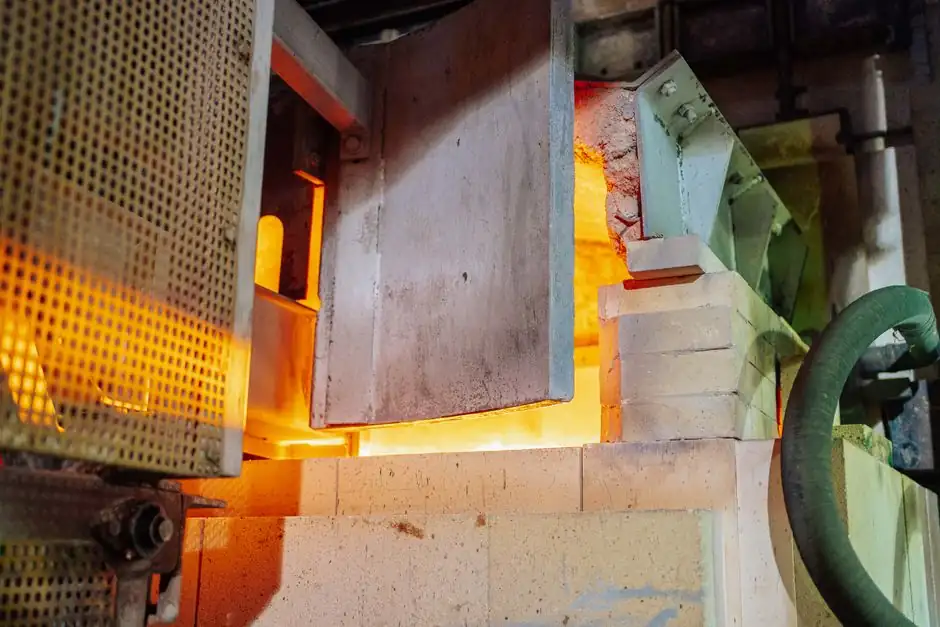
A tempering oven is typically rated 300–1050°F (150–565°C) for sub-critical stress relief and temper, whereas a heat treatment furnace spans 1000–2300°F (538–1260°C) for hardening, annealing, and case-hardening cycles [S8][S3][S6].
Both rely on forced convection, but furnace-class units add atmosphere control (nitrogen cover gas, endothermic gas, or vacuum) and tighter uniformity budgets measured at ±5.6°C or better, against typical oven uniformity of ±10°F to ±25°F across the qualified work zone [S1][S4][S7].
Temperature Range by Equipment Class
Industrial ovens commonly cap at 650–850°F (343–454°C) for composite curing and aluminum aging, with high-temp ovens reaching 1350°F (732°C) for annealing, aging, drying, and stress relieving [S4][S6]. Tempering ovens extend the upper bound to roughly 1050°F (565°C) when configured as vertical-flow temper units, covering 1400°F (760°C) in some specialized builds, although 1000°F (538°C) remains the more typical production ceiling [S2][S3][S8]. Heat treatment furnaces cover the full metallurgical range: hardening austenitizing at 1500–1700°F, carburizing at 1600–1750°F, and high-temp sintering or solution treatment at 2000–2300°F, depending on alloy [S3][S6].
The crossover between oven and furnace is fuzzy and vendor-defined: one OEM lines a "dedicated tempering" build at 1400°F vertical flow, while a "dual chamber" runs hardening to 2300°F, exposing the same frame to both regimes [S3][S6].
Airflow and Circulation Engineering
Oven-class airflow patterns emphasize horizontal and vertical recirculation through adjustable louvers, marketed as "high-velocity uniflow," which moves heated air back into the chamber to cut stratification and trim cycle time on curing and pre-heat loads [S4]. Furnace-class airflow is engineered for high thermal mass loads, with horizontal recirculation paths sized to hold ±5.6°C at 538°C in production cabinet furnaces, a tighter spec than the ±10–25°F band used for ovens [S1][S4].
At furnace scale, airflow is only one driver of uniformity: heating element placement, insulation thermal mass, and chamber door seals together set the achievable envelope, and a poorly designed airflow path will produce hot and cold zones that shift as the load changes, even when the controller holds setpoint [S1].
Uniformity Budget and What It Means for a Heat Treat Recipe
Uniformity is the maximum temperature difference anywhere inside the qualified work zone, not the controller tolerance, and a furnace set to 1600°F with ±10°F uniformity keeps every part between 1590°F and 1610°F during soak [S1]. Tighter specs (±5–10°F) cost money in element layout and insulation; looser specs (±20–25°F) extend soak time and energy use as operators over-process loads to compensate for hot and cold pockets [S1].
For tempering, the consequence of poor uniformity is mostly hardness scatter, since the metallurgical response curve is shallow at 300–1050°F [S8]. For hardening and case hardening, the same degree of variation shows up as inconsistent case depth, distortion, and failed quality inspection, because the steel is crossing a phase boundary where small ΔT maps to large property shifts [S1][S2].
Batch vs Continuous, and Atmosphere vs Air
Heat-treating equipment splits into batch (work stationary) and continuous (work moving through a controlled envelope) categories, with integral quench batch furnaces and pusher continuous furnaces dominating gear production at 50 HRC effective case depths of 0.025–0.060 in (0.6–1.5 mm) [S2]. Ovens are largely batch units with high-velocity air recirculation and optional NFPA 86 Class A ratings for flammable-solvent processes, while furnaces add atmosphere control through endothermic gas, nitrogen purge, or full vacuum [S2][S4][S7].
Inert-atmosphere heat treating starts with a nitrogen purge to displace oxygen before ramp-up, a baseline that air-only ovens cannot meet, and which is the deciding factor when the part is a stainless aerospace bracket, a tool-steel die, or any load that cannot tolerate scale [S7].
Decision Matrix: Oven or Furnace for a Given Job
Match equipment to the metallurgical requirement, not the label. For tempering 300–1050°F and stress relieving up to 1350°F in air, a forced-convection oven with adjustable louvers and ±10°F uniformity is the cost-effective choice [S3][S4][S8]. For austenitizing, hardening, case hardening, or any process above 1400°F, a furnace is required because ovens lose insulation efficiency and the controls needed for atmosphere or vacuum are absent [S2][S3][S6].
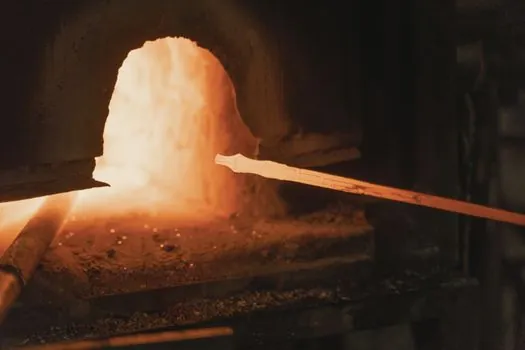
Selection criteria, in priority order: (1) peak temperature and alloy critical point, (2) uniformity budget matched to tolerance on hardness or case depth, (3) atmosphere requirement (air, nitrogen cover, endothermic gas, vacuum), (4) load geometry and whether batch or continuous flow fits the shop, and (5) NFPA 86 Class A need for flammable-solvent processes [S1][S2][S4][S7]. A small bladesmith shop can produce functional knives with a torch and visual judgment, but reproducibility, scale, and audit-ready records require a controlled electric furnace or oven [S5].
Limitations, Failure Modes, and Sourcing Caveats
Ovens that claim higher than 1000°F often lack the refractory and element margin to hold uniformity at temperature, and the "oven" label is sometimes stretched for marketing rather than metallurgical accuracy [S2]. Furnaces that spec a maximum temperature without a corresponding uniformity figure are not a heat-treat furnace, they are a heater, and any recipe that depends on phase transformation will drift across the load [S1].
When sourcing, require a written temperature-uniformity survey across the qualified work zone at operating temperature, NFPA 86 compliance evidence if volatiles are present, and atmosphere or vacuum integrity data for any furnace used in case hardening or inert-atmosphere work [S1][S4][S7].
Trackable signals for the next planning cycle: a vendor uniformity survey tied to a specific alloy and recipe, and a written mapping of the load footprint inside the qualified work zone before scaling to production volumes [S1].
For component-level specifications, see heat treatment furnace, ballast water treatment, and heat detector.
See also our earlier report, Standard Catalog vs Custom Mold Base Lead Time: A 2026 Buyer Spec.