A motor rated Y 380–420 V must be connected in star, while a motor rated D 220–240 V must be connected in delta [S3].
The installation scope covers delivery inspection, foundation, coupling or belt alignment, electrical connections, pre-start testing, startup, and maintenance for three-phase induction motors [S1][S2][S4].
Nameplate and connection determine motor voltage
The motor nameplate is the controlling document for supply voltage, frequency, current, speed, polarity, and connection. A nameplate marked Y 380–420 V and D 220–240 V requires star operation on a 400 V supply; the same motor would require delta operation on a 230 V supply [S3][S5].
In star, U2, V2, and W2 are joined, placing each winding across phase-to-neutral voltage, calculated as line voltage divided by √3. A 400 V supply therefore produces about 230 V across each winding. In delta, each winding receives the full 400 V line voltage, with no common neutral [S3].
Do not infer connection from voltage alone. A motor marked Y 660–720 V and D 380–420 V needs delta at 400 V, not star, because its windings are designed for a different voltage range [S3].
Star-delta starting reduces initial line current to roughly one-third of the equivalent delta starting current before transition to delta. Use it only where the motor nameplate and driven equipment permit the change from star starting torque to delta running torque [S3].
Use the nameplate current to size the circuit
Do not substitute full-load current from a generic catalogue table when a certified nameplate value is available.
Mechanical alignment prevents bearing and coupling failures
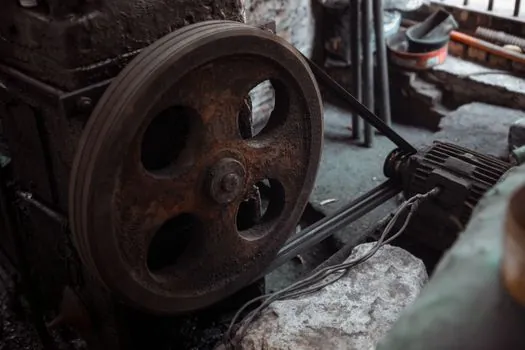
Mount the motor on a rigid foundation, align its shaft with the driven equipment, and verify that the shaft turns freely before electrical energization [S1]. Correct foundation alignment limits vibration, shaft loading, bearing wear, and premature coupling failure.
For direct coupling, check concentricity and angular alignment according to the coupling manufacturer’s limits. For belt drive, confirm pulley alignment, belt tension, shaft parallelity, and adequate guarding; excessive belt tension transfers radial load into the motor bearings and can damage the shaft or bearing housings [S1].
Chain and gear drives require correct sprocket or gear alignment, appropriate tension, and effective guarding. Keep the driven machine’s rotation free of binding before startup because a seized pump, conveyor, fan, compressor, or mixer can stall the motor and trip its protection [S1].
Do not switch motor rotation instantaneously. Reversing the motor while it is running can damage the motor and gearhead, so stop it before changing phase sequence or drive configuration [S6].
Protect the motor during delivery, storage, and commissioning
Inspect the motor on receipt for damaged terminals, missing terminal-box covers, bent shafts, contamination, moisture, and impact damage. Do not energize a motor with its windings visibly wet or with its terminal enclosure open [S1][S4].
During storage, protect the machine from moisture, dust, vibration, and unauthorized starting. Rotate the shaft periodically where the manufacturer specifies it, and keep electrical leads and insulation from exposure to contaminants [S1].
Before startup, confirm that the enclosure is closed, the fan and cooling path are unobstructed, the foundation and coupling are secure, the terminal arrangement matches the nameplate, the protective earth connection is complete, and the motor is mechanically free [S1][S4].
Verify rotation with the load uncoupled where the driven equipment permits it. If rotation is incorrect, stop the motor and correct the phase sequence; do not correct it by repeatedly starting and stopping the motor [S5][S6].
Troubleshoot motor symptoms by cause and action
If the motor hums but does not accelerate, first check for an open phase, restricted load, insufficient starting torque, or incorrect voltage. A stalled motor draws high current, so disconnect it from the supply and correct the mechanical or electrical cause rather than allowing repeated starts [S1][S2].
If the motor runs hot, compare running current with nameplate current, verify that cooling airflow is available, check terminal tightness, and confirm that the overload relay is correctly set. Excess current, mechanical overload, phase imbalance, or restricted ventilation can all raise winding temperature [S1][S2].
If the rotor turns in the wrong direction, stop the machine before exchanging any two supply phases. Running instant reversals can damage both the motor and the connected gearhead [S6].
If the motor is noisy or vibrating, stop it and inspect coupling alignment, belt tension, foundation fasteners, bearings, and load alignment. Continue operation only after the vibration and mechanical loading are brought within the equipment manufacturers’ limits [S1].
For a controlled comparison with another machine architecture, the AC Motor Installation Guide provides a broader commissioning context, while the Three-Phase Asynchronous Motor Types Compared article helps distinguish rotor and construction choices before equipment selection.
Starting current and machine inertia govern the starter
Direct-on-line starting imposes high current and torque on the motor, supply, coupling, and driven load. Where starting current exceeds the electrical system or thermal limits, use a soft starter or variable-frequency drive sized for the motor and load rather than changing the terminal connection without engineering review [S2].
A 50 Hz, 4-pole motor has a synchronous speed of 1500 rpm. The cited DRG-112M-4, rated 4 kW, runs at 1450 rpm at full load, corresponding to approximately 3.3% slip. At 250 kW, the DRG-355M-4 is listed at 1490 rpm and approximately 0.67% slip [S5].
The squirrel-cage asynchronous motor is suitable for most pumps, fans, compressors, conveyors, and mixers because its rotor has no brushes or external electrical connection. The absence of commutator and brush maintenance simplifies service, but starting torque, thermal limits, and load inertia still determine whether direct starting is acceptable [S4][S5].
When a medium-voltage VFD is selected, coordinate its cable length, motor insulation, grounding, and carrier-frequency limits with both drive and motor documentation. Installation should preserve the manufacturer’s cooling requirements because reduced speed can also reduce forced cooling from the motor fan [S1][S2].
Commissioning requires measured acceptance checks

Record nameplate data, supply voltage, frequency, phase-to-phase voltage balance, insulation resistance, and starting current before the first load. Compare measured voltage with the nameplate range and confirm that all three phases are present before energization [S1][S3].
Confirm that the motor accelerates to its rated speed without stalling and that running current remains within the nameplate value. Check shaft speed against the rated value; the expected slip relationship is s = (ns - n) / ns, where ns = 120f/p [S5].
Verify rotation, noise, vibration, bearing temperature, motor temperature, and fan operation after the machine reaches operating speed. A successful commissioning record should include the connection used, protection settings, measured voltage and current, direction of rotation, and any corrective adjustment made to alignment or guarding [S1][S2].
Schedule maintenance from the motor manufacturer’s manual and operating hours. Inspection points include windings, interior and exterior cooling surfaces, bearings, lubrication, shaft alignment, and, where fitted, slip rings for wound-rotor motors; large-frame machines also require defined checks for sleeve bearings and non-reverse ratchet mechanisms [S1].
Use the next maintenance interval to recheck bearing condition, vibration, current balance, and alignment, then compare those readings with the commissioning baseline. Any rise in current, temperature, vibration, or bearing noise that cannot be traced to load should trigger inspection before continued operation [S1].