The three-phase asynchronous motor, also called the three-phase induction motor, is the most widely deployed electric machine in industry. A balanced three-phase supply creates a rotating magnetic field in the stator; that field induces current in the rotor by electromagnetic induction, and the interaction produces torque. The rotor runs slightly slower than the rotating field, and this deliberate speed lag, called slip, is exactly why the machine is named asynchronous.
Because the squirrel-cage version has no brushes, slip rings, or permanent magnets, it is rugged, brushless, and almost maintenance free, which makes it the default prime mover for pumps, fans, compressors, conveyors, and machine tools. This guide decodes its types, slip and torque physics, efficiency classes, insulation and ingress ratings, rated-plate parameters, and the selection logic procurement engineers use before a purchase.
This guide is aimed at industrial purchasing engineers and design engineers. Across 6 chapters it covers rotor types, the slip and torque physics, IE efficiency classes, insulation and ingress materials, rated-plate decoding, and selection decisions, with 7 selection FAQs and manufacturer references, helping you build a complete induction-motor knowledge framework in 30 minutes. All parameters reference the IEC 60034 series (including 60034-1, 60034-5, 60034-6, 60034-7, 60034-12, and 60034-30-1), IEC 60085, and NEMA MG-1 public standards.
Chapter 1 / 06
What is a Three-Phase Asynchronous Motor
A three-phase asynchronous motor is a rotating electrical machine that converts three-phase AC electrical power into mechanical shaft power through electromagnetic induction. A balanced three-phase current set, with phases displaced by 120 electrical degrees, flows through a distributed stator winding and produces a magnetic field that rotates around the air gap at the synchronous speed. This rotating field sweeps past the rotor conductors, inducing a voltage and current in them per Faraday's law, and the induced rotor current interacts with the stator field to develop torque per Lorentz's force law. The names asynchronous and induction describe the same machine from two angles: induction names the cause, electromagnetic induction in the rotor, while asynchronous names the consequence, a rotor that must lag the rotating field.
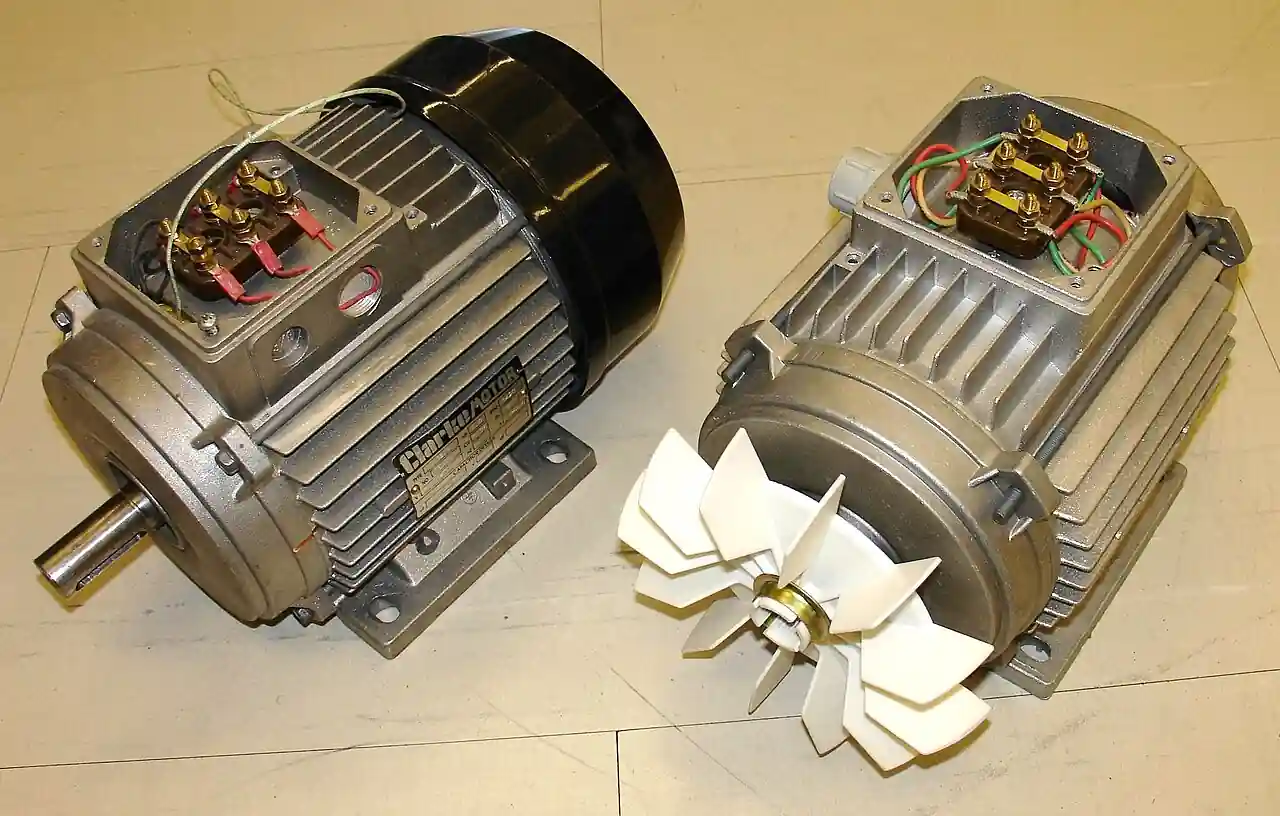
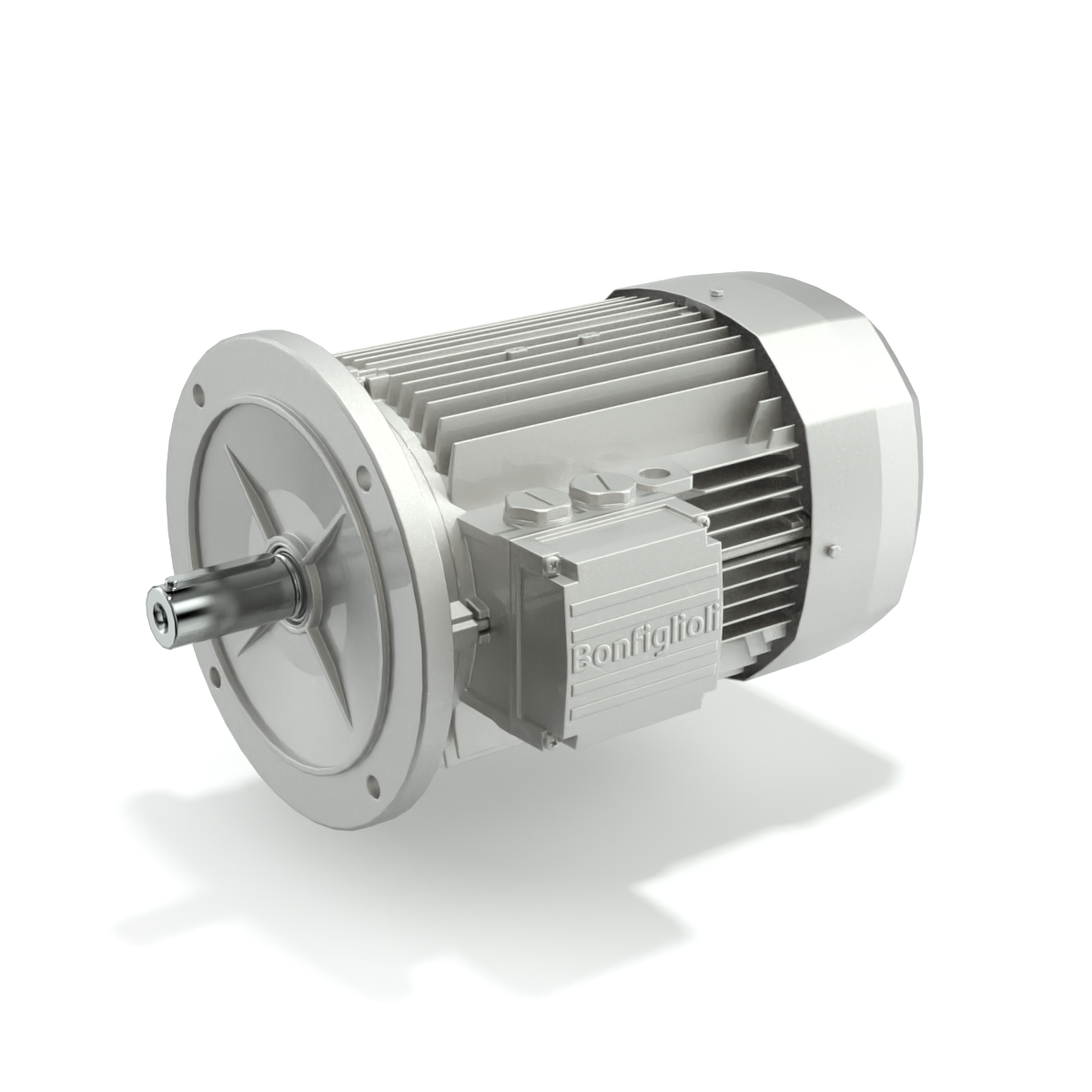
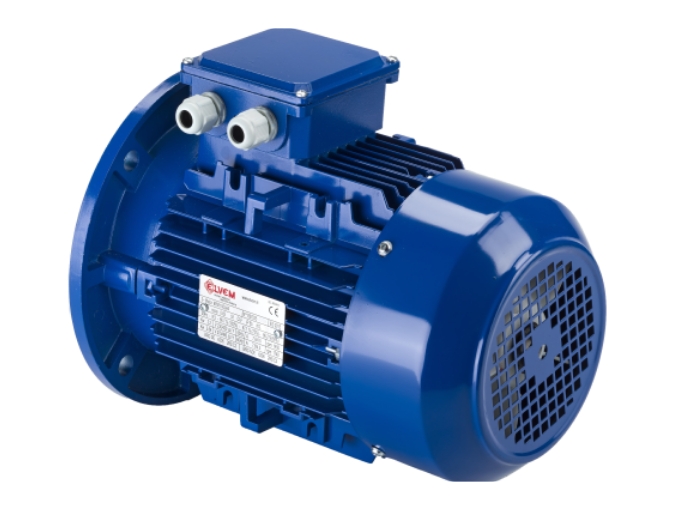
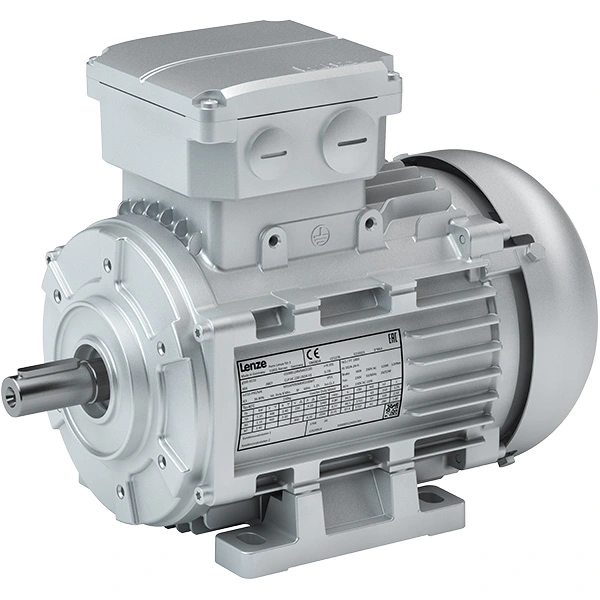
The structure has two electromagnetic parts and a mechanical frame. The stator is a stack of thin laminated electrical-steel sheets with slots carrying the three-phase copper winding; lamination and the silicon content of the steel keep eddy-current and hysteresis losses low. The rotor, also laminated, is either a squirrel cage of bare aluminum or copper bars short-circuited by two end rings, or a wound rotor carrying an insulated three-phase winding terminated at slip rings. Surrounding both is a cast-iron or aluminum frame with a terminal box, two bearings, a shaft, and, for a totally enclosed fan-cooled design, an external shaft-mounted fan and a finned housing that dissipates heat to ambient air.
The decisive operating fact is slip. If the rotor ever reached synchronous speed there would be no relative motion between field and conductors, no induced current, and therefore no torque, so a loaded induction motor always settles at a speed below synchronous. Slip is usually 1 to 5 percent at full load for standard cage machines, which is why a 4-pole 50 Hz motor with a 1500 rpm synchronous speed runs around 1440 to 1480 rpm in service. The frequency of the induced rotor current equals slip times line frequency, only a few hertz at running speed, which is what allows the rotor to be a simple short-circuited cage rather than a separately powered winding.
Historically, the polyphase induction motor was invented in the 1880s, with Galileo Ferraris demonstrating the rotating magnetic field and Nikola Tesla and Mikhail Dolivo-Dobrovolsky developing practical three-phase machines, the latter building the first three-phase cage motor around 1889. That topology has dominated industry ever since because it is electrically simple, mechanically robust, and directly compatible with the three-phase grid. Electric motor systems are estimated to consume on the order of 45 percent of the world's electricity, and three-phase induction motors make up the great majority of that installed base, which is why efficiency regulation focuses on them so heavily.
Four engineering metrics frame the quality of any induction motor: rated efficiency and power factor, the speed-torque (starting and breakdown torque) behavior, the thermal class and ingress rating that set service life, and the duty type the machine can sustain. These four, together with rated power, voltage, and frequency, determine whether a given motor will run a given load reliably for ten to twenty years, and they are the parameters decoded in the chapters that follow.
Chapter 2 / 06
Rotor Types and Classification
Three-phase asynchronous motors are classified first and foremost by rotor construction, because the rotor decides starting behavior, maintenance, and cost. The two families are the squirrel-cage rotor and the wound (slip-ring) rotor. Within the cage family, the cross-sectional shape of the rotor bars (single cage, deep bar, or double cage) tunes the starting-torque versus efficiency trade-off. The table below summarizes the principal rotor types and where each belongs.
Rotor Type
Construction
Starting Torque
Maintenance
Typical Applications
Single-cage
Bare bars, one end-ring set
Normal (NEMA B)
Very low
Pumps, fans, general drives
Deep-bar cage
Tall narrow bars, skin effect
High (NEMA C)
Very low
Loaded conveyors, compressors
Double-cage
Outer high-R, inner low-R cage
High (NEMA C/D)
Very low
Crushers, mills, hard starts
Wound-rotor
Insulated winding, slip rings
Very high, adjustable
Brushes, rings
Hoists, large mills, high inertia
Squirrel-cage rotor. The cage is a set of conductor bars, aluminum die-cast for small and medium frames or fabricated copper for larger ones, embedded in the rotor laminations and short-circuited at both ends by end rings. There are no electrical connections to the rotor at all, so there is nothing to wear out and nothing to maintain. The bars are usually skewed by about one stator slot pitch to reduce cogging, magnetic noise, and harmonic torques. The cage is the default choice for roughly the entire spectrum of fixed-speed and VFD-fed industrial drives because it is the cheapest, most rugged, and lowest-maintenance topology available.
Deep-bar and double-cage rotors. A plain single cage gives modest starting torque and high inrush. By exploiting the skin effect, where the slip-frequency rotor current concentrates near the bar surface at standstill, a deep, narrow bar presents high resistance at start (more torque, less inrush) and low resistance at running speed (good efficiency). The double-cage rotor takes this further with a high-resistance outer cage for starting and a low-resistance inner cage for running. These shapes are how a cage motor can be built to NEMA Design C high-starting-torque behavior without slip rings.
Wound-rotor (slip-ring) motor. Here the rotor carries an insulated three-phase winding whose terminals are brought out through slip rings and brushes. External resistance can be switched into the rotor circuit during start to raise starting torque toward 200 percent or more of full-load torque while simultaneously limiting inrush, then shorted out for efficient running. Historically this also gave a measure of speed control. Wound-rotor machines remain the answer for very high-inertia or hard-starting loads such as large ball mills, kilns, and hoists, but they cost more and demand periodic brush and slip-ring maintenance, so modern installations often replace them with a cage motor plus a variable-frequency drive.
A second classification axis is pole count, which fixes the base speed through the synchronous-speed formula, and a third is mechanical construction (mounting and enclosure). Motors are also grouped by frame size to the IEC system (for example IEC 56 to 355, where the number is the shaft-height in millimeters) or the NEMA system, which lets a motor from any compliant maker bolt straight onto a standard footprint.
Chapter 3 / 06
Slip, Torque, and the Speed-Torque Curve
The behavior of an induction motor is captured by its speed-torque curve, and reading that curve correctly is the single most important skill in matching a motor to a load. Synchronous speed is fixed by supply frequency and pole count through n_s = 120 x f / p. The actual shaft speed sits below it by the slip, s = (n_s minus n) divided by n_s. The table below lists the synchronous speeds that anchor the curve at the two standard line frequencies.
Poles
50 Hz synchronous speed
50 Hz typical full-load speed
60 Hz synchronous speed
2
3000 rpm
2850 to 2950 rpm
3600 rpm
4
1500 rpm
1440 to 1480 rpm
1800 rpm
6
1000 rpm
960 to 985 rpm
1200 rpm
8
750 rpm
720 to 740 rpm
900 rpm
Four points define the speed-torque curve. Locked-rotor torque (starting torque) is what the motor develops at zero speed, where slip equals 1. Pull-up torque is the minimum torque the motor produces while accelerating, the dip the load must clear. Breakdown torque (pull-out torque) is the peak the motor can deliver, typically near 75 to 85 percent of synchronous speed; beyond this peak any further load increase stalls the motor. Rated (full-load) torque is the steady-state operating point on the steep part of the curve near synchronous speed. A load whose torque demand ever exceeds the breakdown torque will pull the motor down and stall it.
At standstill the rotor behaves like the short-circuited secondary of a transformer, so a direct-on-line cage motor draws a large locked-rotor (inrush) current, commonly around 600 to 700 percent of full-load current for a NEMA Design B machine. This inrush falls toward rated current only as the rotor accelerates and slip collapses. The high inrush is the reason reduced-voltage starting exists: star-delta starting cuts starting current to roughly one third, a soft starter ramps the applied voltage, and a variable-frequency drive starts at low frequency so the machine draws little more than rated current while delivering full torque.
NEMA MG-1 codifies the trade-off between starting torque and starting current into design letters, summarized below. Matching the design letter to the load's own speed-torque curve is the core of a correct selection: centrifugal pumps and fans, whose torque demand starts near zero and rises with speed squared, are happy with Design B, while a loaded conveyor or crusher that must break away under load needs Design C or D, or a wound-rotor machine.
NEMA Design
Locked-rotor torque (% FLT)
Breakdown torque (% FLT)
Starting current
Slip at rated load
Typical loads
Design A
70 to 275
175 to 300
High
< 5%
High-inertia, custom
Design B
70 to 275
175 to 300
~600 to 650% FLC
< 5%
Pumps, fans, blowers
Design C
200 to 285
190 to 225
~600% FLC (low for torque)
< 5%
Loaded conveyors, compressors
Design D
~275 (high)
up to 275
Low
5 to 13%
Hoists, punch presses, flywheels
The corresponding international document is IEC 60034-12, which defines starting performance classes for single-speed three-phase cage induction motors. Whichever standard frames the data, the engineering logic is identical: confirm that the motor's locked-rotor and pull-up torque stay above the load's demand at every speed during acceleration, and that the breakdown torque carries a comfortable margin over the worst-case running load.
Chapter 4 / 06
Efficiency Classes, Insulation, and Enclosures
Because induction motors run continuously for years, their lifetime cost is dominated by the electricity they consume, and three construction attributes govern that cost and that service life: efficiency class, insulation thermal class, and enclosure protection. Each is set by a public standard, and each appears on the nameplate.
Efficiency classes (IE). IEC 60034-30-1 defines line-operated efficiency classes IE1 Standard, IE2 High, IE3 Premium, IE4 Super-Premium, and IE5 Ultra-Premium. Its scope covers single-speed three-phase cage motors from 0.12 kW up to 1000 kW, rated voltage above 50 V up to 1 kV, with 2, 4, 6, or 8 poles, at 50 or 60 Hz. Full-load efficiency rises with both power rating and class: a small machine may reach the mid-80 percent range while a large high-class motor approaches 96.5 percent. Crucially, the efficiency curve is fairly flat from about half load to full load and peaks near 70 to 80 percent load, which is why chronic oversizing wastes both efficiency and power factor. IEC 60034-30-2 covers drive-fed (variable-speed) motors as a separate scheme. Regional MEPS rules now mandate IE3 as the line-fed minimum in most major markets, with IE4 required for some ratings.
Insulation thermal class. IEC 60085 grades the winding insulation system by its maximum permissible hot-spot temperature: Class A 105 C, Class B 130 C, Class F 155 C, and Class H 180 C. The widespread long-life industrial practice is to build the motor with Class F insulation but operate it at only Class B temperature rise, about 80 K above a 40 C ambient. That deliberate margin roughly doubles expected winding life compared with running Class F insulation to its own limit, because insulation aging follows an Arrhenius rule where each extra 8 to 10 K of sustained temperature roughly halves life.
Enclosure and cooling. Ingress protection per IEC 60034-5 is given as an IP code: IP55, dust-protected and protected against low-pressure water jets, is the standard for totally enclosed fan-cooled (TEFC) industrial motors, while IP23 denotes a drip-proof open machine with better cooling but less sealing. The cooling method per IEC 60034-6 is given as an IC code, for instance IC411 for a totally enclosed machine cooled by a shaft-mounted external fan over a finned frame. Mounting per IEC 60034-7 uses IM codes such as IM B3 (foot-mounted) or IM B5 (flange-mounted). The table below maps the principal attribute standards.
One attribute deserves special attention for VFD-fed motors: the fast voltage edges of an inverter stress the winding insulation and can drive bearing currents that erode raceways. The standard countermeasures are inverter-duty insulation (reinforced and corona-resistant), an insulated or ceramic non-drive-end bearing, and a shaft grounding ring. IEC 60034-25 and the older IEC TS 60034-17 give application guidance for machines fed from converters.
Chapter 5 / 06
Key Rated Specification Parameters
The nameplate is the contract between the motor and the application, and every figure on it traces to a defined test. The same motor may show 15 or more fields across different makers, but only the parameters below truly drive a selection decision. Each is explained in turn.
Rated power and voltage. Rated output power is mechanical shaft power in kilowatts (or horsepower), not electrical input, and it is the value the motor can deliver continuously at the rated duty without exceeding its thermal class. Rated voltage is the line-to-line supply voltage, commonly 400 V or 415 V at 50 Hz and 460 V at 60 Hz for low-voltage machines, with the winding connection (star or delta) chosen to match. Per IEC 60034-1, a motor must operate within a voltage and frequency tolerance band (Zone A), and sustained out-of-band supply shortens life.
Rated speed and slip. The nameplate speed is the full-load speed, already reduced below synchronous speed by slip. A nameplate reading 1460 rpm on a 50 Hz motor signals a 4-pole machine (1500 rpm synchronous) running about 2.7 percent slip. Reading the slip off the nameplate is the quickest way to infer pole count and base speed.
Rated current, power factor, and efficiency. Rated (full-load) current is the line current at rated load and voltage and sizes the cabling and overload protection. Power factor for a three-phase induction motor is lagging, typically about 0.8 to 0.9 at full load, falling sharply at light load, which is why oversized motors hurt plant power factor. Rated efficiency is the IE-class figure discussed in Chapter 4. Power factor and efficiency both sag at part load, so loading a motor near its rated point matters.
Duty type (S1 to S10). IEC 60034-1 defines ten duty types describing the load-versus-time pattern the motor is rated for:
S1 Continuous duty: constant load held long enough to reach thermal equilibrium. The default for pumps, fans, and conveyors.
S2 Short-time duty: a constant-load period too short to reach equilibrium, followed by a rest long enough to cool fully.
S3 Intermittent periodic duty: repeated identical run-and-rest cycles, with starting current not significantly affecting temperature rise.
S4 to S5 Intermittent with starting (and braking): cycles where frequent starts, and electric braking in S5, dominate the heating.
S6 to S9: continuous-operation periodic duties with load or speed variation, up to S9 with non-periodic load and speed swings.
Ambient and altitude reference. Rated power assumes a 40 C cooling-air ambient and an installation altitude up to 1000 m above sea level, per IEC 60034-1. Above either limit the motor must be derated or specially designed, because thinner air and hotter ambient both reduce cooling. As a guide, output is typically derated for ambient above 40 C and for altitude above 1000 m; the maker's derating chart gives the exact factors.
Overload, service factor, and thermal protection. Beyond the rated point the motor can deliver short overloads but heats quickly; a service factor (common on NEMA machines, for example 1.15) defines a permissible continuous overload margin. Embedded thermal sensors per IEC 60034-11, typically PTC thermistors or PT100 RTDs in the windings, protect against sustained overload, blocked cooling, or single-phasing. Single-phasing, the loss of one supply phase, is a leading cause of burnout and is precisely what motor-protection relays guard against.
Chapter 6 / 06
Selection Decision Factors
To turn the preceding five chapters into a specific model, follow the decision sequence below. Most selection mistakes come not from a single wrong figure but from deciding a downstream detail before an upstream one. These eight steps work as a fixed RFQ template.
Load speed-torque profile: First plot the load's torque demand versus speed. Variable-torque loads (centrifugal pumps and fans) accept NEMA Design B; constant-torque hard-start loads (loaded conveyors, compressors) need Design C; very high breakaway or high-inertia loads (crushers, hoists) need Design D or a wound-rotor motor. Confirm the motor's pull-up and breakdown torque stay above demand throughout acceleration.
Power, poles, and base speed: Size rated kW for the actual operating point, allowing margin but avoiding chronic oversizing, then choose pole count to set base speed via n_s = 120 f / p. If variable speed is needed, plan for a VFD rather than oversizing.
Fixed speed versus VFD: Decide direct-on-line, star-delta, or soft-start for fixed speed, versus a variable-frequency drive for variable speed or soft starting. With a VFD, specify inverter-duty insulation, an insulated or ceramic bearing, and a shaft grounding ring.
Duty type and thermal class: Match the duty (S1 continuous through S9 variable) to the real cycle, and specify Class F insulation at Class B rise for long-life margin, with PTC or PT100 thermal sensors per IEC 60034-11.
Efficiency class: Meet or exceed the regional MEPS minimum (IE3 line-fed in most markets), and step up to IE4 or IE5 for high-runtime, energy-critical loads where lifetime energy dominates cost.
Enclosure, cooling, and mounting: Choose IP rating (IP55 TEFC is the industrial default, higher for washdown or outdoor), cooling code (for example IC411), and mounting (IM B3 foot, IM B5/B14 flange) plus the IEC or NEMA frame size that bolts to the driven machine.
Environment and certification: Confirm ambient and altitude derating beyond 40 C and 1000 m, vibration and balance grade, and hazardous-area Ex certification (ATEX / IECEx) if the area is classified. Verify on-site voltage, frequency, and phase availability.
Total cost of ownership (TCO): Sum purchase price, energy over the service life, maintenance, and downtime risk. For a high-runtime motor the lifetime energy bill dwarfs the purchase price, so a higher efficiency class and a correctly sized rating usually win on TCO even at a higher sticker price.
One last dimension is often overlooked: manufacturer serviceability, meaning local spare-frame and bearing availability, rewind support, and standardized frame and mounting dimensions so a failed unit can be swapped quickly. Mainstream suppliers of three-phase induction motors include ABB (M2BAX and M3BP cast-iron series), Siemens (SIMOTICS GP and the 1LA8 range), WEG (W22 series), Nidec (Leroy-Somer and U.S. Motors), Toshiba, Hitachi, and TECO-Westinghouse, all of which build to IEC and NEMA standard frames so motors are largely interchangeable across makers, an important hedge over a fifteen-year service life.
FAQ
What is the difference between an asynchronous (induction) motor and a synchronous motor?
An asynchronous motor, also called an induction motor, has no separately powered rotor field. The rotating stator field induces current in the rotor conductors by electromagnetic induction (Faraday and Lenz), and the rotor must run slightly slower than the synchronous speed so that relative motion, and therefore induced current and torque, exist. That speed lag is the slip, typically 1 to 5 percent at full load for standard cage designs, which is exactly why the machine is called asynchronous. A 4-pole 50 Hz motor with a 1500 rpm synchronous speed therefore runs about 1440 to 1480 rpm. A synchronous motor instead carries its own rotor field (DC-excited windings or permanent magnets) and locks to the stator field at exactly synchronous speed with zero slip until pull-out torque is exceeded. The three-phase squirrel-cage asynchronous motor is the rugged, brushless, low-maintenance workhorse behind most pumps, fans, compressors, and conveyors.
How do I calculate the speed of a three-phase asynchronous motor?
Synchronous speed is n_s = 120 x f / p, where f is the supply frequency in Hz, p is the number of poles, and 120 converts cycles per second into revolutions per minute. At 50 Hz a 2-pole motor gives 3000 rpm, 4-pole 1500 rpm, 6-pole 1000 rpm, and 8-pole 750 rpm; at 60 Hz the same pole counts give 3600, 1800, 1200, and 900 rpm. The actual shaft speed of an asynchronous motor is lower because of slip, defined as s = (n_s - n) / n_s, typically 1 to 5 percent at full load, so a nominal 1500 rpm 4-pole 50 Hz machine settles around 1440 to 1480 rpm. The slip frequency of the rotor current equals s times f. To change running speed, a variable-frequency drive varies f, while the pole count fixes the base speed.
What is the difference between a squirrel-cage and a wound-rotor asynchronous motor?
A squirrel-cage rotor is a set of bare aluminum or copper bars short-circuited by end rings, cast into the laminated rotor core, with no windings and no brushes. It is the cheapest, most rugged, lowest-maintenance design and the default for the overwhelming majority of three-phase drives. A wound-rotor (slip-ring) motor instead carries insulated three-phase rotor windings brought out through slip rings and brushes, so external resistance can be inserted during start to boost starting torque and cut inrush current, or for limited speed control. Wound-rotor machines suit high-inertia, hard-starting loads such as large crushers, ball mills, and hoists, at the cost of higher price and the maintenance burden of brushes and rings. For most pump, fan, and conveyor duties the squirrel-cage motor is the correct default.
What do the IE efficiency classes (IE1 to IE5) mean for asynchronous motors?
IE codes are the efficiency classes defined in IEC 60034-30-1 for line-operated AC motors, with a scope of 0.12 kW up to 1000 kW, rated voltage above 50 V up to 1 kV, 2, 4, 6, or 8 poles, at 50 or 60 Hz. The classes are IE1 Standard, IE2 High, IE3 Premium, IE4 Super-Premium, and IE5 Ultra-Premium, where each step targets a meaningful reduction in losses. Full-load efficiency typically ranges from roughly 84 percent for a small motor up to about 96.5 percent for a large high-class machine. In most markets the MEPS regime now mandates IE3 as the line-fed minimum, with IE4 required for some power ratings. IEC 60034-30-2 covers variable-speed-drive-fed motors separately. Because lifetime energy cost dwarfs purchase price on high-runtime loads, moving up one IE class usually pays back well within the service life.
What do NEMA Design B, C, and D letters mean for starting torque?
NEMA MG-1 design letters classify the speed-torque curve and starting current of polyphase induction motors. Design B is normal starting torque with normal (low) starting current and is the most common general-purpose choice, with locked-rotor torque commonly around 100 to 200 percent of full-load torque, breakdown torque up to roughly 200 to 300 percent, and slip under 5 percent; it suits pumps, fans, and blowers. Design A is similar to B but allows higher starting current and higher breakdown torque. Design C provides high starting torque (locked-rotor around 200 to 285 percent) with low starting current for hard-to-start loads such as loaded conveyors, compressors, and reciprocating pumps. Design D is a high-slip design (5 to 13 percent) with the highest starting torque, used for punch presses, hoists, and flywheel loads. Match the design letter to the load's speed-torque curve.
What insulation class and IP rating should an industrial asynchronous motor have?
Insulation class per IEC 60085 sets the maximum winding hot-spot temperature: Class A 105 C, Class B 130 C, Class F 155 C, and Class H 180 C. The common long-life industrial specification is Class F insulation used at Class B temperature rise (about 80 K), which leaves thermal margin and extends winding life. Ingress protection per IEC 60034-5 describes enclosure sealing: IP55 (dust-protected and protected against water jets) is typical for totally enclosed fan-cooled (TEFC) industrial motors, while IP23 covers drip-proof open machines. Cooling method per IEC 60034-6 is given as an IC code, for example IC411 means a totally enclosed machine cooled by a shaft-mounted external fan. For VFD-fed motors, additionally specify inverter-duty insulation and insulated or ceramic bearings to block harmful shaft currents.
Why does a three-phase induction motor draw such high inrush current at start?
At standstill the slip is 1, so the rotor behaves like a short-circuited secondary of a transformer and the motor draws a large locked-rotor current, typically about 600 to 700 percent of full-load current for a direct-on-line NEMA Design B machine. The current falls toward its rated value only as the rotor accelerates and slip drops. To limit this inrush and the resulting voltage dip and mechanical shock, engineers use star-delta starting (cuts starting current to about one third), a soft starter that ramps voltage, or a variable-frequency drive that starts at low frequency and draws little more than rated current. A VFD also removes the starting transient entirely and is preferred where the load also benefits from variable speed. Wound-rotor motors instead insert external rotor resistance to limit inrush while raising starting torque.
Three-Phase Asynchronous Motor Manufacturers
Source-backed product routes. Open a company dossier for procurement scope and cited evidence.