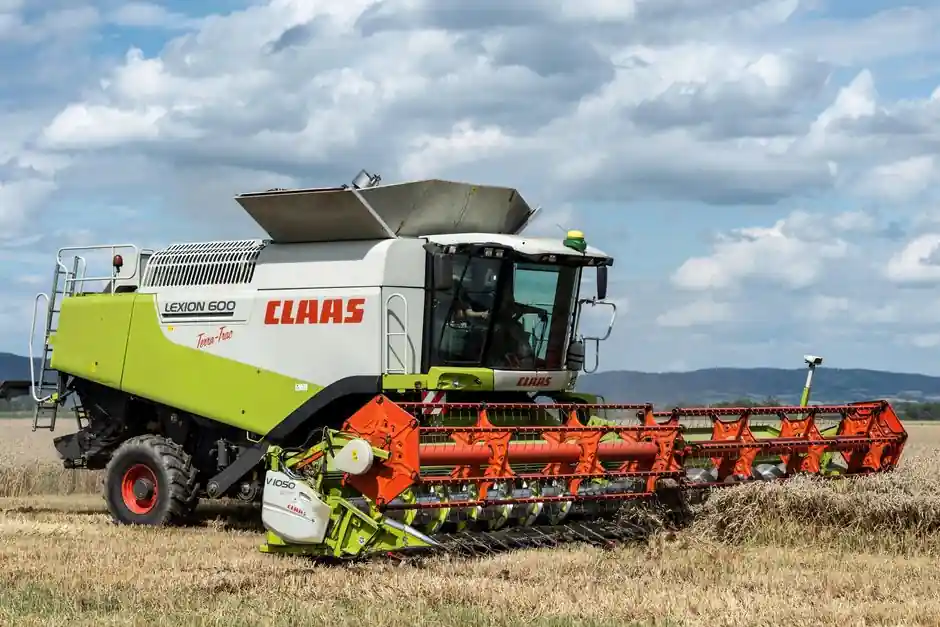
Agriculture equipment imposes some of the harshest loading profiles a thrust bearing sees in service: cyclic shock loads from tiller blades, continuous axial thrust from power-take-off (PTO) shafts, and contamination from soil, chaff, and fertilizer dust. Selection in 2026 still routes through three decision gates: load magnitude and direction, contamination sealing, and lubricant retention.
Chinese bearing factories now publish dedicated "Agriculture Bearings" lines alongside their general catalogue, with thrust ball, thrust roller, and spherical roller variants offered as stock items [S3]. Tier-1 agriculture parts suppliers such as Cixi To-King, founded 1996 and ISO 9001 certified since 1997, distribute matched bearing, shaft, and universal-joint packages to OEMs and the aftermarket across USA, Europe, and Africa [S4].
Load profile and direction: ball vs roller thrust
Thrust bearings carry axial load only; the rolling element determines the load ceiling. A thrust ball bearing handles moderate unidirectional thrust at moderate speed and is the default for planter metering drives, small seed-coulter pivots, and sprayer pump shafts, where typical specific loads sit in the low single-digit MPa range on the raceway [S3]. When axial load climbs above the ball-bearing envelope, the catalog switches to thrust cylindrical or thrust tapered roller variants, which spread load over a line contact and tolerate the cyclic shock spikes generated by rotary tiller rotors and baler plungers [S1]. For pivot housings on mounted implements that see both axial load and shaft deflection, a spherical roller thrust bearing accepts misalignment of a few degrees without inducing edge loading on the rollers [S3].
Contamination and sealing: the field-decisive gate
Agriculture thrust bearings fail more often from ingress than from fatigue. Rotary tillers such as the 1GQN-200 series operate in dry, abrasive soil at continuous-rated PTO speed [S5], so the bearing housing must integrate a multi-lip seal or a face seal plus a slinger, and the bearing itself should be packed with high-tack lithium or polyurea grease rated for dust and water splash. For fertilizer applicators, where ammonium nitrate and urea dust accelerate corrosion, 400-series stainless or chrome-plated raceways extend relubrication intervals; suppliers offering agriculture-specific lines document these as separate SKUs from their general industrial ball bearing stock [S3]. The non-equalizing tilting-pad design language used in heavy turbomachinery [S2] does not transfer down to field-scale machinery, where greased, sealed rolling-element bearings dominate.
Speed and lubrication: when oil bath beats grease
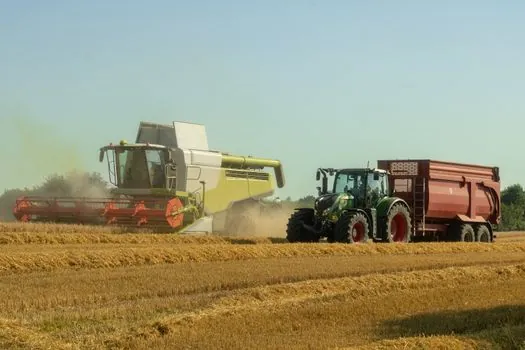
Greasable sealed units cover most tractor PTO and implement applications, but high-speed combine harvester threshing drums and large square baler cranks cross the line where oil bath or oil-mist lubrication becomes mandatory. In that operating envelope, the bearing selection logic converges with industrial practice: flooded or direct-lubricated tilting-pad thrust bearings (LEG, EQH, KingCole series) [S2] are used where continuous oil supply is guaranteed. For sub-PTO-speed gearboxes on planters and seed drills, a grease-packed roller bearing thrust variant remains the cost-effective default.
Material, cage, and clearance choices
Pressed-steel cages are standard on economy agriculture bearings; machined brass or polyamide 66 cages appear on higher-speed PTO units and on bearings destined for combines operating at sustained high rpm. C3 clearance is the typical field baseline, with C4 specified only when the housing expands under sustained solar load or when the shaft runs hot near an engine PTO adapter. For planting and fertilizing machines sold at FOB unit prices in the US$2,695-6,550 band [S5], bearing cost is a single-digit percentage of the machine price, so the design choice is rarely spec-driven by the buyer and instead is locked at the gearbox integrator level.
Comparison: thrust type vs agriculture duty
For a side-by-side spec view, the three principal thrust types line up as follows. Thrust ball: lowest cost, accepts unidirectional axial load only, suits low-to-moderate speed planters and sprayers, requires good sealing in dust [S3]. Thrust cylindrical or tapered roller: line-contact load capacity, handles cyclic shock from rotary tiller rotors, needs precise alignment or a spherical roller variant [S1][S3]. Spherical roller thrust: tolerates several degrees of misalignment, heavier and costlier, used in pivot housings on larger mounted implements [S3]. Sealed, grease-lubricated slewing bearing rings are reserved for rotary rakes and larger trailed implements where the structure itself rotates.
Failure modes and what to inspect at RFQ
Three failure modes dominate field returns: (1) brinelling from shock overload during tiller engagement, addressed by selecting a roller thrust variant with adequate static load rating; (2) seal failure and abrasive wear, addressed by specifying dual-lip seals and a grease-fill-and-relube schedule; (3) corrosion from fertilizer or manure exposure, addressed by specifying stainless or coated raceways on the application BOM. The procurement gate should require ISO 9001 certification, country-of-origin traceability, and a documented dynamic load rating (C) and static load rating (C0) for the chosen bore size, mirroring the discipline already applied by Tier-1 Chinese agriculture parts exporters [S4].
Standards and sourcing checkpoints
No agriculture-specific thrust bearing standard exists; the units are built to ISO 15 (rolling bearings, general plan), ISO 104 (boundary dimensions for thrust bearings), and ABMA tolerance classes ABEC-1 or ABEC-3 for general implement use, with the supplier's ISO 9001 quality system governing dimensional and material consistency [S4]. For OEMs buying in volume, the comparison article on linear motion bearing RFQ specs lays out the same load-rating, tolerance, and lubricant discipline that agriculture thrust bearing procurement should mirror, while the thrust bearing selection for food processing lines reference covers the washdown-grade stainless variants that occasionally cross over into fertilizer-handling equipment.
Trackable next signals for procurement teams: (1) whether major Chinese bearing exporters expand their agriculture-specific SKUs with documented C/C0 ratings rather than catalogue-only entries [S3]; (2) any new sealed-for-life spherical roller thrust offerings aimed at rotary tiller gearboxes, where dust-life remains the binding constraint.