Textile mill duty cycles concentrate axial load on ring frame lifters, calendar roll journals, and stenter chain sprockets, which is why the thrust bearing family dominates the rotating spares list. In spinning and weaving, the contaminants are not water or chemicals but airborne lint, fibre fly, and humid-room condensate, so sealing and lubrication carry as much weight as load rating [S2].
Working from the operating envelope, mill engineers should match three decisions first: the load direction (pure axial vs combined axial plus radial), the shaft speed band (typically 50–1,800 rpm on textile shafts, higher on calendar and printing rolls), and the contamination class (lint-laden humid air in cotton rooms, oil mist in knitting halls) [S2]. The reference stack for textile buyers built around Tianjin-based exporters, Pakistan mill rosters, and Indian processing houses confirms that the same part-number logic travels across yarn, fabric, and made-up segments [S1][S3][S5].
Where Thrust Bearings Sit in a Textile Mill
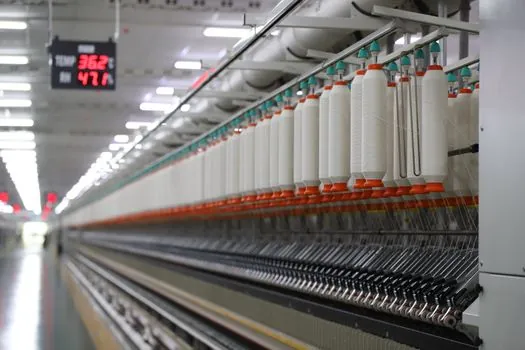
Spinning frames apply the classic case: a ring frame’s traveller and bobbin rail lift a constant downward axial load on the spindle, while the drafting roller applies a smaller combined load through the top roller bearings [S2]. A weaving loom’s crank and cam shafts see reversing axial pulses every pick, with peak loads often 2–3× the running mean during beat-up, and that shock component is the main driver for choosing a higher dynamic load rating C than steady-state maths would suggest.
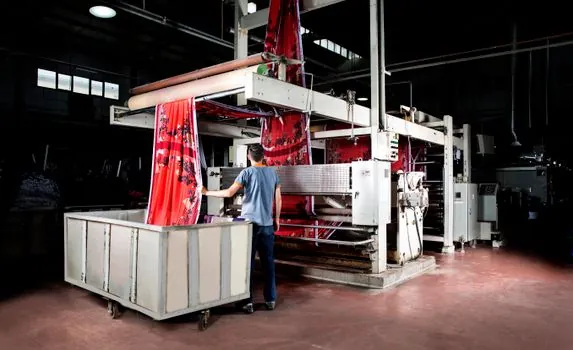
Wet-processing and finishing lines shift the problem. Calender, stenter, and printing-bowl rolls run slower but carry sustained axial thrust from hydraulic or pneumatic nip loading, often 10–30 kN per roll on wide-width lines. In those positions, axial-only ball bearings lose out to combined needle or tapered roller arrangements, because any radial mis-alignment in the roll stand shows up as edge loading on a pure thrust race. Across the sector, the dominant sub-types specified are single-direction thrust ball, cylindrical thrust roller, spherical thrust roller, and needle thrust, with paired angular contact used where combined load is the norm [S2][S4].
Selection Criteria That Actually Move the Spec
The first gate is load direction and magnitude. Pure axial thrust at moderate speed is the textbook case for a single-direction thrust ball bearing, but the moment a radial component exceeds roughly 10% of the axial figure, the conservative move is a tapered roller or paired angular contact arrangement instead [S2]. Dynamic load rating C should be sized for the L10 life target at the mill’s planned operating hours; on ring frames running 7,200 spindle-hours per year, the usual target is 40,000 hours minimum, which forces a C-value of 1.5–2.0× the simple equivalent load.
The second gate is speed, which is where bearing type sorts itself. Spherical thrust roller and heavy cylindrical thrust roller are typically capped near 300–600 rpm; thrust needle and small thrust ball units are the only realistic options above 1,500 rpm, and that is the band most drafting rollers, false-twist texturising spindles, and high-speed winders sit in [S2]. A common mis-spec in older mills is to drop a low-rpm spherical thrust into a winder because it was on the shelf, then chase a chronic grease-temperature alarm for the next 12 months.
The third gate is sealing and contamination. Cotton spinning rooms carry visible fibre fly above 5 µm; if the bearing is a non-contact shielded 2RS unit, that fly migrates past the seal in a few thousand hours. Textile-grade replacements for shaft-mount positions typically use 2RS contact seals with nitrile lips, or a labyrinth plus grease-retention plate for the most exposed positions like ring frame bottom rollers. Material choice on the seal matters: humidity in a typical cotton-spinning room sits at 55–70% RH, and at the high end standard NBR seals age faster, so FKM is worth the premium on bearing inserts that will not see routine re-greasing [S2].
Comparative Map: Bearing Type vs Textile Duty
For the four duty zones that show up in a mill audit, the shortlist looks like this. Ring frame spindles and top drafting rollers: paired angular contact 25–40 mm bore, light-contact 2RS, lithium-complex grease, C-target around 12–18 kN; budget gates out a single-direction thrust ball because combined loading is the rule. Loom crank and cam shafts: tapered roller, 30–55 mm bore, with a C at 1.8–2.2× equivalent load to absorb pick-cycle shock. Calender, stenter, and printing-bowl rolls: spherical roller bearing or heavy cylindrical thrust, 80–200 mm bore, with the seal upgraded to a felt-plus-labyrinth stack and oil-air or grease-bath lubrication rather than hand greasing.
By way of a one-line spec rule: pick a paired angular contact or tapered roller for combined load under 1,500 rpm; pick a single-direction thrust ball or ceramic hybrid above 1,500 rpm; pick a spherical or heavy cylindrical thrust roller for slow rolls with both high axial load and a risk of shaft deflection; and upgrade the seal and the lube regime in any position that sees visible fibre fly or condensate drip [S2].
Materials, Lubrication, and the Lint Problem
Through-hardened chromium steel (DIN 100Cr6 / AISI 52100) is the baseline for most textile mill bearings, and case-hardened variants extend the fatigue life on shock-loaded loom positions. In wet-processing plants where peroxide, sodium hydroxide, or strong detergent condensate can splash the bearing housing, the housing hardware should be 304 or 316 stainless and the bearing insert itself should be specified with a stainless or ceramic rolling element option, since standard carbon-steel races will rust through the seal in 6–12 months on those lines [S2].
Lubrication is the variable most often mis-set. Grease-lubricated thrust bearings in textile rooms generally run lithium or lithium-complex base oils with ISO VG 100–220 consistency; NLGI grade 2 is the safe default, grade 3 only where vertical shafts and drip loss are problems. For high-speed winders and texturising, oil-mist at 30–60 drops/min is standard because it carries heat away faster than grease and washes contamination out of the race. A simple mill rule is that any bearing running at a calculated speed factor n·dm above 300,000 mm·rpm should be reviewed for oil-mist rather than grease [S2].
Failure Modes and the Audit Tell-Tales
The four most common failure signatures in textile service are: (1) axial brinelling on ring frame bottom rollers from a dropped traveller or sudden stop, visible as flat-bottomed indentations across the line of contact; (2) grease purge and overheating on draft rollers run too long between re-lubes, often paired with a dark brown grease colour and a fall in top-roller surface speed; (3) seal lip wear with fibre ingestion on loom sley cams, where the tell is a whitish felt ring and a high-temperature cut on the inner race; and (4) microspalling on high-speed winder spindles from under-rated C and heavy cyclic thrust, typically caught only through vibration spectral analysis around the 3–5× running speed band [S2].
All four are specification failures, not maintenance failures, and they reappear predictably every 2–3 years on a mill that has not re-baselined its bearing list. The pragmatic fix is to keep a duty-zone map per machine family and to review it against the supplier’s current C, n·dm, and seal codes before each capital overhaul.
Who This Spec Is For, and Who It Is Not
This is for mill maintenance engineers, OEM textile machinery buyers, and procurement teams writing annual bearing contracts, particularly where the mill roster is dominated by yarn, fabric, and made-up producers similar to those listed in the Pakistan and India directories [S1][S3][S5]. It is also directly relevant to anyone specifying a new ring frame, loom, calendar, or stenter, because the bearing choice on the drawing is locked in for the next 20 years.
It is not the right guide for the high-precision, low-noise bearings used in low-shock office automation, nor for the slewing bearing class that turns up on large industrial cranes, wind turbines, or radar pedestals, which have very different load and speed envelopes. The same caveat applies to low-speed linear bearing slides on cutting tables: the failure physics is contamination and stick-slip, not thrust load. For those classes, the selection map and the duty zones are not interchangeable.
Procurement Reality and a 2026 Watch Item
Most textile-mill buyers continue to source from regional stockists and from Chinese export hubs (Tianjin, Wuxi, Wafangdian), with a typical enquiry to a Tianjin-based bearing trader covering thrust, needle, and ball lines from a single account for transport economy [S2]. Lead time is the single biggest variable, since the same mill may run a 3-day delivery on a standard thrust ball and an 8–12 week delivery on a matched-paired tapered set for a calendar roll, so the spec sheet has to allow for the long-tail parts separately from the catalogue consumables.
Specifying engineers should also cross-check their bearing choices against adjacent duty maps, including the related field spec guides for agricultural machinery and packaging lines, since the selection logic and the failure modes share more than the casual reading suggests, with sister coverage already published on thrust bearing selection for agriculture machinery and on thrust bearing selection for packaging lines.