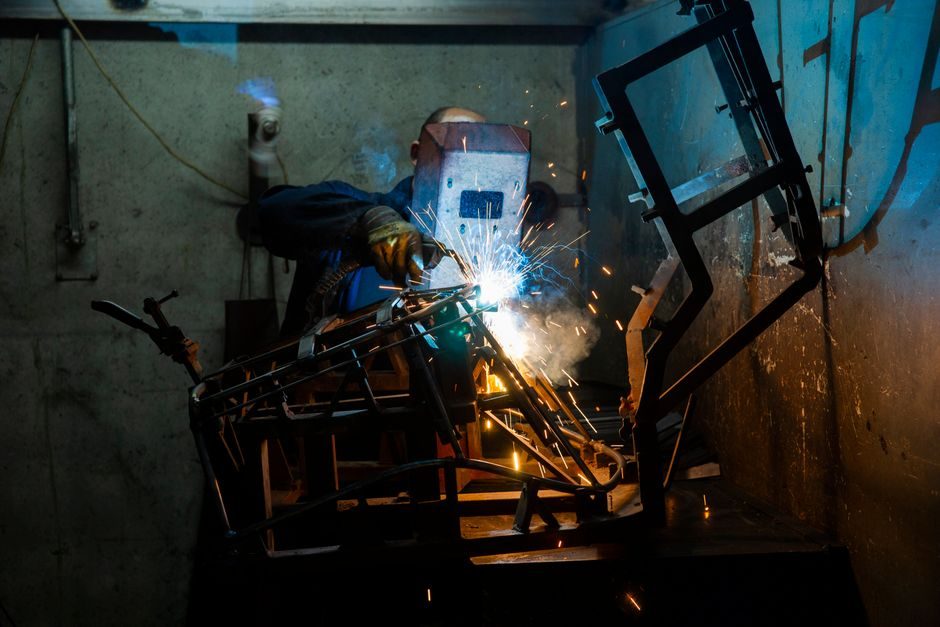
DC-only TIG platforms such as the TELWIN SUPERIOR TIG 421 DC ACC draw roughly 8,000 W from a 400 V three-phase feed for steel, copper, and stainless duty [S1]; adding AC capability on the SUPERIOR TIG 422 WAVE AC/DC AQUA jumps input to 12,900–17,300 W and extends the material list to aluminum via selectable AC waveforms (sinusoidal, square, optimised) [S2].
Both units straddle the industrial/professional line that defines the modern TIG market — inverter-based, multi-process (TIG + pulse TIG + MMA + spot), with USB data logging and EASY/PRO parameter modes on the WAVE OS, the same way an automated longitudinal seam welder like the Schnelldorfer ELENA ONE is offered in 600/1100/1300 mm weld lengths for thin-section tube production [S3].
Where TIG Wins on Spec and Why Process Engineers Specify It
TIG uses a non-consumable tungsten electrode and a separate hand-fed filler rod under inert shielding gas (typically argon), which is why the arc stays narrow, the heat input controllable, and the slag volume near zero — three facts that put TIG at the top of the food-grade, pharma, aerospace, and pressure-vessel weld procedure lists [S5]. Pulse TIG, now standard on mid-range AC/DC sets like the 422 WAVE, further trims heat input on thin sheet and stabilises the arc at low amperage, which is exactly the operating regime where MIG globule transfer and stick electrode stability both fall apart [S2].
Spec-relevant strengths observed across the 2026 product set: TIG handles exotic and dissimilar joints (stainless-to-carbon, copper-to-steel, titanium) without the spatter and post-grind that drag MIG workpieces demand [S5]; AC mode on the 422 WAVE adds adjustable cleaning area for aluminum and magnesium alloys [S2]; the THINSPOT utility on TELWIN sets gives repeatable spot welds on thin sheet without filler, replacing resistance spot where access is one-sided [S1][S2]. For selection context, see the TIG welder reference page.
Where TIG Loses: Throughput, Cost, and Operator Burden
Deposition rate is the headline cost penalty: TIG filler is fed by hand, arc travel speed is roughly half of a comparable MIG short-circuit transfer, and duty cycle drops on AC aluminium work where oxide cleaning forces the operator to keep a tight 2–4 mm tungsten stick-out [S5]. Compared with the HITBOX HBM200 3-in-1 semi-automatic on the consumer end (MMA/gasless MIG/LIFT TIG inverter) or a 567 USD hot-air banner welder, an industrial AC/DC pulse TIG set sits in a different cost bracket — the SUPERIOR TIG 422 WAVE AC/DC AQUA package with trolley, water cooling, and remote-control setup is a capital purchase, not a job-site tool [S2][S6].
Operator skill is the second tax: TIG demands two-handed coordination (torch in one hand, filler in the other, foot pedal for amperage on most professional sets), tungsten preparation (grinding to a point for DC, balling for AC), and pre-flow/post-flow gas management to avoid porosity — variables MIG largely hides inside a synergic curve. The TELWIN EASY mode auto-selects parameters from material + thickness inputs to compress that learning curve, but PRO mode still exposes every variable, and reviewers in the Jasic WS portable line specifically flag that hand-portable TIG units sacrifice the arc stability and duty cycle of a 17.3 kW floor model [S2][S7].
Decision Matrix: DC vs AC/DC vs Automated Longitudinal
DC-only TIG (e.g., SUPERIOR TIG 421 DC ACC, ~8.0 kW, 400 V 3-phase) suits carbon steel, stainless, and copper work where aluminium is not on the docket, and where the lower capital cost matters more than waveform flexibility [S1]. AC/DC pulse TIG (e.g., SUPERIOR TIG 422 WAVE AC/DC AQUA, 12.9–17.3 kW, 230 V single-phase or 400 V three-phase, trolley-mounted with water cooling) covers the full material matrix including aluminium and magnesium, supports EASY/PRO modes, and adds USB traceability — the de-facto shop standard for job shops and light fabrication [S2].
Automated longitudinal TIG (e.g., Schnelldorfer ELENA ONE, automatic seam, 600/1100/1300 mm weld length) targets high-repeatability thin-sheet tube and vessel production where manual dexterity is the bottleneck; the trade is fixed weld geometry and capital intensity in exchange for a documented 25-year design pedigree in seam welding [S3]. The Jasic WS portable family sits below all three on power and duty cycle, for site work and field repair where portability outweighs arc refinement [S7]. For related process context, the coding and marking equipment reference and core winding equipment overview show the same inverter-power, control-logic, and operator-skill axes that drive TIG selection.
Process Limits and Failure Modes You Spec Around
Hard limits consistently reported across the 2026 product range and the TWI technical note: TIG is uneconomical above ~6 mm plate on long production runs because deposition simply cannot match MIG spray-arc or flux-cored; tungsten contamination (the electrode touching the puddle or filler) sends the weld hard and produces a green-grey inclusion that fails radiographic inspection; AC aluminium cleaning balance, if set too far toward cleaning, eats tungsten and overheats the electrode, and if set too far toward penetration, leaves oxide smut on the surface [S2][S5]. Gas coverage is non-negotiable: post-flow time after arc extinction protects the cooling tungsten and the hot bead from oxidation, and on the WAVE OS platform the parameter is user-set rather than guessed [S2].
On the automated seam side, the ELENA ONE's thin-section remit is a hard constraint — push it onto thick plate and the arc length control loop saturates, bead profile goes convex, and the machine's 25-year seam-welding design lineage does not transfer [S3]. Across all TIG variants, shielding gas purity (typically 99.99% argon) and torch consumable quality are upstream variables that an OEM spec sheet cannot fix; the Jasic WS portable product line explicitly sells replacement torch kits and regulator packages alongside the welder itself [S7].
Comparable Welded-Joint Alternatives and When to Pick Them Instead
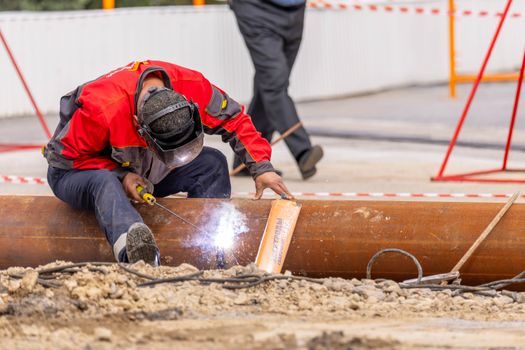
MIG/GMAW with a continuously fed solid wire is faster (higher deposition, less operator coordination), tolerates dirty or mill-scale base metal better, and is the right call for structural steel, automotive bodies, and any long fillet or lap joint — at the cost of spatter, higher heat input, and a bead that usually needs grinding before paint [S5]. MMA/stick remains the field-repair default because it needs no shielding gas and runs on cheap, portable inverter packs such as the 3-in-1 HITBOX HBM200 [S6]. Neither MIG nor MMA matches TIG on cosmetic bead, thin-sheet control, or non-ferrous welding.
For a shop deciding between a 17.3 kW AC/DC TIG floor model, a portable Jasic WS, and a longitudinal seam welder like the ELENA ONE, the decision criteria reduce to: material spectrum (steel/stainless only vs. add aluminum vs. fixed thin-sheet tube), production volume (low-mix job-shop vs. high-repeat automated), and operator pool (skilled TIG welders vs. semi-skilled MIG operators) — TWI's MIG vs TIG technical note frames the same three axes and the same verdict [S5]. The Lidar and ultrasonic-NDT supply-chain articles in this catalogue treat matching the tool to the test volume on the same logic: capital intensity tracks with precision demand.
Sourcing, Standards, and Trackable Signals
TELWIN's 2026 DirectIndustry listings confirm two production TIG platforms (DC-only 421 and AC/DC WAVE 422) sharing the WAVE OS control architecture, the THINSPOT thin-sheet utility, and a dust-protected air-tunnel cooling design that the vendor credits for electronics longevity [S1][S2]. Schnelldorfer's ELENA ONE confirms three standard weld lengths (600/1100/1300 mm) for thin-section longitudinal tube welds, with the vendor's 25-year seam-welder track record as the main commercial differentiator [S3]. Jasic's WS portable line and AliExpress-listed 3-in-1 inverters such as the HITBOX HBM200 anchor the consumer/portable end of the market below the 8 kW industrial threshold [S6][S7].
The cutting equipment reference and filling machine reference cover adjacent process lines where inverter power, control architecture, and operator skill follow the same selection logic as TIG platform choice.
Related analysis: Dynamic Balancing Machine Price and Cost Guide 2026.