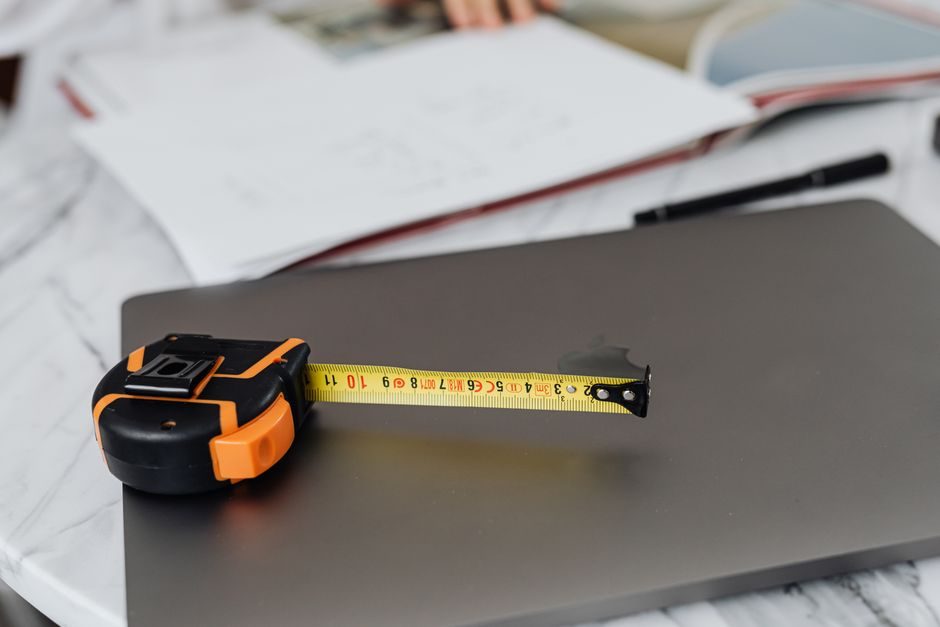
The two technologies are not interchangeable: a tilt sensor outputs an angle in degrees referenced to gravity, while a laser distance sensor outputs a linear range in millimetres referenced to a target surface. Each has its own accuracy, range, and environmental envelope, and the wrong choice typically fails inside 1-3 months of field operation rather than at commissioning.
This map lines the two up on range, accuracy, response rate, environmental rating, and integration effort using documented 2026 product data [S1][S2][S7], then points to selection gates for stackers, cranes, automated parking, and platform-level feedback.
What each sensor physically measures
A tilt sensor resolves the projection of the gravity vector onto its sensing axis, so its native output is angle (degrees, arc-minutes, or arc-seconds) with no line-of-sight requirement. The internal transducer class - MEMS, electrolytic, or servo - sets the practical resolution and bandwidth, but every variant shares the same gravity-referenced nature. [S1]
A laser distance sensor times a laser pulse or triangulates a spot, so its native output is distance to a surface along a beam axis. The PRECITEC OPTRONIK CutBox Pro publishes a 0.1-30 mm range on a 0-10 V / ProfiNet interface aimed at laser-cutting head stand-off [S1], while the Pepperl+Fuchs VDM28-15-L1-IO/73c/110/122 specifies a 15 m detection range on a red Class 1 laser with an IO-Link interface [S7]. At the long-range end, the Dimetix DPE-30-500 covers 50 mm to 500,000 mm with 0.7 mm repeatability on analog and digital outputs [S2].
Range, accuracy, and bandwidth compared
On a one-line decision metric: tilt wins for sub-millimetre angular resolution over short, fixed mounting points; laser distance wins for long, flexible, and variable standoff. The Dimetix DPE-30-500 lists a maximum measuring rate of 250 Hz with 1 mm accuracy and a 1 kHz output rate option [S2], which is roughly the order of magnitude faster than a typical MEMS tilt channel but at a different physical quantity.
For perspective: a 1 degree tilt change on a 1 m boom lifts the boom tip by about 17.5 mm - easily within the 0.7 mm repeatability band of the DPE-30-500. That is the core engineering reason the two technologies are complementary, not redundant: tilt is a local angle, laser distance is an absolute or relative position downstream of that angle.
Selection criteria by use case
Use a tilt sensor when the question is "is this platform, boom, or structure level, and by how much" - concrete examples include scissor-lift platform levelling, vehicle chassis attitude, solar tracker angle, and tower plumb. Spec gates are measuring range in degrees (commonly ±10, ±30, ±60, ±90), single- vs dual-axis, zero-bias stability over temperature, and IP rating. [S1]
Use a laser distance sensor when the question is "how far is the target from this point" - stacker-crane position over a 30 m aisle, automated parking car-pallet profiling, crane-to-wall clearance, or laser-cutting head stand-off. The Tianjin G-TEK product line explicitly addresses stackers, cranes, and automatic parking systems, and Dimetix positions the D-series for exterior solar-irradiated surfaces and dark targets with IP65 sealing [S2][S6].
Limits, failure modes, and what to watch
Tilt sensors degrade in two characteristic ways: thermal zero-bias drift on MEMS, and electrolytic-fluid damping collapse at low temperature. Spec the operating temperature window against the worst-case site exposure, not the annual average, and check the cross-axis sensitivity if the mount can rotate. [S3]
Laser distance sensors fail for four reasons: beam obstruction (dust, steam, snow, rain), target specularity (mirror, glass, polished metal), window contamination, and interference between adjacent sensors. Pepperl+Fuchs publishes laser class 1 eye-safe status for the VDM28-15-L1 [S7], but class 1 only governs the eye-safety hazard - not the measurement reliability. Long-range units like the DPE-30-500 work "on dark surfaces - even in exterior applications with solar irradiation" per the manufacturer [S2], but that capability is not transferable to every supplier's model.
Integration, networking, and software
Fieldbus and configuration footprint is now a hard selection gate. The CutBox Pro offers EtherCAT or ProfiNet with 2x analog inputs and 2x analog outputs (out 1: 0-10 V, out 2: -10 to 10 V) [S1]. The Dimetix DPE-30-500 supports Profibus, PROFINET, EtherNet/IP, and EtherCAT as optional interfaces, with serial and a high-precision analog output at 0.1% [S2]. The Pepperl+Fuchs VDM28-15-L1 ships IO-Link [S7].
On the configuration side, Dimetix provides a free Windows-only configuration tool and a separate PolyDist monitoring / data-logger package [S3]; sourcing teams should treat Windows-only tooling as a lifecycle risk for headless or Linux-based PLC estates. Open-source reference designs such as the festlv/laser-distance-sensor repository show USB and serial output topologies that engineering teams can fork for prototyping before committing to a vendor SDK [S4].
Cost, lead time, and sourcing signals
Pricing is configuration-driven, so the spec sheet matters more than the sticker. A short-range triangulation unit with 0-10 V and IP65 will list in a different tier than a long-range time-of-flight unit with EtherCAT, ProfiNet, EtherNet/IP, and Profibus options across an extended -40 to +60 degrees C envelope [S2]. Chinese suppliers such as Meskernel and Tianjin G-TEK emphasise short-range laser measurement modules, while European suppliers (Precitec, Dimetix, Pepperl+Fuchs) hold the long-range and high-precision tier [S1][S2][S5][S6][S7].
For related cross-category guidance on the tilt side, see Tilt Sensor Selection Criteria: Spec Gates for MEMS, Electrolytic, and Servo Units; for cost-stack mechanics that affect sensor module budgets, see Load Cell Module Price 2026: What Moves the Cost Stack; and for complementary selection logic on a related process instrument, see Solenoid Valve Pressure Rating: Compatibility Map and Selection Gates.
Trackable signals to watch: supplier-published revisions to the D-series, CutBox Pro, and VDM28 firmware notes over the next two quarters; IO-Link adoption rate in long-range laser distance products beyond the current 15 m Pepperl+Fuchs unit; and any new -40 to +60 degrees C ratings on MEMS tilt channels that close the industrial outdoor gap. The decision is rarely tilt OR laser - it is tilt AND laser, with the angle as the upstream signal and the distance as the downstream position.