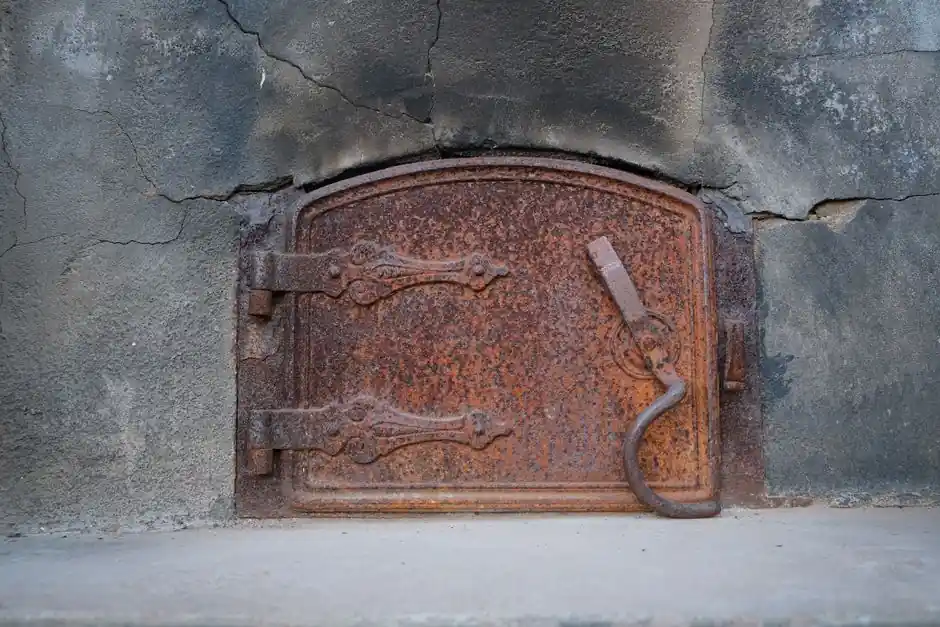
Tilting rather than stationary holding furnaces now feed most new direct-chill (DC) aluminium billet casting operations, with the trend driven by a fully open front for clean draining, faster alloy changeover, and tighter launder-level control [S1].
Reference casthouse lines pair a stationary side-well melter of 100 t/charge and 12 t/h melt rate with a 50 t/charge tilting holding/casting furnace, sized to keep the launder fed without thermal stratification during 6-16 in. billet casting [S4].
Why tilt: draining, changeover, and metal-cleanliness gain
Tilting holding furnaces have a fully open front that allows the operator to drain the bath completely between alloy changes, eliminating the heel of mixed-alloy metal that a stationary pot would retain [S1]. The same geometry lets dross and oxide skins be skimmed out of the bath in one motion rather than raked across a fixed spout, a measurable benefit when feeding extrusion-grade 6xxx and 7xxx aluminum alloy families where Fe and alkali-metal pick-up controls the billet crack rate.
For a 152 mm diameter billet, DC open-top casting runs at roughly 110-130 mm/min, and any pause in launder feed shows up as a cold shut on the billet shell, so the holding furnace is sized for a steady pour rather than peak melt demand [S3]. Tilting also gives the operator a controlled pour angle into the downspout, which matters on closed (hot-top) moulds where the float must sit at a fixed level inside the water-cooled copper mould.
Typical capacities, melt rates, and firing systems
Casthouse reference builds cluster around 50-100 t/charge holding furnaces fired on natural gas, with melt rates of 10-12 t/h on the upstream melter and 1-2 t/h holding trim on the casting furnace [S4]. Regenerative burners are standard on the melter (AMFS-100-RGN, 100 t/charge, 12 t/h) to cut fuel use, while cold burners (ACFT-50, 50 t/charge) are common on the tilting holding/casting furnace where flame impingement on the bath surface would otherwise raise dross [S4].
Electric resistance and induction holding furnace variants are also in service: Almex USA's patented DC casting line couples an induction melter with an in-line filter to remove inclusions before the launder, addressing the cleanliness ceiling of gas-fired pots [S5]. For plants that route metal through a separate launder, a tilting rotary furnace can discharge clean metal into the holding bath or directly toward the casting line, combining melting and transfer in one vessel [S6].
Front-end equipment: charging, skimming, stirring, and launder
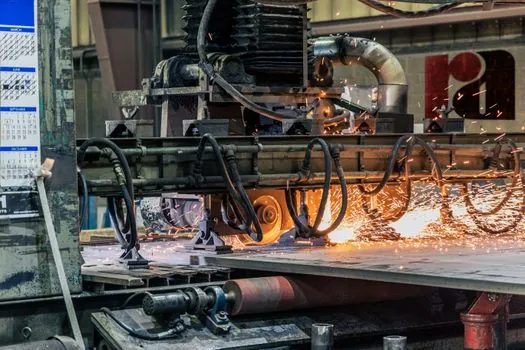
Around the tilting furnace the cashtable is a matched set, not a stand-alone box. A 15 t scrap-charging car (ASCM-15) with a 28 m³ charge box, 6-8 min charge cycle, and SIEMENS S7-1200 PLC control drops returns into the melter front door, while an automatic on-rail dross skimmer travels the same rails to remove oxide and stir the bath [S4].
An ABB ORZ-320 electromagnetic stirrer on a trolley forces convection in the holding bath, equalising temperature before the launder and breaking the thermal gradient that drives settling of intermetallics. From there the metal flows through refractory downspouts into the mould; on a hot-top table, mould-to-platen alignment must hold within 0.1 mm to keep the starter block concentric, and the level in the mould is the controlled variable that ties the holding furnace pour rate to casting speed [S3].
Selection: tilting vs stationary vs crucible
Choose tilting when the line runs multiple alloys, when drain-cleanliness on alloy change is a contractual requirement, or when the mould table sits below furnace floor level and a launder pour is preferred over a fixed spout. Stationary gas aluminum melting furnace pots still win for single-alloy, high-utilisation extrusion plants where the heel is not a problem and the lower capital cost justifies the operational compromise [S1][S2].
For batch flexibility, small R&D cast houses, or schools, crucible furnaces remain the default, but they are not specified for production DC casting above a few tonnes per shift. Electric resistance holding is preferred where emissions limits or noise rules rule out gas firing, while induction is preferred where metal cleanliness (low H, low Na) is the bottleneck [S5][S7].
Integration with downstream casting and homogenising
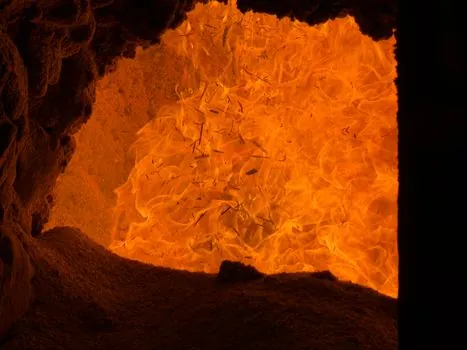
Once the holding furnace is pouring, the rest of the line is fixed: billet diameters of 6-16 in., a 14 t/h continuous homogenisation furnace with an inline automatic billet saw, a 50 t/charge batch homogeniser, a 50 t/charge cooling cabinet, a transfer car, and a billet saw rated for hot cut up to 16 in. [S4]. Pneumatic marking, load-cell weighing, automatic destacking, and stripping systems close the loop so each billet is traceable from launder to saw.
The downstream casters referenced in this article (DC vertical) differ from high-pressure aluminum die casting machine cells, which use a small holding furnace beside the shot end to keep the die at a stable set-point rather than feed a continuous launder; the operating philosophy and capacity class are not interchangeable [S7]. For OEM process engineers weighing furnace type against an extrusion billet line, the practical question is never "what is the best furnace" but "which furnace matches the alloy range, the casting speed, and the changeover frequency the order book demands" [S2].
Trackable signals for the next planning cycle
Two metrics are worth monitoring on any 2026 casthouse RFQ: the ratio of holding-furnace capacity to upstream melt rate (target is roughly 4-5x the hourly melt rate, to absorb charge-car cycles and skimming events without launder-level drift), and the number of alloy changes per shift, which is the single biggest driver of tilting vs stationary payback [S1][S4]. Regulatory pressure on NOx from gas-fired aluminum alloy holders is also pushing more projects to specify regenerative burners on the holding furnace as well as the melter, a 2026 spec trend visible in tender documents and OEM brochures [S2].
This topic is covered further in SPF Roofing: Foam Density, Elastomeric Topcoat Thickness, and Reroof Specs.