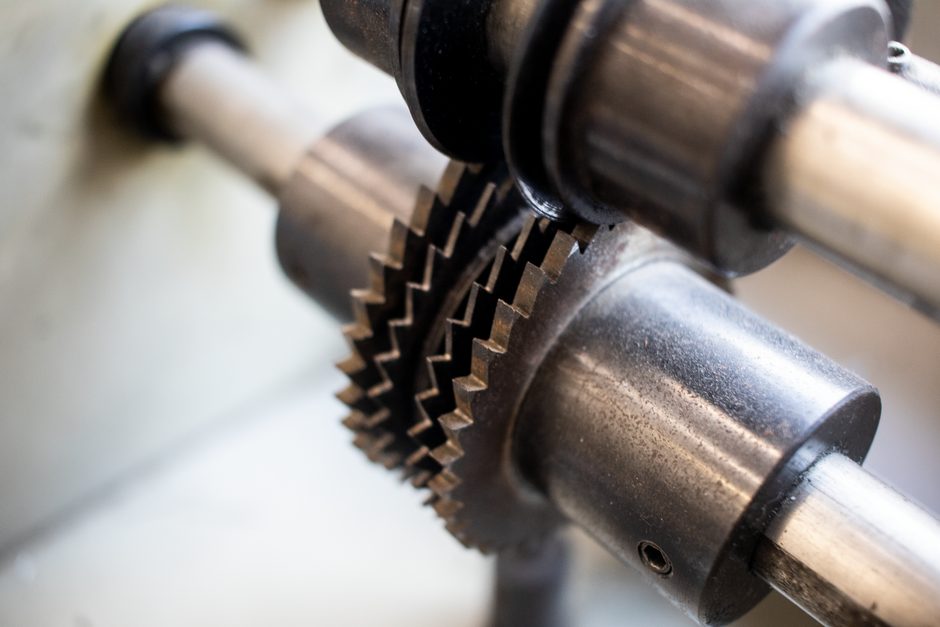
In pharmaceutical packaging, filling and tablet-press conveyors, the spec that decides 10-year drive life is not horsepower — it is material grade paired with tooth profile, and 316 stainless steel paired with an HTD or GT2/GT3 curvilinear tooth is the safe default [S3].
A timing pulley is a toothed wheel that meshes with a synchronous belt to deliver slip-free, ratio-exact power transmission, with ratios set purely by tooth count (e.g. 20T drive + 40T driven = 2:1 reduction, 2× torque multiplication) [S3]. On a 200 mm/s axis that single-percent slip typical of V-belt drives would already pile up 2 mm/s of cumulative position error — unacceptable in a blister-line indexing station.
Why 316 Stainless Steel Dominates Pharma Spec Sheets
316 stainless steel is the default material for timing pulleys in food, pharmaceutical, marine and outdoor service because of its corrosion resistance to CIP chemicals and acidic actives [S3]. Compared with anodized 6061 aluminum, whose surface hardness can be pushed to roughly 60 HRC by hard-coat anodizing versus ~30 HRC untreated, 316SS sacrifices the cost-and-weight advantage to gain chemical resistance that anodized layers simply cannot match in repeated caustic washdown [S3].
Spec sheets from MISUMI confirm hard clear anodize on aluminum timing pulleys reaches about 300 HV film hardness — a meaningful upgrade for dry indoor drives, but still vulnerable to pitting under prolonged chloride exposure typical of pharmaceutical clean-in-place routines [S6]. For fill-finish isolators, barrier-isolated RABS, and any sub-zone classified ISO 7 or cleaner, 316SS is therefore the conservative choice.
HTD and GT2/GT3 Profiles vs. Trapezoidal MXL/XL/L/H
HTD (High Torque Drive) and Gates GT2/GT3 curvilinear profiles deliver 20–40% higher torque capacity than trapezoidal MXL, XL, L and H profiles at the same pitch and width, with lower noise and longer belt life [S3]. That delta comes from the rounded tooth shape distributing contact stress across the tooth face instead of concentrating it at the root, the classic failure site of trapezoidal XL and L timing belts under reversing load.
Pitch choices map to power: MXL at 2.032 mm pitch handles sub-0.5 kW in medical instruments and miniature actuators; XL at 5.08 mm covers 0.5–3 kW; L and H step up for higher loads [S3]. A practical 14M HTD timing pulley with 55 mm belt width, as catalogued by Amironic, uses steel or cast-iron bodies with zinc-plated steel flanges and is typical of higher-power conveyor lines rather than cleanroom-located drives [S9].
What NOT to Specify in a Pharmaceutical Cell

Plastic timing pulleys in acetal or nylon are rated for light duty only, with very low power capacity and moderate durability [S3]. They are inappropriate for anything above 0.5 kW and cannot survive repeated steam-in-place or aggressive CIP chemistries; spec them only on low-noise, non-metallic, light-load requirements such as a bench-top lab labeler.
Cast iron timing pulleys in HTD 14M-55 execution are also a poor fit inside pharma envelopes because cast iron corrodes in chloride-rich washdown and sheds iron oxide into the surrounding ISO-classified air [S9]. Use them only in the grey-space mechanical room outside the cleanroom envelope, and route the belt through a sealed pass-through if it must cross the boundary.
Series-by-Series Selection for Common Pharma Stations
For tablet-press feed screws, blister-line indexers and small cartoning drives in the 0.1–1 kW range, a 36-tooth XL pulley in 316SS running against a matching XL belt is a typical fit; XL pitch 5.08 mm, 0.5–3 kW power band, aluminum-primary in general industry but upgraded to 316SS for pharma [S3]. For higher-throughput conveyors in the 1–5 kW range, step up to L or H series, again in 316SS, and use a 14M HTD curvilinear profile if the line is a new build [S3].
Standard 1008 / 1210 / 1610 / 2012 taper-bushed timing pulleys are the workhorses in the Martin Sprocket catalogue, with pilot-bore options in sizes from 18 to 40 teeth at 100 mm wide for L-series and similar for H-series [S4][S5]. SIT's catalogue adds flanged variants down to T2.5/T5/AT5/T10 pitches with 0.6 mm to 1 mm flange thickness, useful for miniature instrument drives inside isolators [S7].
Surface Finish, Lubrication and Belt Pairing Rules
Electropolished 316SS to Ra ≤ 0.8 μm is the pharma-hygienic surface target, and pairing with an FDA-grade polyurethane or neoprene timing belt with reinforcing fiberglass or steel tensile cords keeps the contact chemistry inert [S3]. Gates GT2/GT3 belts in 9, 12, 15, 20, 25 mm widths with corresponding width correction coefficients (1.00, 1.67, 2.67 for 2GT) are the cleanest drop-in for new lines [S8].
For broader drive fundamentals and how timing pulleys fit alongside V-belt, flat-belt, idler and rope pulleys, the timing pulley reference and the timing belt selection reference lay out the standard series and their pitch-power envelopes. For dry indoor pharma-adjacent mechanical rooms where light V-belt sheaves still appear, a flat belt sizing walk-through sets out the power-width-tension logic those legacy drives still follow.
Trackable Signals Worth Watching
Two signals are worth tracking over the next 6–12 months: (1) wider availability of electropolished 316SS HTD 14M pulleys in the 20–60 tooth range, since today's pharma-grade offerings cluster in the MXL/XL/L window [S3][S9]; (2) belt manufacturers pushing AT5/T10 flanged steel-core constructions into validated cleanroom SKUs to replace the heavier HTD 14M-55 steel-and-cast-iron assemblies currently dominating conveyor spec sheets [S7][S9].
Spec-level background on the components involved: pressure transmitter.