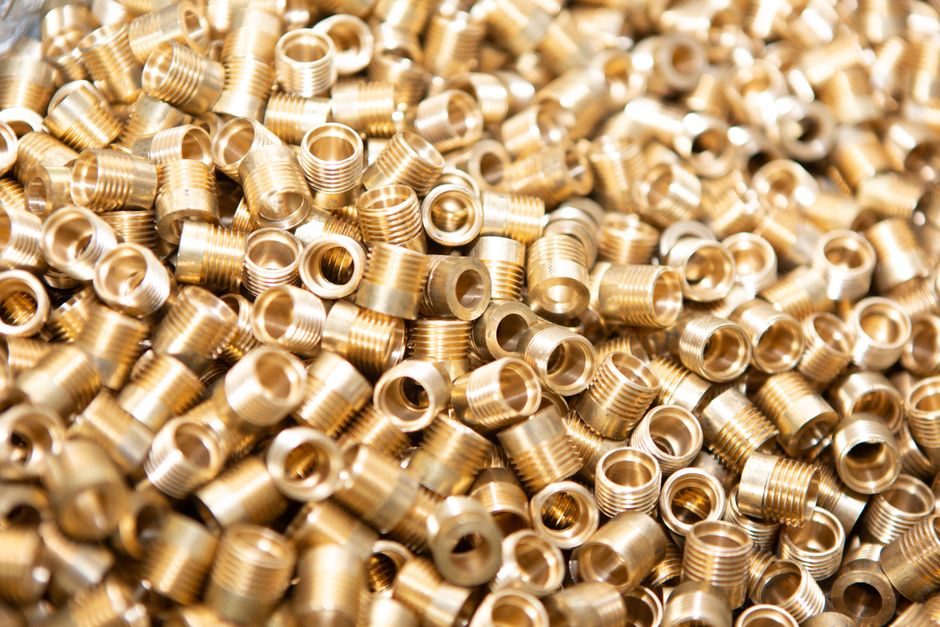
Tin bronze is a copper-tin alloy family, most commonly specified in the 1% to 22% tin range with optional zinc, lead, nickel or phosphorus additions, classified under the UNS C90000-C94700 designation series.
Industrial buyers in 2026 typically select from a small set of standardised casting or wrought grades — most often UNS C90300, C90500, C90700, C91000, C92200, C93200 and C95400 — each pinned to a specific ASTM B-series casting or rod/bar product standard. The right grade is set by required hardness, machinability, pressure rating and corrosion media, not by brand. For buyers who treat tin bronze as a generic phrase, the first mistake is ordering by "bronze bar" instead of by UNS number plus ASTM product form.
Composition Bands and What Tin Actually Does
Tin is the primary strengthening element in copper-tin alloys: each 1% tin addition can raise tensile strength by roughly 10-15 MPa within the workable 5-12% range, while also improving elastic limit and wear resistance in sliding contacts [S4]. Below 5% Sn the alloy behaves close to pure copper; above 15-20% Sn the material becomes hard but brittle, so most industrial castings stop near 10-12% Sn. Phosphorus (0.1-0.5%) is added to form a hard Cu3P phase in bearings and gear blanks, while zinc (1-10%) acts as a deoxidiser and a cost diluent, and lead (1-25%) is introduced purely to break chips and improve machinability rather than for mechanical strength [S2][S4].
For seawater resistance, the historical rule still holds: tin bronze was the default boat-fitting alloy before stainless steel, and the tin-rich surface oxide layer is what slows further corrosion in chloride media [S2]. This is why marine-grade tin bronze still specifies ≥4% Sn even when strength requirements are modest.
UNS/ASTM Grade Map for Common Buyer Use Cases
For sleeve bearings and bushing blanks, the most specified casting grade is UNS C93200 (high-leaded tin bronze, ~7% Sn, ~7% Zn, ~6% Pb) under ASTM B584, prized for emergency lubrication behaviour when the oil film fails. For gear blanks, worm wheels and pump impellers, UNS C90700 (~11% Sn, low Zn, no Pb) and C90500 (~10% Sn, ~2% Zn) under ASTM B505 / B584 give a hard, fine-grain structure suitable for moderate-load sliding gears. For valve bodies, fittings and pressure-containing components in potable water and steam, UNS C90300 and C92200 (naval bronze, ~6% Sn, ~4% Zn) under ASTM B61 / B62 / B584 are the historical default, with C92200 specified where dezincification resistance is needed. [S1]
For structural and high-load parts, aluminum-bronze and manganese-bronze (UNS C95400, C86300) are often selected instead, but those technically sit outside the tin-bronze family even though they are catalogued as "bronze" in trade listings [S3]. A buyer who wants wear resistance plus corrosion resistance in one alloy should compare: C93200 (best machinability, moderate corrosion), C90700 (highest strength in the tin-bronze band, harder to machine), C92200 (best for valves and water service), and C95400 (true aluminium bronze, best corrosion and load capacity but lowest machinability and different chemistry).
Mechanical and Physical Numbers That Drive the Decision
Typical as-cast tensile strength for these grades sits in a tight band: C90300 at 275-310 MPa, C90500 at 310-345 MPa, C90700 at 345-415 MPa, C92200 at 240-310 MPa, and C93200 at 200-260 MPa. Hardness tracks the same direction: C90700 at 80-100 HB, C90500 at 75-95 HB, C92200 at 65-80 HB, C93200 at 50-65 HB. Elongation drops as tin climbs: C93200 can reach 10-15% in 50 mm, while high-tin C90700 often sits at 8-12% [S4].
Density for Cu-Sn alloys is 8.7-8.9 g/cm³, only slightly below pure copper, so weight-driven designs (marine hardware, hand tools) gain little from a tin-bronze swap. Electrical conductivity falls sharply with tin: pure copper is ~100% IACS, while C90700 sits near 12-15% IACS and C93200 around 15-18% IACS — meaning tin bronze is never specified for electrical current paths.
Standards, Documentation and the Buyer's Checklist
Most industrial procurement is locked to ASTM product standards, not generic descriptions: ASTM B22 for bridge and turntable bronze bearings, ASTM B61 for steam- or valve-containing bronze castings, ASTM B62 for composition bronze (C92200) castings, ASTM B66 / B67 for wear- and corrosion-resistant UNS C93200-type castings, ASTM B271 for heavy-section sand castings, ASTM B505 for continuous cast bar, ASTM B584 for copper-alloy sand castings general, and ASTM B140 / B139 for wrought rod and bar. European procurement often references EN 1982 (Cu-Sn castings) and EN 12163 / EN 12167 (wrought rod, bar, profiles) alongside the UNS number. [S2]
A useful buyer-side checklist before placing a mill order: (1) UNS number and ASTM/EN standard written into the PO line, (2) required tensile / yield / hardness with explicit test report requirements (e.g. EN 10204 3.1), (3) chemistry range with upper/lower limits rather than nominal, (4) casting method (sand, centrifugal, continuous) where it affects porosity, (5) machining allowance, especially for continuous-cast bar where the skin is harder, and (6) for potable water or food contact, the regional drinking-water approval (e.g. UBA list, 4MS, NSF/ANSI 61). The Chinese customs lookup page for "tin bronze" as of 2026-05-17 returned no matching HS-code / anti-dumping entries for the bare term, meaning the alloy is generally imported under chapter 74 (copper) subheadings 7403 / 7407 / 7411, with the exact code set by product form rather than alloy name [S1].
Common Pitfalls and Failure Modes

Three failure modes dominate field returns on tin-bronze parts: dezincification in high-zinc grades exposed to stagnant chlorinated water (mitigated by choosing C92200 / C90300 with controlled Zn and adding tin suppression), wear in poorly lubricated bearings when a low-tin, low-lead grade was specified where C93200 was needed (the lead phase carries the emergency-lubrication role), and cracking in high-tin continuous-cast bar caused by unmachined skin or improper stress-relief. Overuse of leaded tin bronze in potable water service is also a recurring compliance issue in regions that follow the 4MS common composition list. [S3]
Buyers sourcing for sliding-contact parts such as linear guides and crossed roller guides — where bronze is sometimes used as a recirculating element in heavy-load or low-noise variants — should note that the bronze specified for those guides is almost always a high-leaded C93200-type or a sintered bronze, not the structural tin bronzes used in valve bodies, and the ASTM line item will reflect that.
Sourcing Channels, Lead Time and Price Levers
Three channels dominate 2026 procurement: (1) direct mill orders for OEM volumes (continuous cast bar, sand castings to drawing) — lead time 30-60 days for castings, 15-30 days for stock-size bar; (2) copper-alloy distributor stock in C93200, C95400 and C95410 bar/plate — same-week shipment for catalogue sizes; (3) importers sourcing under HS 7403 / 7407 / 7411 from Chinese foundries, typically 30-45 days sea freight plus 10-15 days release, with no anti-dumping entry on the "tin bronze" query result in 2026-05 [S1]. Price in 2026 is set first by copper cathode (LME) and tin (LME) on the order date, second by conversion cost, third by machining allowance.
Two trackable signals for the rest of 2026: monitor LME tin (used in tin-bronze, but also in solders and lead-free brass — demand crossover moves price), and confirm any change in UBA/4MS or NSF/ANSI 61 listing status for leaded grades if your part touches drinking water. For a wider read on material grade selection in industrial buying, the stainless steel buying guide for 2026 covers the parallel grade/form/finish logic on the ferrous side and is worth cross-referencing before locking a PO. For a complementary read on copper-alloy usage in fluid-handling parts, the process gas analyzer buying guide 2026 and the ball bearing buying guide 2026 both touch on material selection in adjacent component families.