
Tin bronze is a copper-tin alloy family in which tin (typically 4–20 wt%) drives strength, hardness and corrosion resistance, with smaller additions of zinc, lead, nickel or phosphorus used to tailor a specific duty. The selection decision is fundamentally a match between alloy grade, mechanical duty, and fluid environment rather than a single universal "best" alloy.
For an engineering buyer, the practical frame in 2026 reduces to four levers: required UNS/CDA grade family, mechanical duty (static pressure vs sliding wear vs corrosion), applicable casting or wrought spec, and post-machining tolerance band. The guidance that follows maps each lever to the grades a sourcing engineer will actually be offered on RFQ.
Tin Content Bands and Their Mechanical Consequence
Tin content below roughly 5 wt% is dominated by alpha-phase copper, giving high ductility, good thermal/electrical conductivity, and a relatively low as-cast tensile strength — these lean toward architectural and electrical uses rather than load-bearing parts. As tin climbs into the 5–10 wt% band, alpha+delta microstructures develop and tensile strength rises sharply, with elongation dropping; this is the workhorse window for general-purpose valve and pump bodies (C83600 / C84400 / C90300 family). Pushing tin above ~10 wt% introduces more hard delta phase, raising hardness and wear resistance at the cost of ductility and impact toughness — the rationale for heavy-duty bearing bronzes such as C90500, C91100 and C91300. [S1]
Beyond roughly 20 wt% tin the alloy becomes brittle and commercially impractical, which is why published grade tables cap at C91700 (~12% Sn) and the high-tin journal alloys. Buyers specifying "as strong as possible" should also accept a lower elongation and plan for thicker, more generously radiused sections; specifying "tough and machinable" means holding tin in the 5–8% band and accepting a softer matrix. This tradeoff is what makes tin bronze selection genuinely a multi-criteria decision rather than a single number to maximise.
UNS / CDA Grade Family Map by Duty
The cast copper-tin family splits into a handful of named alloys that an RFQ almost always quotes against. C83600 (leaded red brass, ~5% Sn, ~5% Pb, ~5% Zn) is the dominant plumbing/valve alloy where pressure tightness and free-machining matter more than peak strength. C90500 (gun metal, ~10% Sn, ~2% Zn) sits in the middle, widely used for general-purpose valve bodies, gear blanks and pump impellers handling non-seawater service. C90300 (~8% Sn) is the classic Navy "G" bronze, while C92200 (~6% Sn, ~3% Zn, ~1.5% Pb) targets steam and pressure-vessel valve trim. C91100 and C91300 (~16% Sn) are the high-tin journal bronzes, specified where sliding contact loads and fatigue resistance dominate. [S2]
For buyers cross-referencing standards: ASTM B584 covers sand-cast copper-tin alloys including the C8xxxx valve series; ASTM B505 covers continuous-cast equivalents; ASTM B22 covers the higher-tin bearing bronzes such as C863 and C911. Where the spec must hold against a maritime or chemical environment, common supplementary requirements include dezincification resistance tests (per ISO 6509 or equivalent) and NACE MR0175 compliance for sour service, though the latter is more often applied to aluminium-bronze and copper-nickel families than to the standard tin bronzes above. A spec sheet that omits the casting method (sand vs centrifugal vs continuous) is a flag — the same grade can show 10–20% spread in elongation between sand and centrifugal castings of C90300.
Pressure, Wear and Corrosion: Who Tin Bronze Is FOR vs NOT For

Tin bronze is FOR general industrial valves and fittings up to roughly ANSI Class 300 working pressure, gear and worm-wheel blanks, sleeve and thrust bearings in moderate-load rotating equipment, marine hardware outside of long-term seawater immersion, and pump/impeller bodies in fresh water and many process chemicals. The combination of moderate strength (typical as-cast tensile 240–310 MPa for C90300/C90500), reasonable wear resistance, and a self-lubricating tin-oxide surface film is what keeps this family specified across valve, pump and gearbox catalogues. [S3]
Tin bronze is NOT the right answer for sustained, high-velocity seawater service (copper-nickel C70600/C71500 or aluminium bronze C95400 outperform it), for sour H2S service where NACE MR0175 governs, for very high pressures above the cast bronze rating (forged steel or cupronickel takes over), nor for applications demanding the thermal conductivity of pure copper — the tin additions measurably reduce conductivity. Specifying a high-tin grade like C91100 for a low-load valve body is also a mistake: the buyer pays for wear resistance that is unused, while making the casting harder to feed and machine. The standard bronze valve alloys, often referenced inside industrial valve catalogues, are the safer general-purpose pick.
Selection Criteria Comparison Across the Main Options
Lining the common grades against four decision criteria — tensile strength, machinability, seawater suitability, typical cost band — gives a structure a sourcing team can apply directly to a supplier shortlist. C83600 reads as the easiest to machine (free-cutting leaded red brass), lowest cost, and adequate for fresh-water valves but unsuited to seawater. C90500 is the all-rounder: ~310 MPa typical tensile, good machinability, and tolerable in brackish water but not long-term immersed seawater. C91100/C91300 trade away machinability and ductility for the highest wear resistance in the family. C95400 aluminium bronze is not strictly a tin bronze but is the comparison point buyers should keep in mind when seawater or higher strength is the driver — its strength is roughly double C90500, but the alloy system, casting practice and cost band are different. [S1]
A simple comparison: for a 100 mm nominal-diameter valve body in fresh water, C83600 and C90500 will both pass a standard hydrotest, with C90500 giving a meaningful safety margin in pressure-cycle service; for the same valve on a shipboard seawater line, neither is first choice and copper-nickel or aluminium bronze should be quoted instead. Buyers evaluating similar selection logic for a different alloy family will recognise the pattern used in the steel fiber spec selection frame — match grade to the dominant failure mode, not to the cheapest line on the quote sheet.
Casting Method, Machining Allowance and Inspection
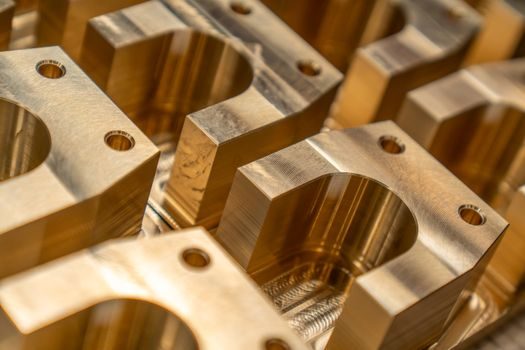
Casting method controls mechanical spread more than most buyers realise. Sand castings (ASTM B584) deliver the most uniform properties in thick sections and are the default for valve bodies above ~50 mm wall thickness. Centrifugal castings (ASTM B271) align grains radially, lifting fatigue and pressure-cycle performance in cylindrical parts like sleeves and bushings — at the cost of higher tooling cost on small batches. Continuous cast (ASTM B505) bar and tube stock is the lowest-cost option for machined parts produced from bar, with property anisotropy aligned along the cast axis. [S2]
Machining allowance on as-cast surfaces is typically 1.5–3 mm per side for sand castings and 0.8–1.5 mm for centrifugal or die-cast equivalents; a buyer who calls out tight "as-cast" tolerances in the RFQ is implicitly accepting scrap rates of 15–30%, which is worth flagging back to engineering. Standard inspection points for a bronze casting RFQ in 2026 include: chemical composition per ASTM E478 or OES, tensile and elongation per ASTM E8 on separately cast test bars, hardness (typical Brinell 60–85 for C83600, 75–100 for C90500), pressure test or radiographic examination for pressure-containing parts per ASME B16.34, and dimensional report against the 2D drawing. Where the part feeds into a pressure transmitter or flow meter manifold, the body alloy also needs to be checked against the instrument's wetted-material list — a common audit finding is a bronze manifold specified where 316L or alloy 20 was actually required by the process.
Sourcing Signals and Common RFQ Pitfalls
Three signals in 2026 sourcing data: lead time for sand-cast bronze valve bodies in the C83600/C90500 family is sitting at 6–10 weeks from Chinese and Indian foundry clusters, with continuous-cast bar stock at 2–4 weeks. Minimum order quantity at foundry level is typically 200–500 kg per heat for sand castings, falling to 50–100 kg for continuous cast bar. [S3]
Two pitfalls to flag in any bronze RFQ: first, a spec sheet that names "tin bronze" without a UNS number is unquotable to a serious foundry — always pin CDA/UNS grade. Second, mixing leaded and lead-free grades on the same drawing is a common source of contamination at scrap-based furnaces; if the application is a potable-water line (e.g. NSF/ANSI 61 or WRAS), the leaded C83600/C84400 family is not acceptable and the lead-free C89836 or C90300 should be substituted. Watch the next 1–2 quarters for revisions to ASTM B584 and B505 and for any tightening of copper-alloy restrictions under the EU Drinking Water Directive, both of which are likely to re-grade a portion of currently specified bronze valves.