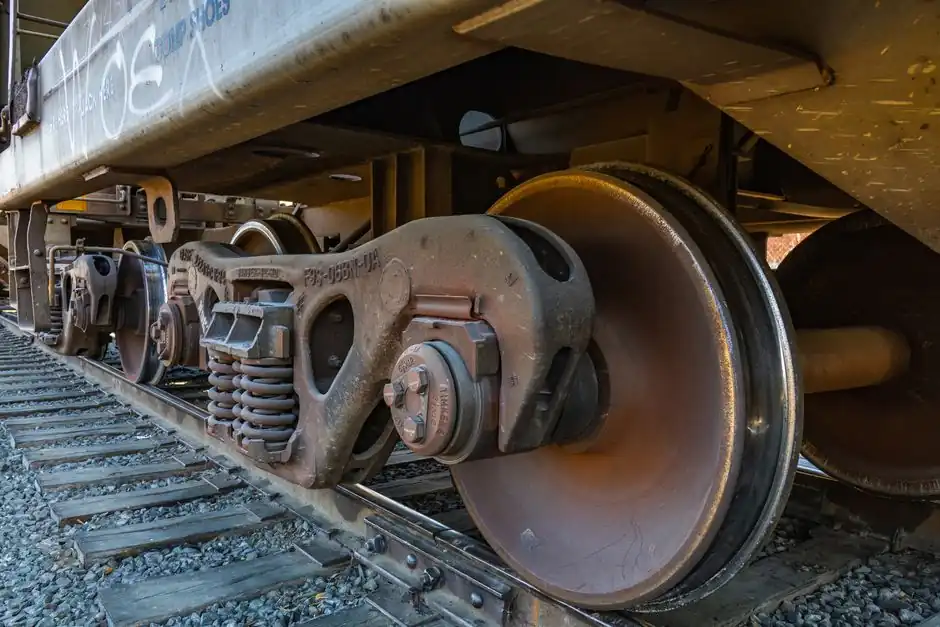
Rail rolling stock is the next structural frontier for titanium outside aerospace: high-speed trains, metro bogies, brake piping, and overhead catenary clamps are all candidates where the 4.43 g/cm³ density and ~895 MPa minimum tensile of Ti-6Al-4V (Grade 5) offset the 4–8× material cost versus structural steel [S1][S4].
The rail market in 2026 is not buying titanium for the prestige; it is buying it for mass savings, corrosion resistance to de-icing salt and brake dust, and galvanic isolation where carbon-fibre composite is co-moulded. Suppliers such as Baoji Sino-Swiss Titanium hold roughly 5,000 tons of stock across tube, rod, plate, and wire to feed those programs [S1].
Why the rail specifier is reaching for titanium in 2026
The hard numbers driving adoption are density 4.43 g/cm³, roughly 60% that of steel, and 30% higher specific strength than comparable austenitic stainless grades at room temperature, per stockist technical data published on Baoji Sino-Swiss Titanium's product page [S1]. Strength retention to 1,000°F (~538°C) makes the alloy family compatible with under-floor exhaust routing, brake caliper hardware, and catenary dropper zones where summer surface temperatures routinely cross 200°C [S1].
For a 16-car high-speed trainset, secondary mass reduction on brake piping, battery trays, and pantograph support brackets can shift unsprung mass enough to extend wheel-rail life; that is the engineering case, not the marketing case. Bulk mill-product pricing for titanium bar in the open Chinese export market runs $19–$55 per kg FOB on go4worldbusiness listings, a wide band that reflects grade, temper, and finish rather than spot volatility [S3].
Grade map: CP titanium, Ti-3Al-2.5V, Ti-6Al-4V
Three grades cover roughly 90% of rail-relevant mill product. Commercially pure Grade 2 (CP2) is the workhorse for cold-formed brake air pipes, HVAC ducting, and any welded joint where ductility and corrosion resistance outweigh strength; Grade 5 (Ti-6Al-4V) covers bogie brackets, bolster covers, and pantograph base castings/forgings where 895–1100 MPa UTS is the requirement; Ti-3Al-2.5V sits between them and is the alloy of choice for hydraulic lines, seamless tubing, and hydrogen line fittings where weldability and moderate strength (≈620–790 MPa) are both required [S1].
A compact comparison for the specifier's desk:
CP Grade 2: density 4.51 g/cm³, UTS 345–550 MPa, excellent cold formability, the lowest cost per kg, the natural pick for non-structural piping and architectural trim.
Ti-3Al-2.5V (Grade 9): density 4.48 g/cm³, UTS 620–790 MPa, weldable, the standard alloy for seamless hydraulic and fuel tubing, well suited to brake lines under EN 45545 fire-smoke constraints.
Ti-6Al-4V (Grade 5): density 4.43 g/cm³, UTS 895–1100 MPa, the workhorse for structural brackets and forgings, restricted above ~315°C in pressure-containing service per common ASME B31.3 practice for titanium pipework.
For readers cross-checking material families, the titanium alloy reference page collates grade designations and ASTM/UNS equivalents; for the steel baseline being displaced, alloy steel is the relevant comparator on cost-vs-mass and weldability.
Spec gates that fail titanium bids quietly
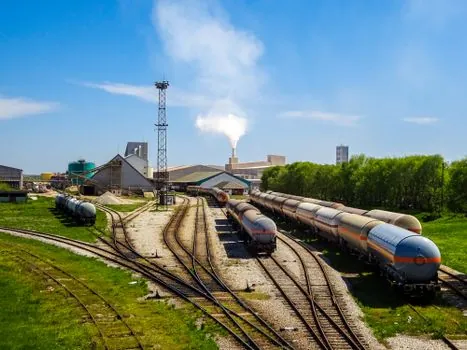
Titanium is unforgiving of three things in a rail bid: galvanic coupling to carbon steel, hydrogen pickup during acid pickling or electroplating, and fire-smoke toxicity. A Ti-6Al-4V bracket bolted to a carbon-steel bogie frame without an EPDM or nylon isolation sleeve will corrode the steel within months; titanium is the cathode in the couple. Hydrogen contamination above roughly 150–200 ppm embrittles CP and alpha-beta grades, so any pickling must use inhibited HNO3-HF baths and post-bake cycles per ASTM B600 [S1].
Fire, smoke, and toxicity are governed by EN 45545-2 hazard levels; titanium's intrinsic oxide layer keeps it in the R1 grouping for most geometries, but the organic sealant or coating system applied to it can drop the rating. Specify the coating, not just the substrate, in the data pack. Daido Steel's medical-implant datasheet is a useful reminder that low specific gravity and corrosion resistance are baseline, not differentiators, for any modern titanium product line [S5].
Form factor and fastener choices that show up on the BOM
Flat-point, cup-point, dog-point, and ball-point socket set screws in titanium are stocked for bogie door hardware and interior fitting retention; Ningbo Huashen Yulu lists nine point geometries under its "Titanium Alloy Series" SKU family, sold as drop-in replacements for A2/A4 stainless where weight and corrosion savings justify unit cost [S2]. These are the only fastener line where every point geometry is offered from one Chinese fastener maker, which simplifies sourcing for retrofit programs.
Bulk pricing for general-purpose bar and wire from Chinese export channels remains in the $19–$55/kg band as of go4worldbusiness's 2026 supplier listing, so the buy decision is engineering, not procurement [S3].
Standards, traceability, and the certification hurdle

Rail buyers rarely accept a mill test report alone; they want AS9100D or IATF 16949 quality system traceability, EN 10204 3.1/3.2 inspection certificates, and often batch-level ultrasonic testing per ASTM B381 or B348 depending on whether the form is forging or bar [S1]. Baoji Sino-Swiss explicitly markets AS9100D certification on its 2026 product page, which is the minimum credible baseline for any rail carbody Tier-1 sourcing audit [S1].
Welding procedure qualification follows AWS D17.1 (aerospace fusion welding) or, more commonly in EU rolling stock, EN 15085-2 CL1 for car bodies; both demand controlled interpass temperature and 100% argon-purged backing on all tube and pipe welds. Eddy-current and dye-penetrant NDT are the default; radiography on titanium welds is rare because of the low density and the resulting poor sensitivity to volumetric defects.
When NOT to spec titanium on a rail car
Titanium is the wrong answer in three common scenarios: primary car-body structural extrusions (aluminium 6000-series or stainless 301LN still win on cost per metre), abrasive-wear surfaces (rail brake discs remain steel or aluminium MMC, not titanium), and any application requiring spark-free tool contact under EN 16261 / NFPA 130 (where beryllium-copper or brass tooling is the spec, but the carbody itself can still be titanium). The 4–8× cost premium must be carried by a weight target, a corrosion target, or a fatigue target; if none of those three is binding, the spec is dead on arrival. [S2]
For context on competing structural metals and their typical envelope, the aluminum alloy reference page is the natural cross-check on density-vs-cost curves; for corrosion-critical fasteners where the rail buyer is moving away from titanium on price, alloy steel and stainless 316 are the next alternatives.
Track the next decision nodes: a 2026 Q4–2027 Q1 bid window on Chinese high-speed EMU secondary structure retrofit kits, an EN 45545-2 implementation review for any new Ti-6Al-4V pantograph bracket design, and a bulk-mill price reset on the $19–$55/kg FOB band as Chinese export flow normalises after the Q3 shipping peak. Related reading: Titanium Alloy Selection for Construction: Grade Map and Spec Gates covers the parallel grade decisions in building services, and Welded Steel Mesh Selection for Commercial Buildings: Wire, Opening, Grade is the comparator when titanium's cost is judged against galvanised welded mesh on platform structures.