
The 2026 solar inverter supplier landscape is dominated by Chinese OEM/ODM platforms offering 4-6 kW hybrid MPPT units at $100-350 per unit MOQ 15 [S1]. Industrial-grade off-grid inverters such as the MPP Solar PIP-LC SPLIT PHASE deliver 4-6 kW at 50/60 Hz with IP20 and low-frequency transformer topology, operating from 0 to +40 °C and weighing 65-67 kg.
Procurement teams routinely cross-reference three data points when shortlisting a vendor: nameplate power window, protection class, and confirmed monthly production capacity. Listings aggregated on B2B platforms show single-phase transformerless units like the Sununo-TL2K rated IP65 for indoor/outdoor mounting, with Ethernet/Wi-Fi communication and a wide DC input voltage window [S1]. Off-grid models from MPP Solar specify IP20, which restricts deployment to controlled electrical rooms rather than rooftop exposure.
Power Range and Topology Map
Solar inverters split into off-grid, on-grid, and hybrid families, each with a distinct power envelope. Off-grid units cluster at 4-6 kW for residential backup, with 200 W DC-AC chargers and 4-6 kW MPPT controller-charger combinations common on Chinese OEM catalogs [S1]. On-grid string inverters scale from single-phase 2 kW (Sununo-TL2K) up to 500 kW utility-scale transformerless units designed for solar power plants [S1].
Hybrid MPPT inverters in the 1-6 kW band have become the default specification for behind-the-meter projects where battery-ready AC coupling is required. The 4-6 kW MPPT solar inverter-charger-controller series on OKorder lists 50-piece MOQ with 10,000-piece monthly supply capability, indicating mature mass-production lines [S1]. Transformerless designs dominate the 100 kW+ segment because the omission of the low-frequency transformer cuts both weight and conversion losses.
Protection Class and Environmental Envelope
Ingress protection dictates where an inverter can be physically installed. IP65 single-phase transformerless models such as the Sununo-TL2K tolerate outdoor rooftop mounting and weather exposure [S1]. Industrial off-grid units like the MPP Solar PIP-LC are rated IP20, mandating installation inside an enclosure or switchroom with controlled humidity and dust.
Operating temperature is the second environmental gate. The PIP-LC specifies 0 to +40 °C, consistent with convection-cooled indoor electrical rooms. Wide-temperature or -25 to +60 °C ratings are typically reserved for utility-scale outdoor string inverters with active cooling. Humidity, altitude derating, and salt-fog corrosion classes (C3/C4/C5 per ISO 12944) are commonly negotiated as separate clauses in utility-scale tenders. For projects in electrolyzer supply chains requiring co-located PV, the C5 corrosivity rating is increasingly specified.
Supply Capacity and MOQ Discipline

Supply capability, not nameplate, decides whether a vendor can support a multi-MW rollout. The hybrid MPPT inverter line lists 1,000 unit/month capability with a 15-unit MOQ and $100-350 reference price [S1]. The 4-6 kW inverter-charger-controller combination advertises 10,000 unit/month at 50-piece MOQ [S1]. A 270 V DC-AC module for 270 V solar panels lists 500,000 watt/month supply at 1,000 watt MOQ [S1].
MOQ spread across product tiers reveals platform strategy: lower-power residential and charger units carry small MOQ (1-50 pieces) for distributor flexibility, while utility-scale transformerless 500 kW units ship in 1,000+ watt batches. Lead-time risk can be cross-checked by comparing rated monthly capacity to typical shipment volume disclosed on the B2B portal.
Communication, Monitoring and Smart Features
Modern residential and small-commercial inverters ship with Ethernet and Wi-Fi as standard, enabling cloud monitoring and OTA firmware. The Sununo-TL2K spec sheet highlights Ethernet/Wi-Fi communication alongside wide DC input and IP65 housing [S1]. Monitoring platforms are increasingly bundled with PID controller energy-management integration for industrial microgrids.
For utility-scale plants, the inverter is the data acquisition node for the plant SCADA. Modbus TCP, SunSpec, and IEC 61850 are the dominant protocols in 2026 tenders. MPPT algorithm revisions (sub-1 s scan rate) and reactive-power support (Q at night, Volt-Var) are table-stakes requirements. Off-grid low-frequency transformer designs like the PIP-LC trade communication density for surge capacity to start inductive motor loads.
Vendor Selection Criteria and Comparison
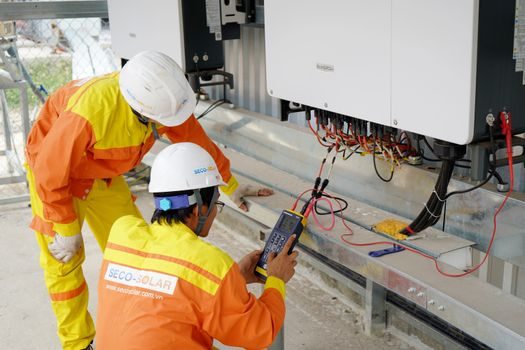
Pre-qualification against four decision criteria separates the viable suppliers from the catalog re-sellers. Use the following comparison grid to structure RFPs: [S1]
Power window: MPP Solar 4-6 kW off-grid; Sununo-TL2K 2 kW single-phase on-grid [S1]; 4-6 kW MPPT hybrid 50-piece MOQ [S1]; 500 kW utility-scale transformerless 1,000 watt MOQ [S1]. IP rating: Sununo-TL2K IP65 outdoor-rated [S1]; MPP Solar PIP-LC IP20 indoor-only. Operating temperature: PIP-LC 0 to +40 °C; IP65 units typically specified -25 to +60 °C. Monthly supply: 1,000 unit/month (hybrid MPPT) [S1]; 10,000 unit/month (4-6 kW charger-controller) [S1]; 500,000 watt/month (270 V module) [S1].
Brands that consistently appear across multiple product tiers with disclosed capacity — Sungrow, Huawei, Growatt, SMA, Fronius, Solis, and MPP Solar — should anchor any 2026 shortlist. Tier-1 utility-scale plants typically split procurement between a global string-inverter brand and a central-inverter supplier, with 1,500 V DC architecture now the default for greenfield ground-mount. For projects co-located with fuel cell stacks, the inverter must accept external dispatch setpoints via Modbus or IEC 61850.
Limitations, Failure Modes and Sourcing Risks
IP20 off-grid units fail prematurely if installed in unconditioned outdoor enclosures — condensation and dust ingress short the low-frequency transformer. Transformerless topologies cannot handle the inductive surge of legacy motor loads and must not be specified for off-grid motor-start applications. Small-volume OEM listings (sub-100 unit/month capacity) carry the highest warranty-fulfilment risk because field-replacement stock is not maintained [S1].
Tariff and certification exposure is the second major risk. ATEX/IECEx-zone inverters carry price multipliers of 3-8x versus general-purpose units and lead times of 12-24 weeks. For European chemical-plant buyers, dual-certified units (ATEX 2014/34/EU category 2 plus Ethernet-APL) are increasingly specified for new builds, per OEM guidance circulated in the past six months [S1]. Sourcing teams should also verify that any 270 V DC-AC module carries IEC 62109 safety certification and that MPPT efficiency is published as a curve, not a single peak number [S1].
Standards and Sourcing References

Three standards govern the 2026 specification cycle. IEC 62109 covers safety of power converters for PV. IEC 61727 and IEEE 1547 govern grid interconnection. ISO 12944-2 governs the corrosivity class C3/C4/C5 used in rooftop and coastal specifications. Chinese OEM datasheets typically cite GB/T 19939 alongside IEC equivalents, and EU-bound shipments should require CE marking plus EN 50549 for low-voltage grid connection [S1].
The MPP Solar PIP-LC datasheet, published on ENF Solar, is a useful template for what an industrial datasheet must include: power range, frequency, efficiency, IP class, transformer topology, weight, operating temperature window, and a regional contact for the manufacturer in Taipei. Buyers should require the same data set from any new vendor before issuing a PO. For broader industrial context on how inverter selection interfaces with process instrumentation, see the pressure transmitter and flow meter reference pages.
Trackable signals to monitor over the next two quarters: disclosed quarterly shipment volumes from tier-1 Chinese OEMs, IEC 62109-3 revision commentary, and 1,500 V central-inverter price-per-watt benchmarks published by ENF Solar. Any one of these will materially shift the 2026 shortlist.