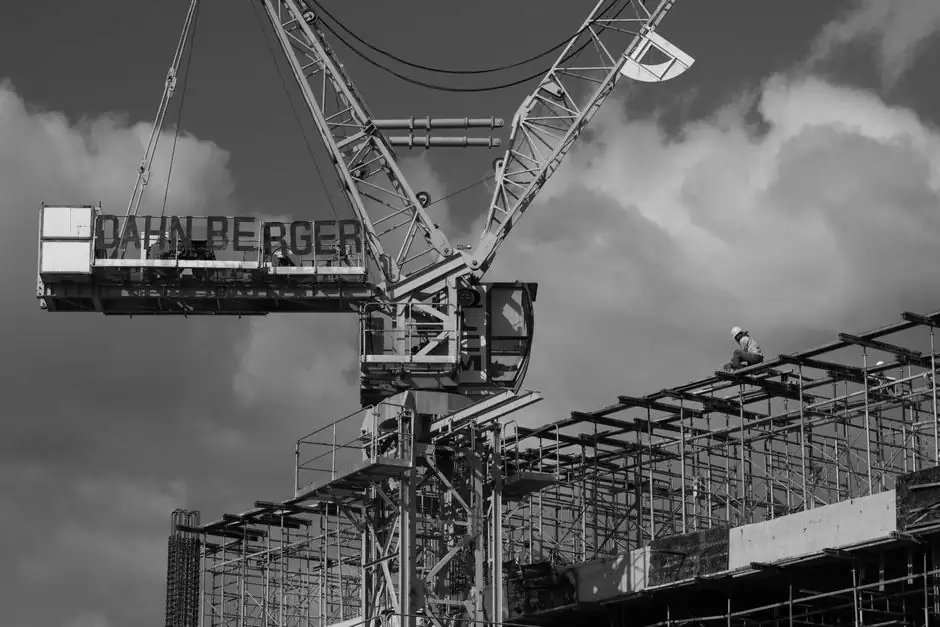
A landfill cell with a 60 m × 80 m footprint and a 25 m daily lift of geomembrane rolls, leachate tank panels, and biogas digester modules demands a stationary vertical hoist, not a mobile crane: cycle time, ground preparation cost, and overswing risk on soft subgrade rule out wheeled alternatives. For typical municipal solid waste sites, the working envelope is a 50-70 m radius at 6-12 t peak load, with the cab positioned outside the active cell and clear of landfill gas venting [S2].
Three of the suppliers active in the 2026 export market list topkit/hammerhead, topless/flattop, and luffing-jib variants as standard product families, with CE and ISO 9001 certification on every chassis shipped from Chinese yards [S3][S4]. Selecting among those three configurations is the single biggest spec decision, and it is driven by the geometry of the cell and the wind regime on the pad, not by brand [S3].
Why a tower crane, not a mobile or crawler pick, on a landfill cell
Landfill working pads cap allowable bearing pressure at 80-150 kPa after compaction of the clay or geosynthetic clay liner, which is roughly 40-60% of what a fully loaded crawler crane exerts through its tracks on unprepared ground [S1]. A stationary tower crane base spreads that load through a 4 m × 4 m ballast pad or a pile-cap foundation, eliminating the risk of differential settlement that has stopped crawler picks mid-lift on capped cells. Vertical lift to 25-40 m, needed for daily cover placement and digester module erection, costs a crawler crane at least one repositioning per shift, whereas a fixed tower crane holds the same pick point for weeks.
Rental fleets in coastal and inland Australian depots stock hammerhead units in the 6-10 t / 60-70 m class as their core hire item, and quote those as the default for multi-week campaigns rather than crawler or all-terrain alternatives [S1]. The pattern repeats in European sales channels, where luffing-jib and topkit units are the bulk of the 2026 catalogue and the mobile crane is treated as the auxiliary, not the primary lift [S2][S3]. Cycle-time math is the underlying reason: a tower crane cycles in roughly 90-120 s per pick at 30 m radius, against 6-8 min for a repositioned mobile unit, and on a 200-pick-per-day digester build that gap is the schedule.
Three tower-crane families, lined up against landfill duty
Manufacturers active in 2026 export markets catalogue three tower-crane families that map directly onto landfill cell geometry: topkit/hammerhead, topless/flattop, and luffing jib [S3][S4]. Each has a distinct envelope, and a spec engineer should pick by duty, not by habit.
Topkit (hammerhead) tower cranes: the traditional A-frame cathead and tie-rod configuration. Typical 2026 catalogue range 6-16 t at 50-75 m jib. Strengths: lowest unit cost, simplest erection sequence, two-tie design tolerates moderate wind. Weakness: the cathead and counter-jib add 8-12 m of overall height above the slewing table, which can conflict with low approach paths and overhead biogas collection mains on capped cells [S3].
Topless (flattop) tower cranes: no cathead, the jib and counter-jib are tied directly to the slewing table through a flat top. Preferred when multiple cranes will be overlapped on a tight pad, because the absence of tie rods above the jib lets two flattops cross each other without clash.
Luffing-jib tower cranes: the jib pivots vertically from 15° to 75°, so the working radius is gained by raising the jib rather than swinging the load. Envelope is typically 35-55 m radius at 4-8 t, with a much smaller ground footprint of the swept circle. That geometry is the right answer when the crane must stand inside the cell footprint or against a vertical cut face, and it is the only one of the three that can work inside a 30 m wide gas-collection corridor without overflying adjacent infrastructure [S3].
A useful rule of thumb, in qualitative terms: pick the hammerhead when the pad is open, the wind is moderate, and budget is the binding constraint; pick the flattop when two cranes must overlap or wind exposure is high; pick the luffing jib when the crane must stand close to a vertical face or inside a constrained cell [S3]. All three families are routinely offered with CE and ISO 9001 documentation, so certification is not a discriminator among the three [S3].
Capacity, jib length, and hoist speed: the numbers that actually move
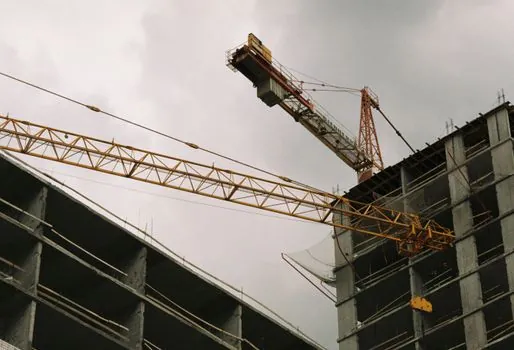
For a 200-300 t/day municipal solid waste cell, the dominant lifts are geomembrane rolls (1.5-3.0 t per roll, 8-12 m long), leachate tank panels (2-5 t), and biogas digester modules (6-10 t for the smaller packaged digesters, 12-20 t for larger steel tanks). A 6-12 t unit at 50-70 m jib covers all of those, with at least 25% hook-reserve for rigging and dynamic amplification [S2][S4].
Hoist speed on modern export units sits at 60-100 m/min for the main hoist at full load, with a 2-fall reeving configuration standard on the 6-10 t models.
Jib length is set by the largest working radius needed on the cell plus a 5 m safety margin, and the rule of thumb among rental fleets is that jib length above 65 m costs roughly 1 t of capacity at the tip for every additional 5 m of radius, on the hammerhead and flattop families [S1][S3]. For a 60 m × 80 m cell with the crane standing on one long edge, a 70 m jib at 8 t tip is a common specified point.
Wind, foundation, and landfill gas: constraints most spec sheets miss
Operating wind speed for tower cranes in the 2026 catalogues is 20 m/s (72 km/h) with the jib in free slewing, and out-of-service wind speed is 42-45 m/s (151-162 km/h), with the jib left free to weathervane. A landfill on a coastal plain, ridge, or open plateau can see sustained 18-20 m/s gusts during storm season, which means the spec must include a wind-speed alarm and an anemometer with audible threshold at 15 m/s, not just the structural limit at 20 m/s [S3].
Foundations on a landfill are the second spec most buyers get wrong. The allowable bearing pressure after clay liner compaction is 80-150 kPa, so the standard 4 m × 4 m × 1.5 m ballast base used on rocky sites will not work; either a pile cap with four 600 mm bored piles to competent stratum, or a reinforced concrete spread footing 6 m × 6 m × 1.0 m, is the normal answer [S1][S3]. SYM Hoist & Tower Crane Equipment and similar Chinese exporters typically include foundation drawings in the shipment, but the geotechnical design must be signed off locally because landfill subgrade is site-specific.
Landfill gas, primarily methane at 40-60% by volume in active cells, is the third constraint. Diesel-engine power packs on older units are an ignition risk within 15 m of an active wellhead, so spec the electric trolley-feed configuration with a 63 A or 125 A site supply rather than a self-contained diesel genset. ATEX-rated electrics on the slewing ring and cab heater are not mandatory in most jurisdictions but are commonly specified on European builds and add roughly 3-5% to the chassis price [S3][S4].
Erection, climbing, and dismantling on a closed or active cell
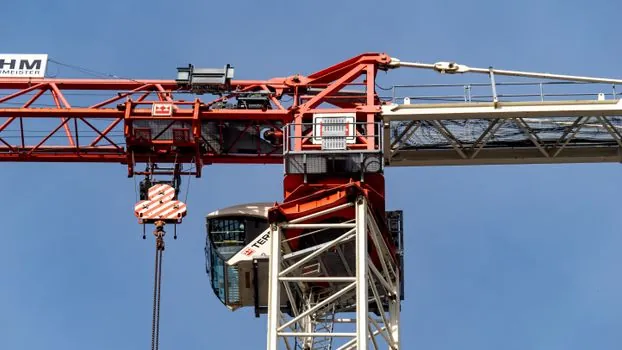
Erection sequence governs whether the crane can be assembled on site at all, and on a landfill the constraint is the position of the nearest hardstanding. A standard topkit unit in the 6-10 t class ships in 4-6 × 40 ft container loads and can be erected with a single 50 t mobile assist in one working day, assuming a 6 m × 12 m hardstanding pad within 20 m of the final base [S1][S4]. Luffing-jib units take a day longer because the luffing cylinder and pivot pin require a 80-100 t assist for the jib raise.
Climbing (or "tie-in") is the spec gate on capped cells. A hammerhead or flattop can be tied to the structure or to a separate mast at 4-6 intermediate levels as the cell rises, which keeps the hook height above the working face as the landfill is built up. This is the reason tower cranes are preferred over crawler cranes for multi-year capping projects: the crane climbs with the work, while a crawler has to be craned out and repositioned every 5-6 m of fill rise.
For sites where the cell will not exceed 25-30 m total lift, a stationary base without climbing is the cheaper option and is the standard rental configuration offered by the Australian and European fleets in the 2026 catalogue [S1][S2]. For taller or phased builds, the climbing mast adds 8-12 weeks to lead time and roughly 12-18% to total cost, and that has to be in the spec from day one, not added mid-project.
Standards, certifications, and what to demand in the contract
All three Chinese export catalogues reviewed in 2026 list ISO 9001 and CE marking as standard on every tower-crane chassis, with the Chinese 3C (Compulsory Product Certification) as a domestic baseline [S3][S4]. The CE marking on a tower crane is the Machinery Directive plus EN 14439, which covers structural design, slewing, hoist, and safety devices, and that stack has been stable since 2009. For European sites, FEM 1.001 / EN 13000 hoisting-class classification should be referenced in the contract because it sets the duty cycle (typically C.25-C.35 for landfill work, which is "medium" or "heavy" in FEM nomenclature).
For Australian and New Zealand sites, the relevant standard is AS 1418.1 (Cranes, Hoists and Winches) plus AS 2550 (Safe Use), and rental fleets in Queensland reference these explicitly on their hire terms [S1]. For North American landfill work, OSHA 1926.1400-1441 and ASME B30.3 (Construction Tower Cranes) are the binding pair. A spec that does not name the governing standard at the point of order is a spec that will be re-litigated during commissioning.
Operator certification is a separate gate: in the EU it is the CPCS A04 or national equivalent, in Australia it is the High Risk Work Licence class (CT for tower crane), and in North America it is the NCCCO certification. Demand the operator logbook for the last 90 days at the point of mobilisation, not on day one, because the renter's roster rotates and the operator who commissions the crane is not always the one who runs it for the next six months [S1][S2].
Failure modes the catalogue does not list
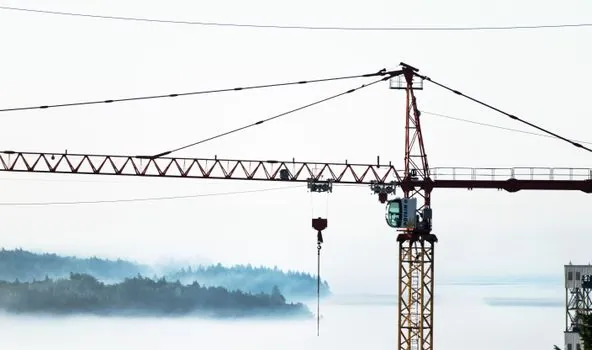
The three failure modes that the marketing material does not list, but the field engineer sees every year, are foundation tilt, slewing-ring bolt loosening, and out-of-service wind damage during a storm. Foundation tilt shows up as a slow drift in the load-radius indicator and is almost always traced back to a ballast pad that was placed on a non-compacted subgrade; the cure is a re-survey and a grout-injection lift on the affected corner, not a crane rebuild. Slewing-ring bolt re-torque is a 12-month or 2,000-hour service interval on most 2026 units, and skipping it is the most common cause of unplanned slewing-ring replacement, which is a 6-8 week parts lead time [S3].
Out-of-service wind damage is the third failure mode, and on landfill sites it is more common than on building sites because the surrounding terrain is flat and the wind is unobstructed. The mitigation is the weathervane mode (jib free to rotate to the prevailing wind) plus a storm pin kit, and the spec must require both, plus a documented daily wind log. Suppliers in the 2026 export catalogues will include weathervane as standard, but storm pins are often a separate line item and are worth insisting on in the order [S1][S3].
A related constraint is anti-collision when two cranes are overlapped on a tight pad, common on large digester builds. The 2026 generation of anti-collision systems uses GPS or laser ranging at the jib tip and will lock both cranes' slewing if the envelopes cross; this is a standard option on flattop units and is the cleanest way to run two 8 t class cranes on a 50 m × 50 m cell [S3]. It is worth comparing this spec across at least two vendors before ordering, because the user interface and lockout behaviour vary more than the brochures suggest.
Sourcing paths and 2026 vendor signal
Three sourcing paths are active in the 2026 export market: Western rental fleets (Australia, Northern Europe) for short-term hire with operator, Chinese OEM direct purchase for fleet ownership, and European pre-owned market for mid-life units refurbished to current EN 14439 [S1][S2][S3][S4]. For a single landfill campaign of 6-12 months, the rental route is typically 30-40% cheaper than purchased-and-sell, and the operator comes with it. For multi-year programmes, purchase from a Chinese OEM with a European technical advisor (the FOIN pattern, with 8-language sales support and factory-to-site logistics) is the most common 2026 spec for emerging-market municipal contracts [S3].
A trackable signal for the next 6-12 months: bauma CHINA 2026, scheduled in late November 2026 in Shanghai, is the venue at which the three Chinese exporters (FOIN, SYM, and peers) typically release their model-year updates, including the next generation of variable-frequency hoist drives and the new anti-collision firmware versions [S4]. The German bauma in April 2027 will be the venue for the European pre-owned market refresh. Watch both for spec-sheet revisions on out-of-service wind lock and on foundation reaction load, which are the two numbers that bind the most on landfill work [S1][S3][S4].
Two related reads for spec engineers in adjacent fields: port terminal tower crane selection follows a similar envelope-and-duty logic for high-cycle container work, and urban infrastructure truck-mounted crane selection is the comparison case for when a mobile crane is genuinely the right tool instead of a fixed tower install. For a 6-12 month municipal landfill campaign, the stationary tower crane remains the lowest-risk, lowest-cost-per-pick spec, provided the foundation, wind, and gas constraints are written into the contract from day one [S1][S2][S3][S4].
For component-level specifications, see signal tower light.