
A tower crane lifts 1.5–25 t on a vertical mast that can climb past 200 m, with a hammer-head or flat-top jib reaching 30–80 m radius; a gantry crane rolls on ground rails or rubber tyres with a 10–500 t main hoist and a span set by the beam length between the legs. That is the headline split: vertical-reach specialist against ground-traversing heavy lift.
Both belong to the ISO 4300 crane-family vocabulary, but their operating envelopes diverge fast once job-site geometry, cycle rate and load chart are written down. Choosing wrong typically shows up as a re-tender or a months-long site-standstill, not as a small bill.
Definition and Mechanical Architecture
A tower crane is a vertical jib crane whose steel mast is fixed to a foundation anchor or tied to the building under construction, with the slewing unit, jib and counter-jib mounted on top; typical free-standing height is 40–80 m and climbs in 3–6 m mast sections as the structure rises, which is why it dominates high-rise concrete and steel cores. A gantry crane is a bridge-type crane supported on two or more A-frame legs that travel along ground-level rails (rail-mounted gantry, RMG) or on rubber tyres/pneumatic wheels (rubber-tyred gantry, RTG), with a horizontal beam spanning the working area — common spans run 20–50 m and heavy shipyard versions reach 150 m. The defining difference is anchor: tower cranes are tied to a foundation, gantry cranes move freely along a fixed track on the yard surface. [S1]
Sub-families matter for procurement. Tower cranes split into hammer-head, flat-top and luffing-jib, with luffing-jib specified where multiple cranes overlap on a tight site. Gantry cranes split into single-girder, double-girder, semi-gantry and truss-girder, with double-girder the default above 30 t or where a top-running trolley houses two independent hoists.
Core Spec Comparison: Reach, Lift, Footprint, Mobilisation
Engineers typically score these two types on four decision criteria before any RFQ goes out: vertical reach, working radius, peak hoist, and site footprint. Tower cranes win on vertical reach and radial coverage from a fixed point: a 25 t flat-top can climb to 200 m with tie-ins and place 3 t at an 80 m jib radius, which is the reason dense urban cores cannot be built without them. Gantry cranes win on ground coverage, peak lift and yard mobility: 500 t shipyard gantries span 100–150 m and roll a full ship block across the assembly bay, a load geometry a tower crane cannot serve. [S2]
Load capacity in the two machines scales differently. Tower crane chart capacity decays sharply with jib radius — a 12 t tip load at 20 m typically drops to 2.5–3 t at 80 m — because the jib is bending. Gantry crane chart capacity stays near the rated value across the span, because the load travels on a trolley along a horizontal beam rather than being suspended from a cantilever. Hoist speeds also differ: tower crane hoist 2–4 m/min on full load and 8–12 m/min empty; gantry main hoist 1.5–6 m/min on full load with creep at 0.5 m/min for rigging. For a complete spec walk on one side, the tower crane buying guide 2026 lays out the model-code levers end-to-end.
Job-Site Match: Where Each Crane Actually Wins
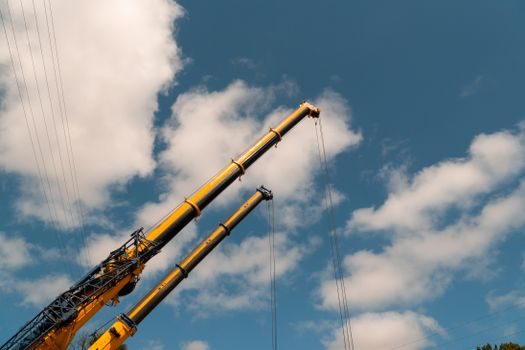
Tower cranes own the high-rise vertical build. Typical lift on a 30+ storey core is 1.5–6 t of rebar, formwork, jump-form platform and concrete skip at radii up to 60 m, repeated 30–50 times per shift. Mast tie-in spacing on the building is normally 3 mast sections (about 12–18 m vertical spacing), which is why climbing sequence must be planned in parallel with the structural pour cycle. Gantry cranes own the horizontal yard: container terminals stack 20–40 ft ISO boxes in 5+1 rows with 35–45 t lifts using RTGs at 9 m clear stacking height; shipyards use 100–800 t gantries to lift hull blocks into the dry dock; precast yards use 10–50 t gantries to load trailer trucks directly from the casting bed. A mobile crane is a third option, but typically a complement, not a substitute, because neither vertical reach nor full-span yard coverage is its strength. [S3]
Overlap zones exist. Pre-engineered metal buildings up to 25 m eave height can go either way: a rail-mounted gantry on slab rails for repetitive bay construction, or a small hammer-head tower crane if the building is narrow and tall. Wind regime is the dividing line — gantries need to be parked and pinned above 72 km/h (per typical OEM operation manuals), whereas tower cranes are designed to weathervane the jib and remain standing in storm conditions as long as out-of-service procedure is followed.
Siting Constraints, Foundation and Assembly
Tower crane siting is governed by ground bearing pressure under the base ballast (typically 75–150 kPa under the corner outriggers) and by tie-in load into the host structure, normally 30–80 kN horizontal per tie level on a high-rise climb. Foundation options are reinforced concrete ballast (most common, 80–250 m³), pile cap with anchor cage, or rail-embedded base for a travelling tower variant. Crane erection itself is a one-day climbing-frames erection plus a 1–3 day jib-assembly lift, requiring a 100–250 t assist crane — that assist crane is a hidden line item that often shows up as the largest single cost on the mobilisation tab. [S4]
Gantry crane siting is governed by rail alignment, gauge and gauge tolerance, plus power supply. RMGs run on rails with 1.5–3.0 m gauge, supported on sleepers or reinforced concrete beams, with a 10–20 mm/m vertical tolerance across the length. RTGs need a 30+ MPa concrete apron in the stacking zone, 6–8 m wide lanes, and 1–2 MW of diesel-generator or cable-reel power. Assembly of a 500 t shipyard gantry uses strand jacks or two crawler cranes in tandem and is typically a 4–8 week campaign on site, not a weekend lift.
Standards, Safety Envelope and Wind Regime
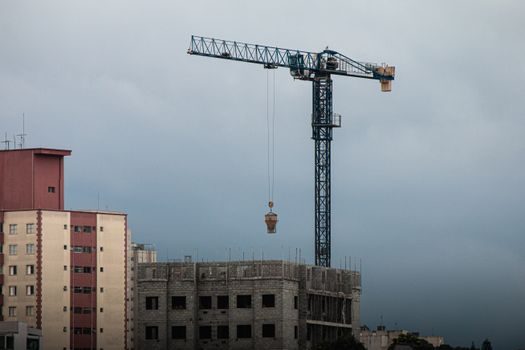
Both machine families sit under ISO 4300 series nomenclature and are rated to FEM/ISO load-spectrum classes (typically FEM 1Am through 5m for tower cranes, FEM 4m–5m for gantry hoists). Wind-speed limits are written into every OEM chart: tower cranes normally work to 72 km/h with the jib in service and survive 126–144 km/h out of service (per typical European OEM operation manuals); gantries are parked and rail-clamped above 72 km/h in most fleets. Lightning protection, anti-collision for multiple tower cranes on one site, and slewing-moment limiters are non-negotiable in the spec. [S5]
Operator certification follows local crane-operator licence rules (NCCCO in the United States, CPCS A04 in the United Kingdom, Chinaspecial operation certificate for the equivalent domestic ticket). The legal rule that bites most often is the anti-collision radar or zone-limit switch on sites with two or more overlapping tower cranes — the OEM default is a buffer of 2–3 m radius and 5–8 m height, but site layouts frequently demand a tighter buffer that the OEM must sign off in writing.
Cost, Sourcing and Total-Cost Levers
Daily rental for a mid-size tower crane (8–12 t at 60 m jib) lands in the USD 2,500–5,500/day band in mature Western markets, with a 6–12 t mobile assist crane adding USD 1,500–3,500 per erection day. Buy price for the same class from a Chinese OEM (used as a benchmark because Chinese manufacturers dominate global supply in this class) runs USD 180,000–420,000 FOB for a 6–10 t flat-top, with 25 t hammer-head units USD 450,000–850,000 FOB [S5]. Gantry crane buy price tracks span and capacity: a 20 t double-girder EOT-style gantry at 30 m span sits at USD 80,000–180,000 ex-works, while a 500 t shipyard gantry with 100 m span runs USD 4–9 million installed. The rule of thumb: tower crane cost is driven by jib length and free-standing height, gantry crane cost is driven by span and main-hoist rating.
Sourcing levers that move price: mast-section and jib-section standardisation across a fleet (cuts spare parts inventory), used-versus-new condition (typical depreciation 30–45% by year 5), and Chinese OEM versus European OEM (typically a 30–55% cost delta at the same load chart, with longer lead time on European brands and tighter documentation). For deeper sourcing levers on the tower-crane side, the model-code gates in tower crane selection: six gates that lock the model code before RFQ are a working shortcut, and a third option worth scoring is the truck-mounted crane vs tower crane spec cut for sites where mobility, not vertical reach, drives the decision.
Common Failure Modes and Limitations

Tower crane incidents cluster around three root causes: slewing-ring bolt fatigue on machines over 8 years old, foundation-ballast settlement when ground-bearing pressure is under-spec, and tie-in failure on the host structure during a storm event. Each one is detectable with predictable inspection cadence — annual slewing-bolt torque check, six-monthly ballast settlement survey, and pre-storm tie-in audit. Gantry crane incidents cluster around rail-alignment drift, rail-clip failure on RTGs, and trolley-derailment on long-span beams. A useful rule of thumb on both: if a crane is more than 12 years old and has run more than 18,000 hours, plan a structural-fatigue assessment before the next major project. [S1]
Limitations worth flagging at spec time: tower cranes cannot move a load horizontally except by slewing the jib, so they are poor at shifting loads across a wide yard; gantry cranes cannot reach above their own beam, so they are poor at serving tall cores or roof structures. A crawler crane is the usual third machine in the fleet to cover those two gaps, particularly for heavy pick-and-carry moves on a job site where neither a tower nor a gantry is set up.
Two trackable signals for the next planning window: Chinese OEM delivery lead time for flat-top 8–12 t units (currently 60–90 days ex-works per typical sourcing patterns) [S5], and European OEM price-list revisions that historically move twice a year in Q1 and Q3. A spec written off 2024 charts will be off by one price-list cycle by mid-2026, so lock the offer validity window in the RFQ before any model code is frozen.