
Selecting a tower crane in 2026 is less about brand and more about closing six engineering gates — max lift at radius, jib reach, hook height, site envelope, duty class and the certification set the jurisdiction demands. The contrast on the open market is wide: QTZ40(TC4708) units ship with a 4 t maximum load, a 47 m nominal jib and roughly 0.8 t tip capacity [S1], while DaHan's DHL3300-220 — described as the first ultra-high, ultra-large 220 t class unit built for wind-power erection [S2] — sits at the top end of the model-code envelope.
For readers new to the equipment, a tower crane is a vertical-mast, horizontal-jib machine fixed to a foundation or tied to a structure, used for repeated lifts over a defined radius envelope in mid- and high-rise work. Most procurement mistakes in 2026 happen at gate 1 and gate 2, where the specifier locks a model code before confirming what the heaviest pick is, and how far from the mast that pick sits.
Gate 1 — Maximum Load and the Load-Moment Curve
The first gate is the load-moment envelope, not a single number [S1]. A 4 t max rating applies at the minimum radius, and the allowable load drops as the radius grows — for the TC4708 platform the tip capacity falls to roughly 0.8 t at 47 m of jib, which is the constraint that usually kills the cheaper model for steel-structure jobs. A common 2026 mistake is quoting the headline "max load" to a client and then discovering the radius-matched pick exceeds the curve, forcing a re-spec mid-project.
Engineers should read the load chart at the radius of every heavy pick, then add a 25 % margin for dynamic effects and rigging weight. A frequent rule of thumb: if the heaviest pick plus rigging uses more than 80 % of the curve at its working radius, step up one model class — QTZ40(TC4708) is the floor for most mid-rise residential work, QTZ63(TC5013) through QTZ80(TC5610) covers general commercial, and the 100 t+ class opens at QTZ100(TC6013) and above [S1].
Gate 2 — Jib Length and the Tail Radius
Jib length is set by the largest plan dimension that must be served. The TC4708 jib of 47 m covers most 30 m × 30 m floor plates, but a 60 m × 60 m footprint needs a 56 m or 60 m jib — pushing the spec toward QTZ80-class units. Don't forget the counter-jib (tail radius): the rear slewing arc typically sweeps 12–14 m behind the mast and blocks scaffolding, parking and access roads [S1].
For projects with a 2 m clearance to a property line or adjacent structure, the specifier usually has to switch from a hammerhead to a luffing-jib configuration to fold the jib up and over the obstacle. In dense urban sites a mobile crane sometimes replaces the tower crane entirely for the steel phase — see the 2026 buying guide on truck-mounted units for that procurement branch.
Gate 3 — Free-Standing Height vs Tied Height

Hook height is governed by the mast section count above the foundation, but only up to the free-standing limit. Most flat-top hammerhead cranes free-stand to 40–45 m before they must be tied to the structure; beyond that, wall ties are added at roughly every 20 m of vertical rise. A 30-storey building (≈90 m) typically needs 3–4 tie sets and a climb-climb-climb sequence, not a free-standing stick [S1].
Wind exposure rewrites this gate. The DHL3300-220 220 t wind-power tower crane [S2] is built specifically for hub erection at 120 m+ where ground-level gusts and rotor-induced turbulence are continuous; its climb system and structural bracing differ from a residential QTZ40. If the site is above Grade 6 wind exposure or above 100 m hook height, the specifier should request the manufacturer's wind-load certificate and a separate fatigue dossier for the mast section.
Gate 4 — Site Footprint, Foundation and Erection Envelope
The foundation type is part of the selection, not an afterthought. A 4 t-class TC4708 can sit on a 6 m × 6 m × 1.5 m reinforced concrete pad with a single M36 anchor cage; a 220 t class unit needs a piled cap or a structural-steel base tied into the slab [S1][S2]. Crawler cranes and self-erecting units reduce foundation work but trade off reach and tip capacity — the comparison frame in Crawler Crane vs Truck-Mounted Crane: 2026 Spec Frame covers that fork in the decision tree.
For confined sites, a self-erecting tower crane folds to a 2.5 m × 2.5 m footprint and erects in 2–3 hours with a small assist crane, but caps out around 2 t at 28 m radius. The decision rule: footprint below 4 m × 4 m → self-erecting; footprint 4–8 m → flat-top hammerhead; footprint above 8 m and hook above 80 m → luffing-jib or 100 t+ class [S1].
Gate 5 — Duty Cycle, Drive and Power
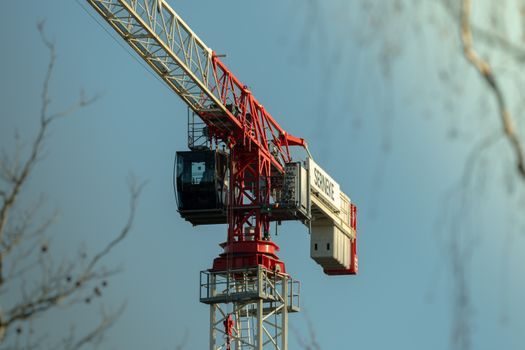
Duty class is the second number that gets ignored. Light residential cycles (≈20 lifts/day, 60 % utilisation) suit the TC4708 hoisting + trolley + slewing + traction brake package; continuous commercial cycles (60+ lifts/day, 80 % utilisation) demand variable-frequency drives on hoist, trolley and slew to keep motor thermal headroom and brake life within OEM limits [S1].
Power supply at 380 V / 50 Hz is the default on Chinese-built units for export, but North American and most European sites need 480 V / 60 Hz or 400 V / 50 Hz with CE conformity, plus an external power-lockout and anti-two-block device. Confirm in the RFQ whether the unit ships with a VFD on the hoist or a single-speed pole-change motor — it changes both the price band and the electrical substation sizing.
Gate 6 — Safety Devices and Certification Set
The minimum safety stack on a 2026 unit is: lifting height limiter, moment limiter, amplitude limiter, lifting weight limiter, slewing limiter, rotary brake, traction-mechanism brake, trolley rope-breakage protection and anti-broken-shaft device [S1]. The OEM cab should also integrate a Taiwan-sourced or equivalent linkage control console — the operator-side differentiator is cab ergonomics, not the safety list, since the safety list is regulatory, not optional.
Certification scope is where export orders fail. CE marking under the Machinery Directive plus EN 13000 covers the EU; the GCC conformity scheme covers Saudi Arabia and the UAE; for North America, the unit needs a UL 508A panel and ASME B30.3 / OSHA 1926.1400–1438 compliance package on top of the CE base. Buyers in Australia should also request AS 2549 compliance and an in-country inspection by a JAS-ANZ-accredited body. The 220 t wind-power class [S2] is typically built to a project-specific certification dossier rather than an off-the-shelf kit.
Comparison: Three Tower-Crane Classes Side by Side
Three model classes cover roughly 90 % of 2026 orders. The QTZ40(TC4708) is the residential / light-commercial entry: 4 t max, 47 m jib, ~0.8 t tip, 40 m free-stand, single-speed hoist options [S1]. The QTZ80(TC5610) / QTZ100(TC6013) band is the mid-rise / commercial workhorse: 6–10 t max, 50–60 m jib, 1.5–2.5 t tip, tied up to 150 m, VFD hoists standard. The 100 t+ class — represented at the extreme by the DHL3300-220 220 t wind-power unit [S2] — covers heavy industrial, power-plant and wind-hub erection with custom climb systems, project-specific certification and typically 80–120 m jib.
Decision rule by criteria: if max pick × radius < 200 t·m and free-stand < 40 m, the QTZ40-class is the cost-optimal pick. If the project is 100 t·m–800 t·m with tied operation, mid-class VFD units are correct. Above 800 t·m, or hook above 120 m in high-wind terrain, the wind-power / heavy-lift class applies. For procurement teams new to lifting gear, the crawler crane page covers the horizontal-reach alternative when vertical-hook service isn't the binding constraint.
Limitations and Failure Modes Specifiers Hit in 2026
Three failure modes dominate the 2026 RFQ pile. First, under-specifying the tip capacity — a 0.8 t tip on a 47 m jib [S1] cannot lift formwork bundles 45 m from the mast, and the field fix is a second crane, not a larger one. Second, ignoring counter-jib sweep — a 14 m tail arc collides with site access roads and forces a re-layout. Third, mismatched certification — a CE-only unit delivered to a GCC site will be refused at the gate, and re-certification costs run 8–15 % of the unit price.
For buyers comparing tower cranes to other lifting families, the gantry crane page is the relevant fork for ground-level repetitive lifts (container yards, precast yards). Where the spec frame overlaps with general material-handling selection — like the seven-gate approach in AS/RS Selection Criteria 2026 — the same gate logic applies: lock max load, envelope, duty, certification and power before naming a model code.
Trackable signals for the next quarter: DaHan Technology's wind-power crane rollout [S2] is the leading indicator on whether 220 t+ class units move from one-off projects to serial production; GCC conformity updates and any EN 13000 amendment cycles will set the certification baseline for EU-bound orders; the QTZ40(TC4708) export price band [S1] is the floor reference for any RFQ below the 50 m jib threshold. If all three move, the model-code bookends for 2027 are essentially set.