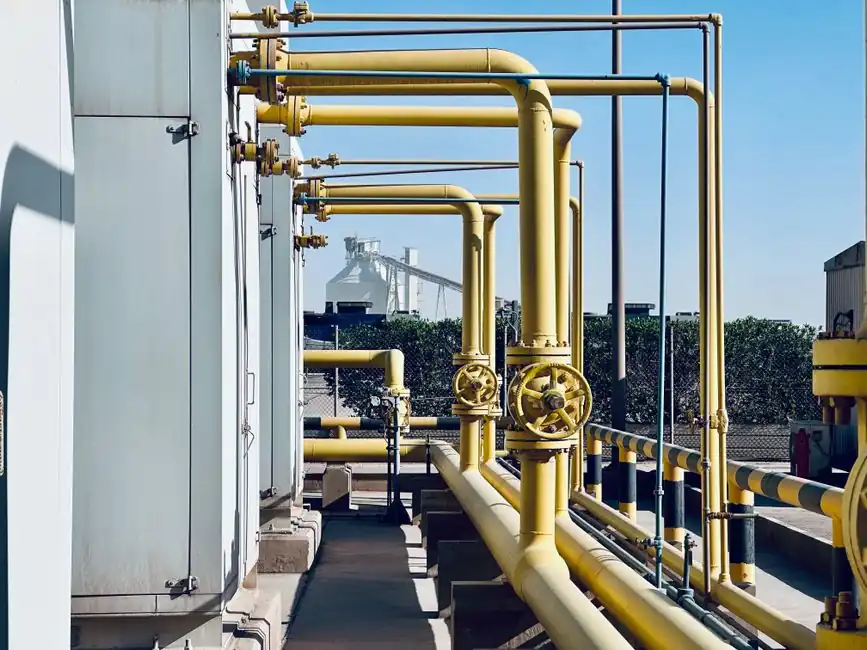
Three geometric offsets in a single valve body, the first behind the sealing plane, the second off the pipe centreline, the third on the cone axis, let the disc lift off the seat for nearly the entire 90° stroke and only touch the seat at the final degree of closure [S2][S4]. That cam-style, frictionless action is what gives the design its repeatably bubble-tight, metal-to-metal shutoff, rated to ASME B16.104 Class VI, and its commercial identity as a true high-performance isolation valve [S3][S4].
The operating envelope is broad: a typical triple offset body is offered in 2" to 48" (DN50 to DN1200) with larger sizes on request, in wafer, lug, and flanged end connections, and with body materials in WCB, CF8, and CF8M against seat constructions of 304 + graphite or 316 + graphite laminated rings [S3]. Steam service reaches 550 °C out of the catalogue, and bidirectionally tight shutoff is a stock feature rather than a special order [S3][S4].
How the three offsets combine to eliminate seat friction
The first offset places the shaft behind the centreline of the disc/seat sealing surface, the second places the shaft off the centreline of the pipe bore, and the third is purely geometric: the seat and disc sealing faces are each machined into an oblique conical profile so the cone axis no longer coincides with the shaft axis [S2][S4]. With all three offsets in play, the disc lifts cleanly out of the seat from the moment it begins to open and only re-engages at the final degrees of closure, a behaviour commonly described as a right-angled cone or cam action [S1][S2][S5].
Because the metal sealing components never rub during the stroke, there is no elastic deformation of the seat and no incremental wear from cycling; the seal energy at closure comes from the actuator torque transmitted through the geometry rather than from compressing a soft insert [S2][S5]. The practical consequence, beyond longer seat life, is that the same torque that closes the disc is the torque that loads the seal, so a lower-torque actuator can be specified than for an equivalently sized double offset valve [S1][S2]. For a working primer on how a butterfly valve is constructed and where the disc edge meets the seat, the geometry described above only makes sense once that base architecture is clear.
Shutoff class, temperature, and pressure envelope
Triple offset valves are consistently rated to ASME B16.104 Class VI bubble-tight shutoff, the same leakage tier commonly applied to soft-seated ball valves, and are zero-leakage against API 598 test media as a baseline [S3]. Shutoff is bi-directional because the cone geometry loads the seal symmetrically regardless of flow direction, and the same body is qualified for both throttling modulation and positive isolation rather than being limited to on/off service [S3][S4].
Standard catalogue temperature reaches 550 °C (about 1022 °F) in steam and geothermal steam service, with higher-temperature executions available on request, while cryogenic service is feasible because there is no elastomer in the wetted seal path [S3][S4]. Pressure classes are described to API 609 Category B face-to-face dimensions, with flange drilling to ANSI B16.5 Class 150 and 300, BS 4504, and AWWA C207, and a top mounting per ISO 5211 for direct actuator fit-up [S3]. For broader context on how these bodies sit inside a pumps, valves, and piping train, the relevant detail is that the triple offset sits in the high-performance quarter-turn slot alongside fully metal-seated ball valves rather than next to resilient-seated butterflies.
Material and trim options that actually change the duty envelope
Stock trim combinations cover most hydrocarbon, steam, and water duties: body in WCB carbon steel or CF8/CF8M stainless, disc in CF8 or CF8M, stem in 17-4PH, 410, 304, or 316 stainless, and a laminated seal ring made of grafoil (flexible graphite) layers sandwiched between metal laminations to give the snap-in energising action at closure [S3]. Seat options extend to Viton, PTFE, and EPDM for lower-temperature services where the customer prefers a soft seat over the standard metal/graphite stack [S3].
For sour and NACE service, hard-facing selection on the disc edge and seat is the variable that decides whether the valve is qualified; suppliers commonly call out NACE MR0175 compliance for hot gas and sour gas, while acid, caustic, chloride, and abrasive slurry services are listed as standard applications with appropriate alloy upgrades [S3]. The laminated graphite/metal seal ring is the component that gives the design its resilience against thermal cycling: it flexes to absorb minor body deformations caused by temperature swings without jamming the disc, which is the usual failure mode in solid metal-seated ball valves [S3].
Selection: triple offset vs double offset vs concentric butterfly
Concentric (zero offset) and single offset designs remain in the catalogue for low-pressure water and HVAC duty, but the disc continuously drags across an elastomeric seat, which limits temperature and accelerates wear [S4][S5]. Double offset, or high-performance butterfly, designs reduce friction during most of the stroke but still contact the seat in the first and last ~10° of travel, with cam-style lift in between, and so they are usually the best fit for moderate pressures and temperatures with an elastomeric or PTFE seat [S4][S5].
Triple offset is the right pick when the duty demands all of: metal-to-metal shutoff, Class VI leakage, temperatures above the elastomer range (typically above ~200 °C), bi-directional tightness, or fire-safe service without relying on a secondary graphite backup [S1][S3][S4]. Cost is higher up front than either of the other two geometries, but the trade is fewer seat replacements, no cavity to trap debris, and the ability to use a smaller actuator, which together close the lifecycle gap in severe service [S1][S2][S4]. Comparisons between seat materials such as EPDM and PTFE, and how each behaves at temperature, are covered in detail in the EPDM vs PTFE-faced diaphragm valves guide; the same chemistry trade-offs apply to the optional soft seat executions on a triple offset body.
Where triple offset is specified, and where it is the wrong choice

Typical service categories published by multiple suppliers converge on the same list: process fluids, hydrocarbons, steam and geothermal steam, hot gas and sour gas under NACE MR0175, blowdown, sulfur recovery, acid/caustic/chloride, and abrasive slurry, plus cryogenic liquefied gases when the body and seal are specified accordingly [S3][S7]. Pharmaceutical, FMCG, paint, and petrochemical plants specify triple offset specifically because zero leakage at the isolation point is a cGMP or emissions requirement, not a nice-to-have [S7].
It is the wrong choice when a soft-seated resilient butterfly is adequate, when the line is below about 2" or above 48" and a custom build pushes lead time and price out of proportion, or where the duty does not require bi-directional Class VI shutoff and a lined plug or ball valve is cheaper to install [S3][S4]. The decision map on internal corrosion protection for adjacent gate and ball valves, particularly between electroless nickel plating and fusion-bonded epoxy, is laid out in the ENP vs FBE for gate valve internals reference, and the same coating selection logic carries over to triple offset bodies in corrosive service.
Sizing, torque, and CV data engineers actually need to apply
For a 150# triple offset body in the 2" to 12" range, published unseated breakout torque at 10 bar differential pressure runs from 15 N·m at 2" up to 450 N·m at 12", and rises roughly linearly with size and pressure: a 12" valve at 5 bar needs about 400 N·m, at 20 bar about 625 N·m [S3]. CV values for the same range scale from 85 at 2" / 90° to 3940 at 12" / 90°, and the equal-percentage characteristic is steep enough that 10°-30° opening is where throttling control actually lives, beyond 60° the CV curve flattens [S3].
Face-to-face lengths follow API 609 Category B short pattern, so a direct dimensional replacement for an existing high-performance butterfly is feasible without reworking the piping spool, and the ISO 5211 top mounting lets a gear operator, pneumatic quarter-turn, or electric actuator be bolted on without a bracket kit [S3]. Inspection and testing are to API 598, BS EN 12266, AWWA C504, and ISO 5208 depending on the project specification, and the standard leakage acceptance is ASME B16.104 Class VI [S3]. For an overview of the broader industrial valve family and how quarter-turn valves are positioned against linear valves, the relevant baseline is that triple offset occupies the high-integrity end of the quarter-turn spectrum.
Standards, testing, and SIL status to put on the datasheet

Build and test references that recur across manufacturer catalogues: design and manufacture to API 609 and BS EN 593, inspection and testing to API 598, BS EN 12266, AWWA C504, and ISO 5208, flange conformity to ANSI B16.5 Class 150/300, BS 4504, and AWWA C207, and shutoff acceptance to ASME B16.104 Class VI [S3]. For functional safety, third-party tested SIL-3 capability is published on the high-performance triple offset family, with SIL-4 the upper limit of the IEC 61508 scale and a step above the typical SIL-2 rating of soft-seated quarter-turn valves [S5].
Fire-safe performance is inherent because the seal stack uses graphite/metal laminations rather than relying on an elastomer that would burn out and leave a leak path, and low fugitive emissions come from the quarter-turn geometry with fewer stem packing rotations per cycle than a rising-stem valve [S3][S5]. The combination of API 609 geometry, ASME B16.104 Class VI, SIL-3, and fire-safe construction is what lets the same body be specified for both hydrocarbon isolation on a pressure transmitter tapping manifold and high-temperature steam block, and why it is increasingly the default for new European chemical-plant builds. A practical read on how the upstream pressure transmitter and its manifold interact with the block valve specification is given in the related article on capillary remote seal vs direct-mount diaphragm seal transmitter configurations.
Two signals to track next: fire test certificates to API 607 or ISO 10497 specifically for the soft-seat laminated execution, not just the all-metal build, and SIL-3 certificates naming the actual IEC 61508 certificate number and the proof-test interval assumed, since both vary between vendors and are the items that get challenged first in a Hazop review.