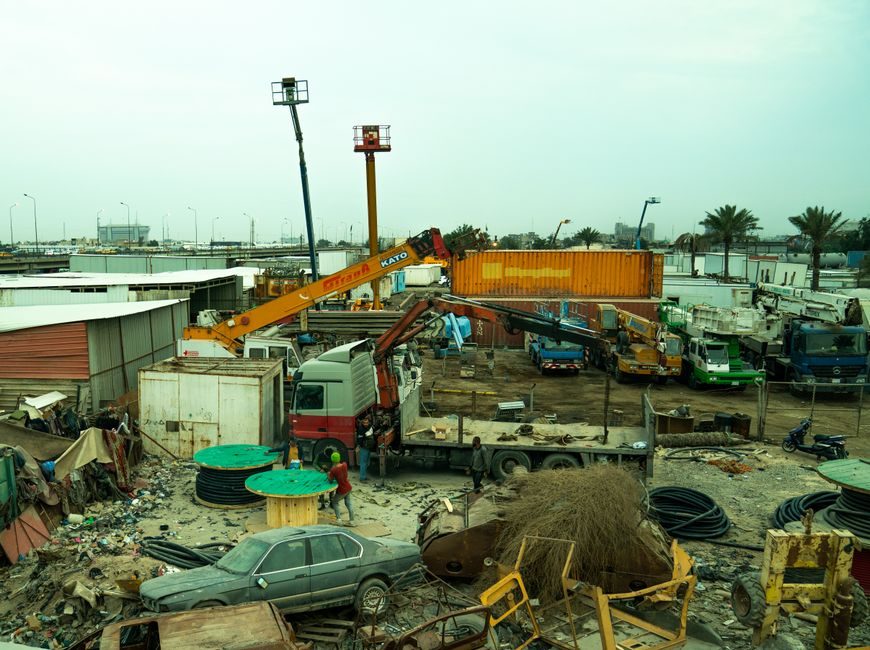
Truck crane selection in 2026 is driven by six engineering gates: maximum lifting capacity, boom length and number of telescopic sections, outrigger span, carrier axle configuration, hoist line speed, and overall roadable dimensions for transport permits — and on the 2026 used market a 25 t XCMG XCT25L5_Y lists at roughly USD 10,000–100,000 while a 60 t XCT60_Y sits in the same broad band per current XCMG export listings [S2].
Used International 2554-based truck cranes from the early 2000s remain a recurring entry point on the North American resale channel, confirming that mid-2000s carrier chassis and 20–30 t booms are the most common second-hand bracket for first-time fleet buyers [S1]. On the lighter end, Foton truck-mounted crane (福田随车吊) chassis cover 1–16 t lift classes for municipal, coal-mine and landscaping work, showing how the same basic vehicle format scales across an order of magnitude in capacity [S3].
Capacity Class and Boom Geometry
Lift capacity is the first gate and the one that drives every other spec. Light-duty classes run 1–16 t on a 2-axle Foton or equivalent carrier and are commonly used for landscaping, light pole erection and small equipment handling [S3]. Mid-range mobile truck cranes cluster at 25 t (XCT25L5_Y, 5-section telescopic boom) and 60 t (XCT60_Y) on the XCMG export catalog, and these are the two capacities that show up most often on 2026 procurement lists [S2]. Heavier classes (80 t, 100 t, 130 t and above) move to multi-axle carriers (4–6 axles), and these units are almost always specified new rather than bought used because the resale pool thins out above 70 t.
Boom length governs reach, and boom section count governs setup time and stowed envelope. A 5-section telescopic boom is the modern norm for the 25 t class because it folds shorter on the deck while still reaching the 30–40 m working radius typical of tower erection and sign-installation jobs [S2]. Buyers who only need 3-section geometry can save weight and cost, but they trade working radius and face restrictions on jobs where the crane must reach over a structure rather than beside it.
Carrier Axle and Roadable Dimensions
Carrier axle count decides both payload budget and road legality. A 2-axle carrier (typical of 1–16 t classes) usually keeps overall length under 10 m and gross vehicle weight under 18 t, so it can run on standard urban permits in most jurisdictions [S3]. A 3-axle carrier (typical of 25 t class) pushes GVW toward 26–33 t and length toward 12 m, which triggers escort-vehicle rules in several US states and EU countries. 4-axle and larger carriers (60 t and up) require special-transport permits in essentially every market and add a fixed logistics cost per move that should be priced into the ownership calculation [S2].
Wheelbase and outrigger spread are the two sub-criteria under the carrier gate. Short wheelbase improves site maneuverability but limits counterweight clearance; long wheelbase gives better lifting stability on the side and rear but rules out tight urban yards. Outrigger spread — usually 5.6 m to 7.8 m for 25–60 t classes — sets the effective lift chart because the load chart is calculated at full outrigger extension; partial extension derates capacity by 30–60% depending on the model.
Outrigger Span, Hoist Speed, and Hydraulic System
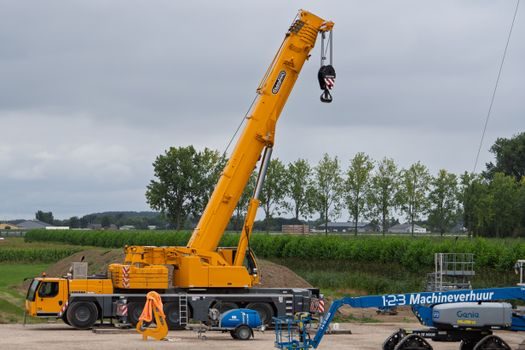
Outrigger span is where most failed selections originate, because the published load chart assumes the box-section beams are fully extended and correctly shimmed. Buyers on tight sites should derate capacity by at least 25% when outriggers are constrained, and should require the OEM to supply a partial-extensions load chart in writing before delivery [S2]. Hydraulic system pressure (typically 28–32 MPa on modern truck cranes) governs hoist line speed and slewing acceleration, and a single-stage gear pump is no longer adequate above 25 t — a load-sensing piston pump is the current baseline.
Hoist line speed and single-line pull matter more than buyers expect. A main hoist with 90–120 m/min line speed and 40–50 kN single-line pull is the working norm for 25 t telescopic units; below that, the crane loses cycles on repetitive lifts and the productivity case collapses. A secondary (auxiliary) hoist is mandatory for jobs that need a second line under the boom tip — most sign and tower work fits this pattern.
Selection Criteria Comparison Across Capacity Classes
Lining the three main capacity bands against four decision criteria gives a defensible shortlist. For 1–16 t classes on a 2-axle carrier, the working envelope is short, road permits are standard, and pricing on a Foton-style chassis is the lowest of the three bands [S3]. For the 25 t class (XCT25L5_Y reference), the unit is roadable in most jurisdictions without special permits, the 5-section boom reaches typical 30–40 m radius, and the 3-axle carrier keeps GVW under 33 t [S2]. For the 60 t class (XCT60_Y), capacity is doubled, reach extends toward 50 m+ with a jib, but road permits and the 4-axle carrier add a fixed logistics overhead per move [S2].
The decision breaks cleanly on job profile: municipal and landscaping buyers belong in the 1–16 t band; general construction and sign/tower erection belong at 25 t; bridge-beam and heavy industrial erection belongs at 60 t and above. Buyers who specify a 25 t unit for 60 t-class work will overload it on the first non-trivial lift; buyers who specify a 60 t unit for landscaping work will burn fuel and lose site access without gaining any productive capacity. The crane format itself — boom on a truck chassis — is shared with truck-mounted crane reference data, so the same selection logic applies across all three bands.
Used Market Pricing, Hours, and Inspection Gates
On the 2026 used market, listing data shows a 2001 International 2554-based truck crane still active in the resale channel, with condition and hours reported per-unit rather than aggregated — the relevant check for any second-hand purchase is engine hours (typically 8,000–15,000 hours is a realistic working-life band before major component work), boom-section wear, and outrigger hydraulic leak-down [S1]. XCMG export pricing for 25 t and 60 t telescopic truck cranes clusters in a USD 10,000–100,000 FOB band, which is wide because it spans new factory-direct and refurbished export inventory at the same time [S2].
Inspection gates for any used truck crane should be: (1) boom sections — check for ovality, dent depth, and section-slide wear; (2) outrigger pads and box beams — corrosion at the slide contact is the most common failure point; (3) hydraulic pump and motor — request a cold-start pressure test; (4) carrier engine and gearbox — the chassis is half the value of a used unit and a rebuilt engine is a USD 15,000–25,000 line item on most 2000s-vintage carriers; (5) load moment indicator (LMI) calibration certificate dated within 12 months. A crane without a current LMI calibration should be re-calibrated before any lifting work in jurisdictions that enforce it.
Standards, Safety Systems, and Compliance
The governing standards for a truck crane in most markets are the mobile-crane standard in the country of operation (for example, GB/T 6067 in China, ASME B30.5 in the United States, EN 13000 in the EU for crane safety, and ISO 12480 for safe-use procedures). Buyers should confirm which standard the load chart and the operator's manual are rated against, because a crane designed to one standard can be legally restricted in another market. The load moment indicator (LMI) and anti-two-block (ATB) system are mandatory safety systems on any modern truck crane above 16 t; absence of either on a used unit is a deal-breaker rather than a discount point. [S1]
Operator certification is the second compliance gate and is independent of the machine. A certified operator with a current credential is required in essentially every market; the certification must match the capacity class — a 16 t ticket does not cover a 60 t machine. For buyers scaling a fleet, this constraint often binds before machine availability does, and it should be planned into the procurement timeline.
Where a Truck Crane Is and Is Not the Right Machine
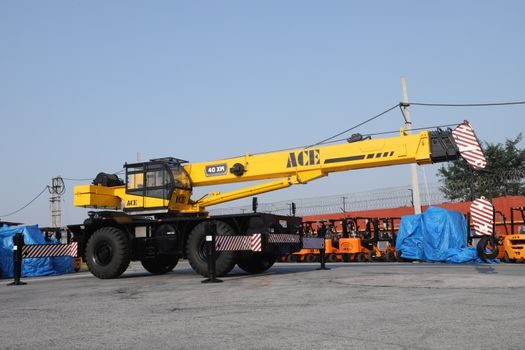
A truck crane is the right machine when the job moves between sites, when road permits can be obtained on a normal commercial-vehicle schedule, and when lift capacity is below roughly 100 t. It is the wrong machine when the work is site-bound (a crawler crane or aerial work truck is more efficient), when the job needs rough-terrain mobility rather than highway mobility (a rough-terrain crane on an off-road chassis fits better), or when the load is bulk material rather than a discrete lift (a dump truck or concrete mixer truck is the matching tool). [S2]
For buyers comparing truck cranes against other lifting formats, the wheel loader vs excavator decision follows similar capacity-versus-mobility logic and is a useful parallel reference. Likewise, fleet buyers balancing a new truck crane against a reach truck for warehouse work are really making a site-mobility decision, not a lifting decision, and should keep the two procurement paths separate. A truck scale on the yard is the right adjunct to a truck-crane fleet for invoicing by net lift weight on third-party jobs.
Trackable signals to watch over the next reporting cycle: (1) any tightening of road-permit rules for 4-axle carriers in the EU or US Northeast, which would shift demand toward 3-axle 25 t units; (2) OEM price moves on the 60 t class, where current FOB listings are compressed in a wide USD 10,000–100,000 band [S2]; (3) resale turn-over of early-2000s International 2554-based units, which signals whether the entry-level used bracket is contracting or holding [S1].