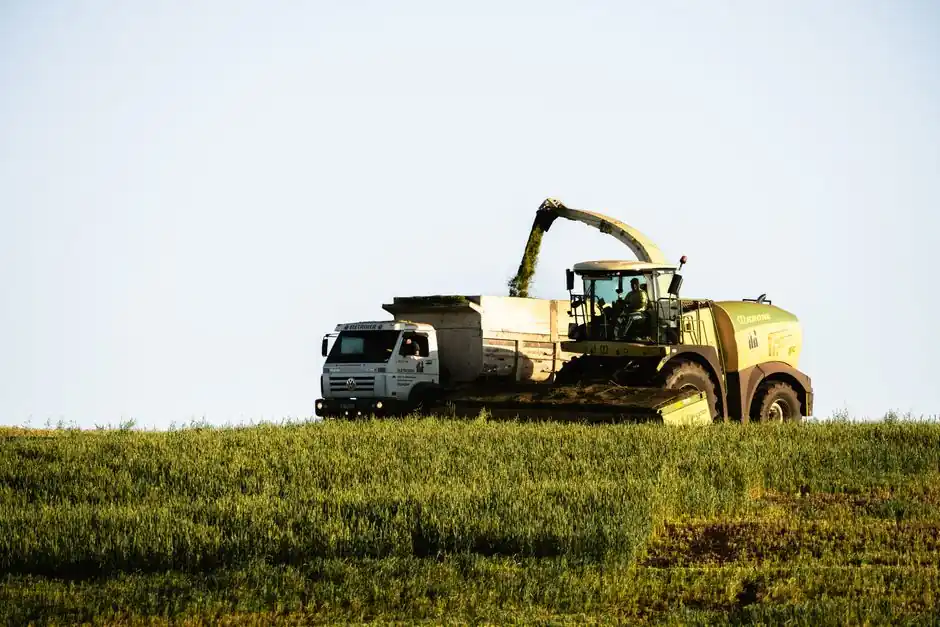
Boom-equipped truck-mounted concrete pumps sized 38-47 m vertical reach dominate agricultural concrete pours because farm drainage channels, silage clamp walls, and bunker floors demand high-volume placement in a single, continuous lift that wheelbarrow or crane-and-bucket methods cannot match [S3][S4].
For farm work the chassis choice matters as much as the pump: a 4-axle (8x4) or 5-axle carrier on agricultural tyres keeps ground pressure in the 80-120 kPa range needed to cross cultivated headlands without rutting, while still carrying the 30-40 tonnes GVW of a mid-range boom pump [S3].
Why a Boom Pump, Not a Line Pump, on the Farm
Boom pumps deliver 60-160 m³/h through a 4- to 5-section articulating arm, and that high reach is the reason they are specified for agricultural concrete rather than trailer or line units, which Utranazz describes as "towed behind a truck, offering mobility and versatility" but limited to slower output over ground-level runs [S2].
Trailer pumps lack the vertical lift for 4-6 m silage-bunker walls, and they need a separate concrete mixer truck feed loop that doubles the rolling stock on narrow farm tracks; EDDY Pump notes trailer pumps "are not as accurate as boom pumps" and are "ideal for small-scale applications" such as swimming-pool or residential pours, not large agricultural structures [S4].
Output, Pressure, and Boom-Reach Match
Most agricultural pours need 40-90 m³/h sustained, with theoretical concrete pressure in the 70-85 bar range and piston bore typically 230-260 mm on the S-class pump end used by Putzmeister, Schwing Stetter, SANY, and Liebherr [S3][S5].
Boom-reach selection for the farm usually lands in the 38 m, 43 m, or 47 m class: 38 m covers most dairy-parlour slabs and bunker walls, 43 m reaches over silage clamps with 6 m height, and 47 m is reserved for larger feed-centre or biogas digester work, since Strategic Market Research cites "heights of 60 meters or more" as the commercial-infrastructure range that agricultural work rarely needs [S3].
Carrier, Axle, and Tyre Constraints on Cultivated Ground
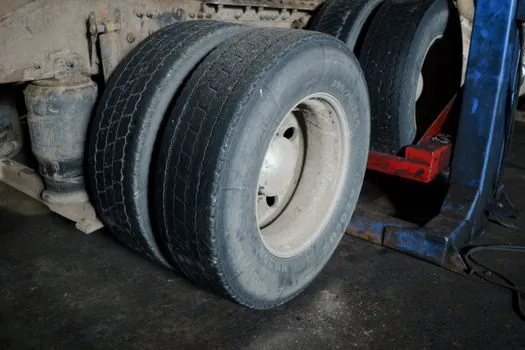
Agricultural sites punish equipment that concentrates load: a 5-axle carrier with a 4.8-5.4 m outrigger spread drops pad pressure to roughly 90 kPa, against the 180-220 kPa that a 3-axle 4-section boom exerts on a poorly positioned outrigger, and that delta is what stops a 30-tonne pump from punching through a wet headland apron [S3].
Tractor or auxiliary-engine selection is the second decision: a 6-cylinder diesel at 300-340 kW (Stage V / Tier 4 Final) running through a closed-loop hydraulic pump end is now standard, and the same hydraulic circuit also powers the boom-fold, so oil-cooler capacity must be sized for continuous slow slew on long bunker pours [S1][S3].
Comparison: Boom Pump vs Trailer/Line Pump for Farm Concrete
On the four criteria that matter to agriculture, the boom pump wins on three and loses on one: output (60-160 m³/h vs 20-45 m³/h for trailer), vertical reach (28-47 m vs 0 m without secondary boom), and placement accuracy ("maximum accuracy when pouring fine concrete", per EDDY Pump), but it loses on manoeuvrability inside narrow farm lanes because the carrier cannot back into sheds the way a 2-tonne trailer can [S2][S4].
For mixed farms that pour a few slabs a year, a tow-behind line pump paired with a small concrete pump truck for the heavy days is often the lower-capital route, but any operation pouring more than 200 m³ per week will pay back the boom-pump premium in labour and pour-cycle time within two seasons [S2][S3].
Pump-End Wear, Cleanout, and Farm-Site Water
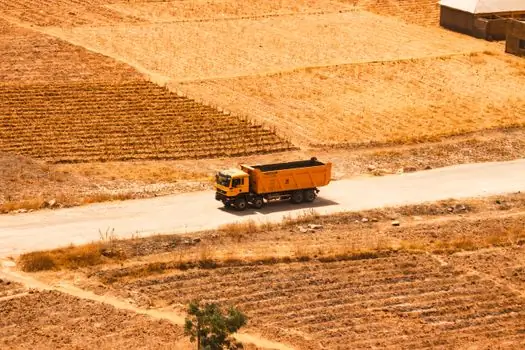
Farm concrete often contains a higher fines load from on-site aggregate, which accelerates wear-ring and S-tube replacement to roughly 8,000-12,000 m³ instead of the 15,000-20,000 m³ typical on washed urban mix, and that is the single biggest maintenance cost to budget against the capital price [S3][S4].
Water access is the other hidden constraint: a 47 m boom pump consumes 400-600 L of wash-out water per pour and needs a settling pit, so sites without a yard tap must budget a 1,000 L bowser on the support dump truck shuttle, otherwise cleanout grinds the pour to a halt [S2].
What a Truck-Mounted Concrete Pump Will Not Solve on the Farm
These units are not built for narrow orchards, polytunnel rows, or livestock buildings with 2.4 m door heights, and EDDY Pump is explicit that a truck-mounted boom pump "is not suitable for narrow spaces or sites with obstacles as large vehicles cannot be used in these areas" [S4].
For under-roof pours the practical answer is a 28-32 m boom on a 3-axle carrier or a static placing boom fed by a trailer line pump, because anything larger cannot reach over the eave line of an existing shed without scraping the roof sheet [S3][S4].
Sourcing, Standards, and Telemetry to Specify
Putzmeister, Schwing Stetter, SANY, and Liebherr lead the OEM list, with SANY's product line covering the truck-mounted, trailer, line, and placing-boom variants the agricultural buyer can mix-and-match [S3][S5]. Bonfiglioli slew drives are specified on the boom turret where high-holding-torque safety matters during a 6 m wall pour [S1].
Newer builds integrate "digital pressure monitoring, real-time performance diagnostics, and semi-autonomous boom operations" per Strategic Market Research, and buyers should require an OEM telemetry export so the farm's existing machinery telematics can log pour volume per hour against diesel burn [S3]. Engine emissions compliance to EU Stage V or US EPA Tier 4 Final is standard on 2024+ builds and should be confirmed at PO stage, since retrofit scrapping on agricultural fuel rebates is a recurring cost [S3].
Two trackable signals to watch into late 2026: the rollout of electrified and hybrid-hydraulic chassis from SANY and Putzmeister, which will change the auxiliary-engine and PTO question for farm buyers, and any 2026 dealer-network expansion of mid-range 38-43 m units into the UK, Ireland, and Polish dairy regions where the current rental fleet is thin [S3].
For related coverage, see Concrete Pump Truck Selection for Mining: Boom, Outrigger, and Ground-Pressure Criteria.