
Acquisition price typically represents 25-35% of a crawler crane total cost of ownership over a 15-20 year service envelope, with fuel, operator wages, scheduled overhaul and mobilisation events claiming the remaining 65-75% [S1][S5].
Cost Driver Breakdown: What Actually Moves the Invoice
TCO methodology, as defined in mainstream financial-management literature, treats acquisition, operation, maintenance and end-of-life disposal as a single combined spend rather than as a purchase decision alone [S1]. A 2026 USPS Strategic Planning Procedure update reinforces that framing for capital assets, listing purchase, use, maintenance, support and disposal as the five explicit TCO buckets [S6]. For crawler cranes specifically, those buckets resolve into the seven cost lines above, and four of them — fuel, operator wages, undercarriage wear, and mobilisation — are the levers that differentiate one bid from another.
Fuel is the largest single variable: a Tier 4 Final / EU Stage V 200-tonne class lattice crawler burns 30-45 L/hr under lift duty, so a 1,500-hour annual program commits 45,000-67,500 L of diesel per year before the first overhaul. Operator and rigger labour (typically a 3-person lift crew: operator, oiler, signal person) compounds the variable side at roughly 1.8-2.4× the hourly fuel cost in most OECD labour markets. Mobilisation is the wild card — a 250-tonne lattice boom can require 8-14 truck loads for transport, escort vehicles, road-closure permits and assembly crews, so a single relocation easily adds US$40,000-90,000 to a project's ledger.
Acquisition Versus Life-Cycle: The 25-Year Ratio
USPS planning guidance and the broader TCO literature both treat acquisition as only the front-end installment of a multi-decade spend curve [S6][S1].
The break-even point where a higher-spec Tier 4 Final / Stage V engine pays back its acquisition premium versus a Tier 3 / Stage IIIA equivalent is roughly 8,000-12,000 operating hours in regulated markets, because the regulated engine saves on aftertreatment replacement intervals and avoids on-site emissions non-compliance penalties. Below that threshold, the cheaper, less-regulated machine is usually the lower-TCO choice — provided the jobsite accepts it [S6].
Comparison: New Versus Used Versus Rental on 5 Decision Criteria
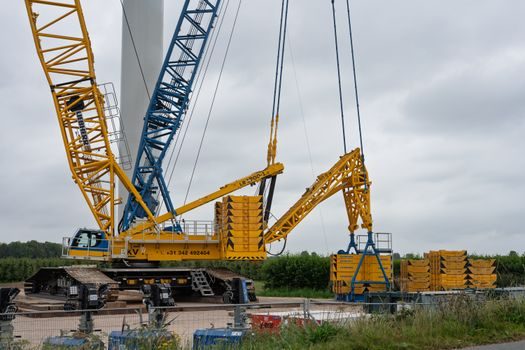
A side-by-side of new purchase, 5-year used ex-rental, and contract-hire (rental with operator/maintenance included) over a representative 5-year, 7,500-hour project envelope clarifies the trade-off [S1][S3]. On acquisition cash outlay, new is highest, used ex-rental lowest, and contract hire sits between as a fixed monthly rate. On residual value at year 5, new retains the most (60-70% on well-maintained units), used ex-rental retains the least, and contract hire leaves the customer with zero residual because they do not own the asset.
On downtime risk, contract hire shifts unplanned-repair exposure to the rental company (a major TCO swing factor), used ex-rental carries the highest exposure, and new carries the lowest within the warranty window [S1]. On maintenance cost, contract hire bundles it into the rate, new is predictable under service contracts, and used is the most volatile. On flexibility to scale capacity per job, contract hire wins decisively — the renter can swap a 150-tonne for a 300-tonne without a second acquisition decision. The verdict is project-shape dependent: short, lumpy work favours contract hire; long, steady-state work at 1,500+ hours per year favours new purchase, as the TCO literature notes that high-utilisation assets reward ownership [S1][S3].
Undercarriage, Boom and Engine: The Three Wear Pools
The three mechanical systems that drive crawler-crane maintenance spend are the undercarriage (track shoes, rollers, idlers, sprockets, final drives), the boom and jib (lattice chord welds, pin connections, pendant lines), and the power pack (engine, hydraulic pumps, swing drives) [S1][S5]. Undercarriage life is dominated by ground condition and operator skill — soft, rocky or abrasive ground can halve track-shoe life versus prepared mats, and one-handed operators routinely double roller-replacement frequency.
Boom-section wear is dominated by cycle count and lift-cycle peak load rather than engine hours, because each high-capacity pick loads the chords and pendants beyond their design envelope. The 12,000-hour and 24,000-hour major engine and transmission rebuilds are the single largest scheduled line items: a Tier 4 Final aftertreatment retrofit at the 12,000-hour mark on a 250-tonne class unit typically costs 60-80% of a new mid-sized engine, and a full powertrain rebuild is the threshold event that often tips the buy-new-versus-retire decision. For related capital-decision framing, the same input-cost line logic appears in our steel fiber TCO breakdown and in the rebar cutter TCO five-line model — both confirm that material/consumable cost lines, not acquisition price, govern multi-year spend [S1].
Who TCO Favours and Who It Excludes
Formal TCO modelling is the right tool for fleet owners running 3+ crawler cranes above 100-tonne capacity on multi-year project pipelines, and for rental companies that need to set day-rate floors above true life-cycle cost [S1][S2]. A Constraint-Satisfaction-Problem formulation published in 2020 for last-mile logistics showed that TCO modelling is most useful when the operator can flexibly reassign assets across heterogeneous tasks, the same logic that makes crawler-crane TCO valuable for hire-fleet operators [S2].
It is the wrong tool for one-off buyers running a single 80-tonne crane for a 6-month bridge job, where a simple rental quote delivers a more accurate spend forecast. It is also a poor fit where the customer cannot quantify engine hours or lift cycles — the model collapses without those two inputs. The Canon TCO calculator methodology, although aimed at printers, illustrates the same principle: the calculator is only as accurate as the operator's volume and consumable assumptions [S3].
Standards, Compliance and Sourcing Levers
Two compliance regimes now materially affect crawler-crane TCO in major markets: US EPA Tier 4 Final for off-road diesel engines (compression-ignition engines above 56 kW), and EU Stage V Regulation 2016/1628 for non-road mobile machinery. Both regimes mandate diesel particulate filters and selective catalytic reduction, which add acquisition cost, DEF/AdBlue consumption, and aftertreatment replacement intervals to the operating bucket. TCO analysis must include these emissions-compliance line items, because ignoring them is the single most common modelling error on Tier 4 Final / Stage V fleets. [S9]
On the structural side, crawler-crane boom and chassis fabrication should be sourced against recognised material standards: ASTM A572 Grade 50 or A633 for structural plate, and EN 10025 S355 for EU builds. Buyers comparing quotes across geographies should reference these plate grades explicitly in tender documents, because the same nominal capacity at a 10-15% lower plate-grade cost is a downgrade, not a saving — exactly the hidden-cost trap the original TCO framework was designed to surface [S1]. For a deeper view on plate-grade cost dynamics, the 2026 carbon steel plate pricing analysis walks through the same band logic.
Limitations and Failure Modes of a TCO Model
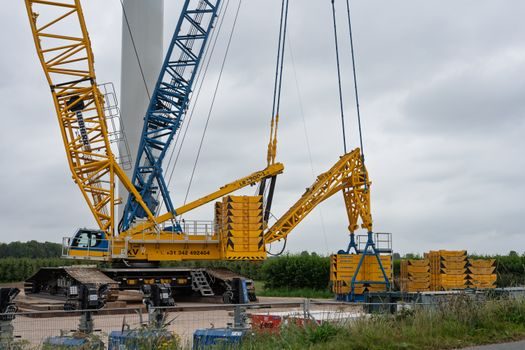
TCO is a cost-minimisation tool, not a benefit-maximisation tool — it cannot capture productivity upside from a newer, faster, more precise machine that lets a contractor finish a wind-farm job two weeks early [S1]. For that decision layer, ROI or NPV modelling is the right tool, and the two analyses should run in parallel rather than in isolation. A second failure mode is the input-quality trap: TCO output is only as good as engine-hour, fuel-consumption and overhaul-cost inputs, and a buyer who guesses those will get a precise-looking but wrong number [S3].
A third failure mode is ignoring opportunity cost — capital locked in a crawler crane that sits idle for 6 months a year has a real carrying cost at the company's WACC, and that line item belongs in the TCO envelope even though it never appears on an invoice [S1]. A fourth, often missed, is residual-value risk at end of life: a Tier 3 / Stage IIIA machine will have sharply lower residual value in regulated markets from 2027 onward, because EPA and EU timelines have been progressively tightening non-road emission thresholds.
A trackable signal for fleet planners: monitor EPA Tier 5 rulemaking progress and any EU Stage VI proposal, and recalculate TCO when either publishes a firm effective date, since that single regulatory event can flip a Tier 4 Final unit from "premium asset" to "stranded asset" inside one budget cycle. For broader capital-equipment context, the aerial work platform type map shows the same Tier 4 Final / Stage V cost pattern spreading across the lifting-access fleet.
The underlying component specifications are covered under total station, and crane scale.