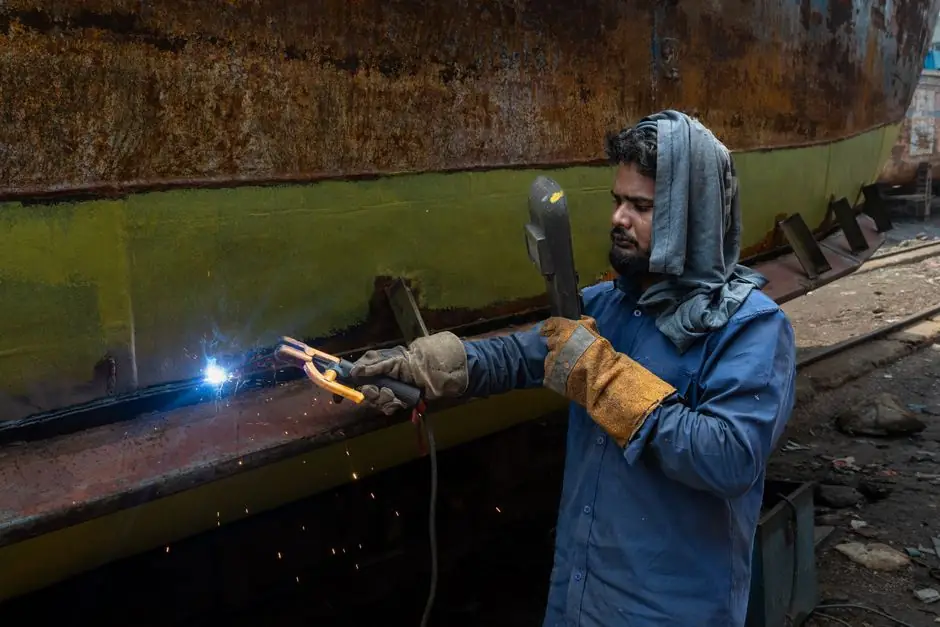
Specifying arc welding machines for tunnel construction is dominated by three constraints: space, ventilation, and power stability. Engine-driven MMA, FCAW self-shielded, and compact inverters with VRD and PFC are the practical choices on underground sites [S1][S2].
Tunnel welding loads split into rebar cages, water-stop splicing, gantry/segmental steel, and on-site repair. Plate thicknesses from 6 mm rebar to 30+ mm gantry plates demand outputs between 200 A and 500 A, with duty cycle de-rated against ambient heat [S2][S3].
Why inverter and engine-driven machines split the work
Modern inverter power sources operate at switching frequencies well above the audible range, which shrinks magnetics and lets a 500 A class machine fit in roughly 25-35 kg, compared with 80-120 kg for an older silicon-controlled-rectifier (SCR) set of equal nominal output. For tunnel crews carrying gear down shafts or on narrow gauge trolleys, this mass saving is the dominant procurement driver, not the spec sheet's "advanced features" [S2].
Selection criteria for tunnel sites
Five engineering variables drive welder selection underground: material and thickness, joint position, ventilation, available power, and duty cycle headroom. Carbon steel rebar and structural plate up to 20 mm are commonly joined with Stick (SMAW) or self-shielded FCAW because no shielding gas cylinder is needed and wind/draft does not strip the gas shield [S3].
Plate thicknesses above 20 mm in gantry and segmental steel ring splices generally call for higher amperage and a process with deep penetration, typically Stick with cellulosic electrodes (E6010/E7010) or FCAW with rutile or basic tubular wire. The Darda engineering reference for tunnel construction emphasises that the welding machine must deliver defined open-circuit voltage, selectable polarity, and either constant-current (CC) or constant-voltage (CV) characteristic matched to the electrode type, with remote-control interfaces and parameter memory for reproducible results across shifts [S2].
On the power side, tunnel sites usually run 400 V three-phase distribution or diesel generator sets, and welding loads share the bus with ventilation fans, dewatering pumps, and shotcrete rigs. Inverters with PFC place less reactive load on the generator, while a defined IP protection rating (commonly IP23S for the electronics enclosure) keeps humidity and dust out of the cabinet [S2].
Process comparison for tunnel welding tasks
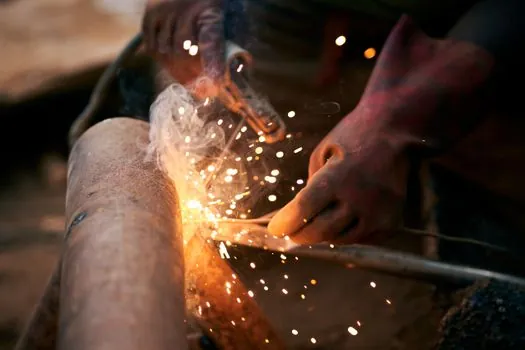
For an engineer choosing between the main process options on a tunnel job, the practical comparison on four criteria is: [S2]
Stick (SMAW): fits outdoor, drafty, dirty, and confined underground work; tolerates rusty rebar and mill scale; lower deposition rate (typically 1-3 kg/h for a 3.2 mm electrode) and slag cleanup overhead. Best for tacking, root passes on gantry splices, water-stop plates, and emergency repair [S1][S3].
Self-shielded FCAW: deeper penetration than MIG on thick plate, high deposition (4-8 kg/h typical), no shielding-gas cylinder to transport through a tunnel. Limitation: higher fume volume, so ventilation must be sized for it. Best for structural seam welding on thick gantry steel and heavy rebar cages [S1][S3][S4].
MIG/MAG (GMAW): clean weld bead, high speed, easy to mechanise, but requires Argon/CO2 shielding gas that drifts off in tunnel draft and consumes limited bottle storage. Best suited to shop prefabrication of segmental reinforcement cages and invert formwork before they go underground [S3][S4].
TIG (GTAW): highest quality and aesthetics, excellent on stainless and non-ferrous, but slow (often under 1 kg/h) and operator-skill intensive. Generally reserved for sanitary or instrument-line welds in service shafts, not bulk structural work [S1][S3].
Duty cycle, derating, and site power reserves
Duty cycle is stated as a percentage of a 10-minute window at a given current; for example, "60% DC at 400 A" means the machine can sustain 400 A for 6 minutes out of every 10 before thermal protection forces a cool-down. Darda's engineering note specifies ambient 40 °C as the typical reference condition, with derating required above that and free airflow around the cabinet mandatory [S2].
On tunnel sites, plan for derating: ambient rock temperatures in deep bores can sit at 28-35 °C, humidity is high, and dust from drilling and shotcrete restricts heat-sink fins. A 500 A class inverter specified at 60% DC at 40 °C will often deliver closer to 40-50% DC in real tunnel air, so over-spec the nominal current by at least one frame (e.g. select a 500 A machine if calculations say 400 A continuous). For repetitive seam welding on thick plate, this margin prevents the thermal cutout trips that stop shift production [S2].
Power quality, generator pairing, and cable practice
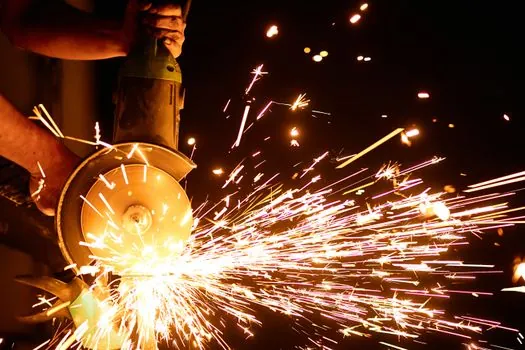
Welding machines supplied from diesel generators need stable voltage and low total harmonic distortion; otherwise the inverter's control loop can mis-trigger and the arc becomes unstable. Recommended measures are automatic voltage regulation (AVR) on the generator, sufficient short-circuit power (typically a genset rated 1.5-2x the welding machine's kVA draw), and PFC on the welder to reduce reactive current [S2].
Long extension leads cause voltage drop that reduces arc energy at the workpiece. A practical rule: keep the welding lead run under roughly 30 m, use 50 mm² or larger flexible cable for 400 A class work, and parallel-cable beyond that rather than going to a single longer run. Residual current devices (RCDs) downstream of the welder must be specified for potential DC fault current components where inverter output is not isolated; otherwise nuisance tripping or blind protection results [S2].
Safety features required for tunnel work
Voltage Reduction Device (VRD) cuts open-circuit voltage to a safe level (commonly below 12-24 V DC) when the arc is not struck, which is mandated in many underground coal and gassy-tunnel rules because stray voltage can ignite methane-air mixtures. Thermal protection with clear status and fault codes reduces troubleshooting time, and IP23S or higher ingress protection keeps conductive tunnel dust out of the electronics [S2].
Fume extraction is a parallel selection criterion, not a welder spec. FCAW produces roughly 1.5-2x the fume volume of MIG per kg of weld metal, and Stick with cellulosic rods is again higher than rutile low-fume types. Tunnel ventilation must be sized for the welding load on the shift, or low-fume electrode classifications (E7018 low-hydrogen, basic-flux FCAW wires) should be substituted [S3].
Decision rules for the specifier
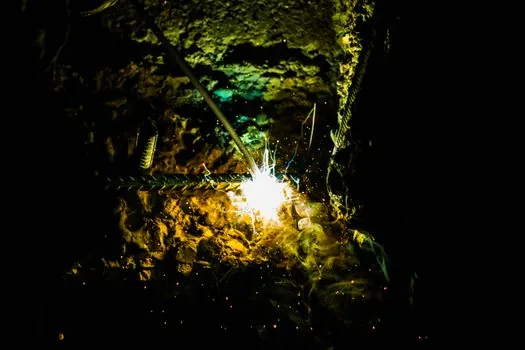
For rebar splicing and water-stop plates in NATM tunnels, specify MMA/Stick inverters in the 200-400 A class, 60% DC at the rated current, VRD fitted, IP23S, with E7018 or E6010 electrodes chosen by joint position. For thick-plate gantry and segmental steel, use self-shielded FCAW at 350-500 A or Stick with cellulosic E7010 for root and cap. For shop prefabrication, MIG/MAG is the right tool. For stainless or thin non-ferrous, TIG only. [S3]
In all cases, match the welder to the generator's short-circuit power, oversize the duty-cycle frame for tunnel ambient, and treat ventilation and fume extraction as part of the welding package rather than an afterthought [S1][S2][S3].
For related site specification, see the stud welder selection guide for tunnel shear connectors and the arc welding machine picks for steel construction sites; the arc welder fundamentals entry is the reference starting point for process and terminology.
The underlying component specifications are covered under welding cutting tool, and construction tools.