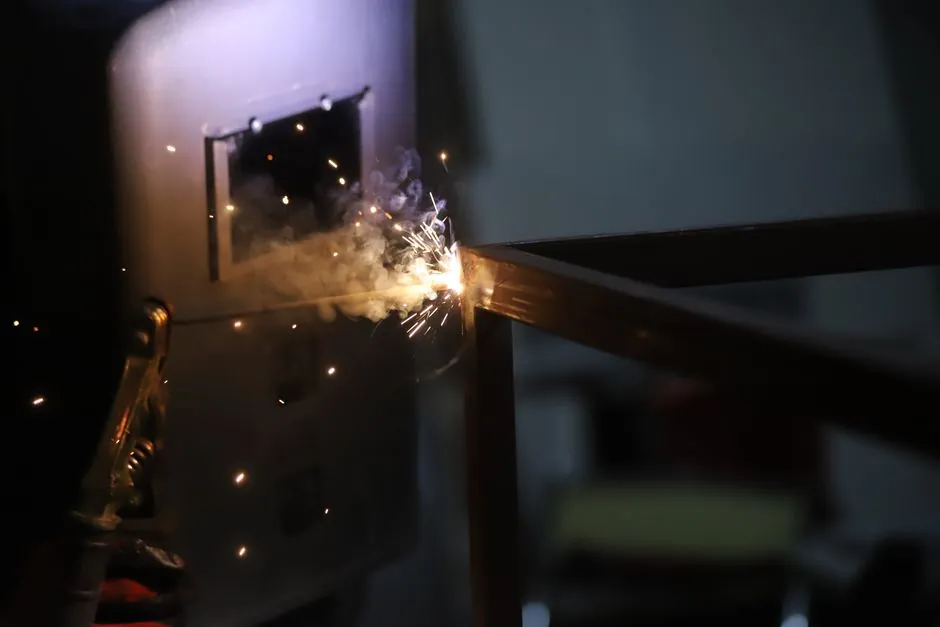
On structural steel sites, stick (SMAW) and flux-cored arc welding (FCAW) dominate because they tolerate dirt, wind, and the deep-penetration multi-pass work that I-beams, plate girders, and rebar splices require [S1][S5].
For typical 6-25 mm carbon-steel plate and reinforcing bar, a 200-300A output class with at least 60% duty cycle at the rated current is the practical baseline; a 140A hobby unit is too small for anything beyond tack welding [S5][S6].
Process Match for Site Work: SMAW vs FCAW vs MIG vs TIG
Stick (SMAW) is the most common site choice for construction and pipeline work because the flux-coated electrode supplies its own shielding and stays stable in wind and dirty steel, the conditions that defeat gas-shielded processes [S1][S3]. Flux-cored arc welding (FCAW) runs the same wire-feed logic as MIG but uses a flux-cored wire that does not need an external gas bottle, which is why it is the default for outdoor structural and heavy-plate fabrication [S4].
MIG (GMAW) is faster and cleaner but needs shielding gas and a sheltered bay, so it belongs in a fab shop welding light-gauge steel and stainless, not on an open deck [S1][S4]. TIG (GTAW) handles stainless, aluminum, nickel alloys, brass, magnesium, gold, and copper, but the operator skill and travel speed make it uneconomic for primary structural members [S2][S5]. For primary steel framing, an arc welder in stick or flux-cored configuration remains the workhorse; reserve MIG/TIG for the shop-fabricated sub-assemblies that arrive on site already welded.
Output Class, Duty Cycle, and Input Power Sizing
Welding output for a structural site is sized to plate thickness, not to marketing amps: 140A covers sheet steel and light repair, 200-250A is the working sweet spot for 6-12 mm plate and rebar, and 300A+ is reserved for thick-plate multi-pass work and pipe [S4][S5]. Duty cycle is the second number that actually matters: it states the percentage of a 10-minute window the machine can deliver its rated output without tripping thermal protection; structural work should spec at least 60% at the rated amperage, and heavier production should look for 80-100% [S6].
Input power is dictated by the site supply. A 120V/20A branch limits you to roughly 140A output and thin materials, while 220-240V single-phase unlocks the 200-300A industrial class; engine-driven MIG/stick combos such as the Lincoln Ranger 305 G at 50-300A run on their own fuel for sites without grid power [S4]. A typical 510 lb engine-driven multi-process rig trades portability for site independence, while inverter stick units near 40 lb cover the rooftop work where a 510 lb genset will not go. In the broader construction tools inventory, a site electrician will usually run a dedicated 32A or 50A feeder to the welding bay to keep voltage drop under control on long cable runs.
Polarity, Electrode Choice, and Filler Matching
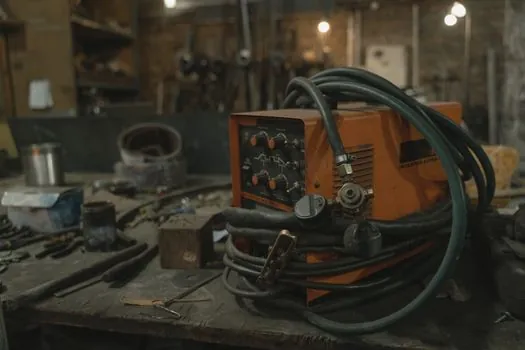
Polarity drives penetration, not just arc stability: DCEP (reverse polarity, electrode positive) gives deeper penetration suited to structural butt joints, while DCEN (electrode negative) gives shallower penetration and faster deposition suited to thin sheet and surfacing; AC is reserved for processes such as AC TIG on aluminum where the oxide skin must be cleaned each half cycle [S1]. The arc itself runs near 3,600 deg C (about 6,500 deg F), well above the melting point of carbon and low-alloy carbon steel plate [S1].
For mild and low-alloy structural steel the E6010/E6011 cellulose-stick electrodes deliver the deep-penetration, all-position performance AWS D1.1 welders expect on pipe and plate; E7018 low-hydrogen electrodes are the default where notch-toughness and low hydrogen are specified, especially on thick-plate bridge and high-rise work [S1][S5]. In FCAW, E71T-11 self-shielded wire is the field default because it does not need a gas bottle, while E71T-GS or gas-shielded E71T-1 is faster indoors. For the alloy steel grades (e.g. ASTM A514, A572 Gr. 50) and weathering steel (A588) used in bridges and high-rise cores, low-hydrogen practice and matching low-hydrogen consumables are mandatory to avoid underbead cracking.
Power Source Type: Transformer, Inverter, Engine-Driven
Conventional transformer-rectifier stick welders are heavy, rugged, and cheap to repair, which is why they still dominate site racks; they typically run only on 220-240V input. Inverter-based stick/MIG units weigh around 13-40 lb for a 160-220A class (e.g. Miller Maxstar 161 at 13 lb, ESAB Rebel EMP 215ic at 40 lb), offer 120V/240V dual-voltage flexibility, and add arc-force, hot-start, and anti-stick features that make them forgiving for less experienced operators [S4].
Engine-driven welder/generator sets (Ranger 305 G class, 50-300A, ~510 lb) combine a multi-process welder with a 5-10 kW auxiliary generator for lights, grinders, and the welding cutting tool accessories the fitter carries, which is why they remain the standard on remote pipeline and bridge sites. Multiprocess inverter rigs (Lincoln MIG 210 MP, ESAB Rebel) trade raw amperage for the ability to run stick, MIG, and flux-cored from one box, useful for a small steel-fab subcontractor that mixes site erection with shop time but overkill for a pure erector.
Decision Matrix for Common Steel-Construction Scenarios
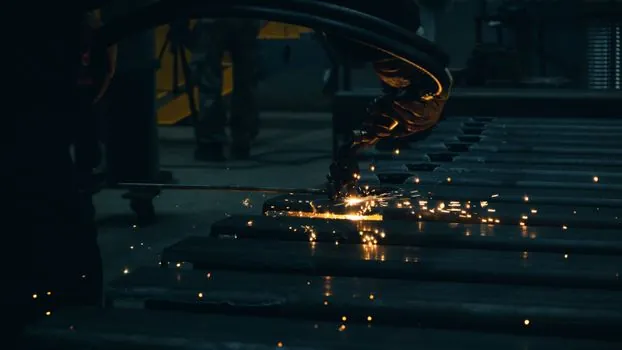
For shop-prefab beam splices in 6-20 mm mild steel, a 200-250A inverter MIG (GMAW) with Ar/CO2 shielding gives the best productivity and bead cosmetics. For site erection of I-beams, columns, and base plates in 10-25 mm plate, a 250-300A stick (SMAW) inverter with E7018 low-hydrogen electrodes is the safer choice, with a 60%+ duty cycle and 220-240V input. For rebar splicing in mat foundations, a 300A engine-driven stick/FCAW combo handles the long leads, dirty bars, and outdoor wind that disqualify gas-shielded MIG. [S1]
For thick-plate bridge girders (25-50 mm) and seismic moment-resisting connections, a 400A+ diesel engine-driven stick set with E7018 or E8018 low-hydrogen electrodes and preheat discipline is the minimum; this is the same envelope where electroslag pressure welding selection for steel construction becomes the faster option for vertical column-to-column splices. For tunnel or shaft steel sets, FCAW with E71T-11 self-shielded wire is the safer call than gas-shielded MIG, since wind and confined-space ventilation make shielding gas unreliable; the same logic shows up in stud welder picks for tunnel construction where drawn-arc and capacitor-discharge processes are the no-gas alternative.
Limitations, Failure Modes, and What to Reject
Stick welders produce more spatter, slag, and slower travel speeds than MIG, so they are the wrong tool for cosmetic architectural steel and high-volume production [S1][S4]. FCAW slag must be removed between passes, and self-shielded wire generates fumes that demand forced ventilation, especially in tanks, shafts, and confined basement pours. Low-quality inverter units under 140A cannot sustain structural weld profiles and will trip thermal protection during a multi-pass groove weld, which is the single most common on-site failure mode in budget machines.
On galvanised or painted steel, the zinc or coating must be removed locally before welding or the weld will be porous and the welder exposed to toxic fumes; this is a job-procedure issue, not a machine one. Welding dissimilar metals (e.g. carbon-steel rebar to weathering-steel beam) generally requires a third compatible filler and prequalified WPS, and is rarely a one-machine-swap problem; brazing is sometimes the correct call instead.
Trackable Signals to Watch Next
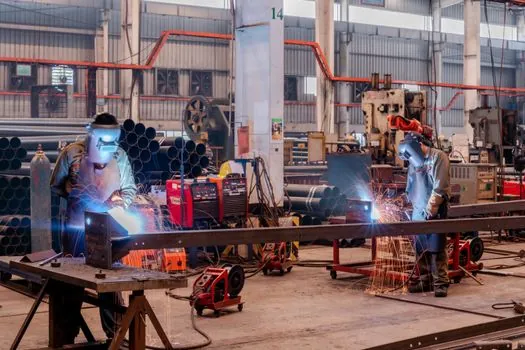
Two data points to monitor over the next 12 months: (1) inverter-stick efficiency gains in the 200-300A class, which keep cutting weight from ~30 kg to under 20 kg and shift the cost-vs-portability balance on multi-storey jobs; (2) wider field deployment of battery-powered stick inverters (around 200A peak) for high-rise and indoor sites where engine exhaust is restricted, complementing the electroslag and stud-welder options already covered for rebar and shear-connector work. [S4]