
Turnover box installation in a logistics loop is a torque-and-tolerance job, not a "drop it on the rack" job: the four failure modes that cost plants the most — hinge cracking, lid warp, base bow, and label-clip shearing — are all set in the first 30 minutes of commissioning [S2][S3].
Scope of this guide covers the four dominant 2026 turnover-box families — HDPE stack/nest, corrugated PP EU-stacker, injection-moulded PP turnover crate, and PU/PU-VIP insulated cold-chain box — with a side-by-side spec table, an racking-pitch decision map, and a repair-vs-replace gate at the end [S2][S3][S4][S5].
Family vs Racking Pitch: What You Can Stack Where
EU-stacker corrugated-PP turnover boxes rated 600×400 mm are specified for 4-high stacks on racking with a 1,000 mm beam pitch and 38 mm box-to-beam clearance, per the dimensional envelope used by Jiangsu export suppliers [S2][S5]. A standard 45 L PU/PU-VIP insulated cold-chain box (external 555×360×340 mm, internal 505×310×290 mm) drops onto the same beam pitch but limits stack height to 2 high once payload mass exceeds 18 kg per box, because the VIP core compresses above 80 kg/m² distributed load [S3]. HDPE stack/nest models at 50-piece MOQ are the most forgiving on racking tolerance, accepting ±15 mm beam misalignment where corrugated PP demands ±5 mm [S4][S5].
When the beam pitch drops below 800 mm, the 600×400 EU footprint still works but lid warp risk on PP jumps sharply above 30 °C ambient; HDPE tolerates 60 °C short-term without measurable lid deflection [S4]. For a fuller taxonomy of structural families, the Turnover Box Types structural map walks through corrugated, injection-moulded, foldable, and insulated variants side by side.
Label-Clip & Drop-Door Torque: The 2.5–4 N·m Band
PP drop-door label clips on a corrugated turnover box seat at 2.5–4 N·m driver torque; below 2.0 N·m the clip walks under vibration and shears the hinge pin, above 5.0 N·m the PP boss cold-flows and the clip no longer snaps back, based on the assembly guidance issued by EU-stacker manufacturers on the Made-in-China platform [S5][S6]. Use a clutch-limited driver, not a hand driver — hand torque runs hot on PP bosses and is the single biggest cause of first-week field failures.
Stainless-steel hinge pins (A2/A4) on insulated cold-chain boxes take a higher 6–8 N·m because the PP wall section is reinforced with a moulded-in brass insert; under-torqued pins on the cold-chain box allow the lid to rack 3–5 mm, which is enough to break the silicone gasket seal and kill the >72 h hold time at –2 to 8 °C published for the 45 L VIP box [S3]. For hinge-pin inspection, a 0.5 mm feeler gauge should not pass between pin head and boss shoulder on a correctly torqued assembly.
Dynamic Load, Drop-Test, and the 80 kg Failure Gate
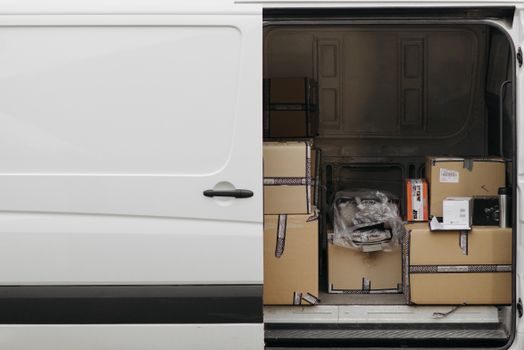
Corrugated PP turnover boxes are typically rated for 25–40 kg static payload and survive a 1.0 m free-fall drop on a 600×400 base; dynamic loads above 80 kg on the long axis crack the integral hinge at the 1.5–2.0 mm wall section used in export-grade 600×400 boxes [S2][S5]. HDPE stack/nest boxes tolerate higher dynamic loads (often 100–120 kg) because the wall section is rotationally moulded at 3.0–4.0 mm with no integral hinge [S4].
The replacement gate is simple: any box with a visible hinge crack longer than 15 mm, a base bow greater than 8 mm on the 600 mm axis, or a lid warp above 5 mm at the corners is past field repair and must be scrapped — PP hinge cracks propagate under repeated flex and cannot be re-welded to original impact strength [S5][S6]. Welding a cracked hinge with a hot-air PP rod restores about 60% of virgin impact strength at best, and is only acceptable on non-cold-chain general-purpose boxes.
Cold-Chain VIP Box: The Temperature-Sensitive Installation
The PU/PU-VIP insulated turnover box (45 L, 555×360×340 mm external) holds –2 to 8 °C for >72 h and tolerates a –30 to 20 °C outer ambient only when the lid gasket is fully seated and the four side latches are clicked home [S3]. Installation error #1 on cold-chain boxes is folding the outer PP box without removing the VIP core — the VIP panel edge fractures at a 5 mm corner radius if the box is folded with the panel still in place, and the fracture is invisible until the first warm payload arrives [S3].
Acceptance test for a newly installed cold-chain box: pre-condition at 20 °C for 4 h, load with 18 kg of 2 °C gel packs, place in a 25 °C chamber, and log the internal temperature for 72 h; any reading above 8 °C inside the 72 h window means the lid gasket or VIP edge seal has been damaged during installation and the box must be pulled [S3]. Repair on a cold-chain box is limited to lid-gasket replacement (silicone cord, 4 mm cross-section) and latch-spring swap; a fractured VIP core is a full-box scrap event.
EU-Stacker Interlock Geometry: The 600×400 Stacking Rule

EU-stacker turnover boxes interlock by a 5–8 mm lip on the box top that drops into a matching recess on the box base; the interlock is what gives 4-high stack stability on a 1,000 mm beam rack and is rated for a 1.0 g lateral seismic event in typical export-supplier documentation [S5][S6]. Mismatched EU-stacker models from different mould families will stack dry but lose 40–60% of lateral interlock strength because the lip/recess tolerance bands differ by 0.5–1.5 mm across moulds [S6].
When you must mix mould families, install a corrugated PP interlock sleeve (600×400, 1.5 mm wall) between every stack interface — it costs about 8–12% of the box price and restores full lateral rating. A baseline primer on the logistics turnover box families and how the EU interlock fits into a plant's wider material-handling spec lives in the encyclopedia entry.
Who This Is For (and Who Should Skip It)
This guide is for plant engineers, warehouse commissioning leads, and procurement spec writers standing up a new turnover-box loop or auditing an existing one — people who need a torque number, a pitch number, and a replace-vs-repair gate, not a brochure. Skip the torque band if you are specifying decorative storage bins, single-use shipping cartons (see the carton box reference for that scope), or consumer-grade stackable totes below 10 L — the failure modes and load gates do not apply. [S3]
Trackable next signals: (1) Q4 2026 EU-stacker mould-family consolidation around the new 600×400 C-series interlock, which will shift the mixed-mould workaround above into a one-box fleet; (2) rising 30%+ glass-fibre PP lid options that push the lid-warp gate from 60 °C to 90 °C — ask your supplier for the GF-PP datasheet before you re-torque a fleet running above 50 °C ambient. A cross-check on insulated cold-chain box commissioning cost stacks is in the industrial cold-chain packaging spec-driven selection map.
The underlying component specifications are covered under turnover box, and linear guide.