
A turnover box is a rigid, reusable industrial container engineered to circulate repeatedly through a closed storage-and-transport loop; in B2B catalogues it is classed by wall structure, moulding process, and stack/return geometry rather than by generic capacity [S3][S4].
Two polymers dominate the mould: polypropylene (PP) for higher tensile strength and chemical resistance, and polyethylene (PE) for impact resistance, low-temperature flexibility, and natural UV tolerance — the same material split that drives plastic pallet selection [S3].
Five Structural Families Used in Industrial Loops
Industrial plastic containers are organised by how the box is shipped empty and how it stacks when full, and Chinese manufacturers commonly list five families: solid-wall injection-moulded, foldable/collapsible crate, ventilated (mesh or slotted) wall, stack-nest (rotational stack), and pallet-box (pallet + sleeve + lid) [S1][S4].
The 550-series industrial containers catalogue groups "plastic turnover box" alongside injection-moulded pallets, blow-moulded pallets, and the foldable crate/basket series — confirming that the turnover designation is a return-loop property, not a moulding process [S4]. Solid-wall injection-moulded PP is the default for closed-loop automotive and electronics dunnage where one-piece rigidity matters more than empty-return density [S3]. Foldable/collapsible variants — including the "foldable plastic basket (new type)" lines — trade moulding complexity for 3:1 to 4:1 empty-return volume reduction, which is the single largest landed-cost lever on long-haul lanes [S4].
PP vs PE: When Each Polymer Wins
PP turnover boxes deliver higher tensile strength and better chemical resistance against acids, alkalis, and most coolants, making them the default for automotive, electronics, and chemical-adjacent lines where the box sees incidental solvent splash [S3][S5].
PE — typically HDPE for industrial duty — wins on impact resistance at low temperature, retaining flexibility in cold-store and outdoor winter loops, and carries natural UV resistance that extends service life under direct sun [S3]. Both polymers are moisture-proof, moth-proof, and recyclable; the trade-off is real: PP is stiffer but more brittle at sub-zero, PE is tougher in cold but softer at elevated temperature, so specifying a single resin for a mixed-environment fleet is a known mis-spec [S3][S5]. For a deeper look at how those same resin choices cascade into load behaviour, the structural map of pallet classes gives a parallel engineering read.
Process Routes: Injection Moulding, Blow Moulding, and Sheet Welding
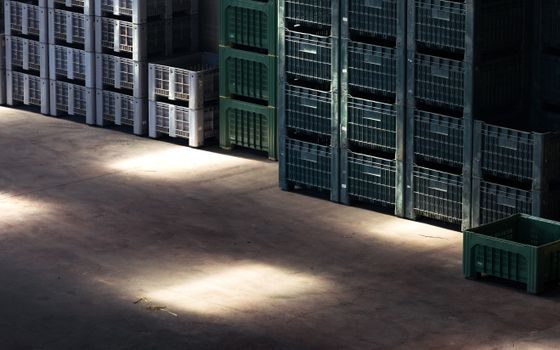
One-piece injection moulding produces a seamless, high-gloss wall with uniform wall thickness and service lives commonly cited in the "durable, long service" range for closed-loop reuse [S5]; blow-moulded turnover boxes are used where deep, hollow bodies and lower unit cost outweigh surface finish [S4].
Sheet-welded or "plastic-sheets" turnover boxes — fabricated from extruded PP or PE panels — are offered with custom dimensions, custom colours, custom printing, optional handles, and internal dividers, and are typically aimed at retail, manufacturing, and agricultural duty where box geometry must follow the SKU rather than the other way around [S3]. Custom printing for branding and identification, plus internal dividers, are listed as standard customisation options on the Suneco spec sheet, alongside size, colour, and handle variants [S3].
Comparison: Structural Family vs Decision Criteria
Lining the five families up against the four criteria that drive 80% of plant-floor spec disputes — empty return ratio, dynamic load, cleanability, and unit cost — gives a working matrix for RFQ drafting [S3][S4].
Solid-wall injection-moulded PP scores low on empty return (ships fully built), high on dynamic load and cleanability (seamless wipe-down), and mid-to-high on unit cost [S3][S5]. Foldable/collapsible crates score high on empty return (3:1–4:1 reduction), mid on dynamic load (hinges are the fatigue point), and mid on unit cost because of added hardware [S4]. Ventilated-wall turnover boxes (mesh or slotted) score high on cleanability for fresh-produce and cold-chain lines, low on liquid containment, and mid on load [S1]. Stack-nest variants rotate 180° between empty and full to cut empty volume by roughly half without hinges, and are common for in-process WIP shuttles [S4]. Pallet-boxes (pallet + sleeve + lid) score highest on bulk-volume logistics but require matched fork pockets and a 1000–1200 mm typical footprint, and they are often compared directly with carton-based dunnage on cost-per-cycle [S3][S4].
Use Cases by Loop, Not by Capacity
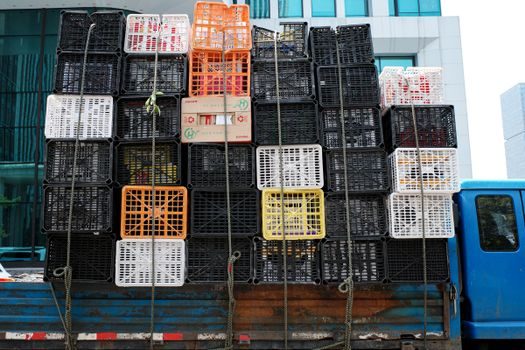
For automotive tier-1 and tier-2 returnable dunnage, solid-wall PP turnover boxes with matched lids are the workhorse — sized to a 600×400 or 400×300 mm footprint module that stacks on standard Euro pallets [S3][S5].
For fresh produce, seafood, and cold-chain distribution, ventilated PE turnover boxes are specified because the mesh walls drain melt-water and allow forced-air pre-cooling, with PE chosen over PP to survive the –18°C to +4°C window [S3]. For e-commerce and retail replenishment, sheet-welded custom-dimension PP/PE boxes with branded printing and internal dividers are the dominant customisation path, and Suneco's spec sheet explicitly lists retail, manufacturing, and agriculture as target verticals [S3]. For agricultural bulk loops, blow-moulded PE turnover boxes are widely quoted because unit cost dominates over surface finish [S4].
Limits, Failure Modes, and Sourcing Standards
Plastic turnover boxes are not a fit for high-temperature metal-foundry loops, hot-part racks above the PP heat-distortion range, or for direct food-contact applications that need a specific FDA / EU 10/2011 declaration that the supplier does not hold [S3].
Common failure modes tracked in the field are hinge fatigue on foldable crates after roughly 800–1500 fold cycles, UV-driven brittleness on PE used outdoors without pigmentation, and stress whitening at injection gates on heavily loaded solid-wall PP — none of which is captured by a single capacity number on a catalogue page [S3][S4]. On the sourcing side, the Suneco manufacturer declaration lists ISO 9001 (quality management) and ISO 14001 (environmental management) as the certifications carried by the plant, with recycling certifications referenced for end-of-life take-back [S3]. Buyers comparing European production should also weigh decade-resistance box and limit switch box lines, which sit in adjacent industrial-enclosure categories and are sometimes quoted alongside turnover boxes on the same capital-purchase tender.
Trackable Signals for the Next Spec Cycle
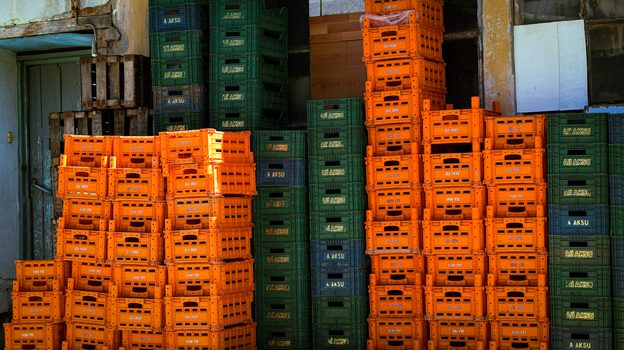
Closed-loop retailers are extending PP turnover-box service life past the old five-year mark by mandating recycled-content targets of 30–100% depending on the resin grade, and ISO 14001-audited plants are now the floor rather than the ceiling for tier-1 RFQs in 2026 [S3].
Two signals to watch on the next quarterly review: (1) the stack-nest return geometry being adopted for WIP shuttles versus foldable crates on long-haul empties, because the 3:1 return density edge is shifting back toward stack-nest where hinges and parts are a maintenance liability; (2) whether Chinese injection-moulded PP turnover boxes continue to clear ISO 9001 + ISO 14001 dual audits at the rate shown on the Suneco datasheet, since that combination has become the de-facto entry ticket for European automotive-loop tenders [S3].