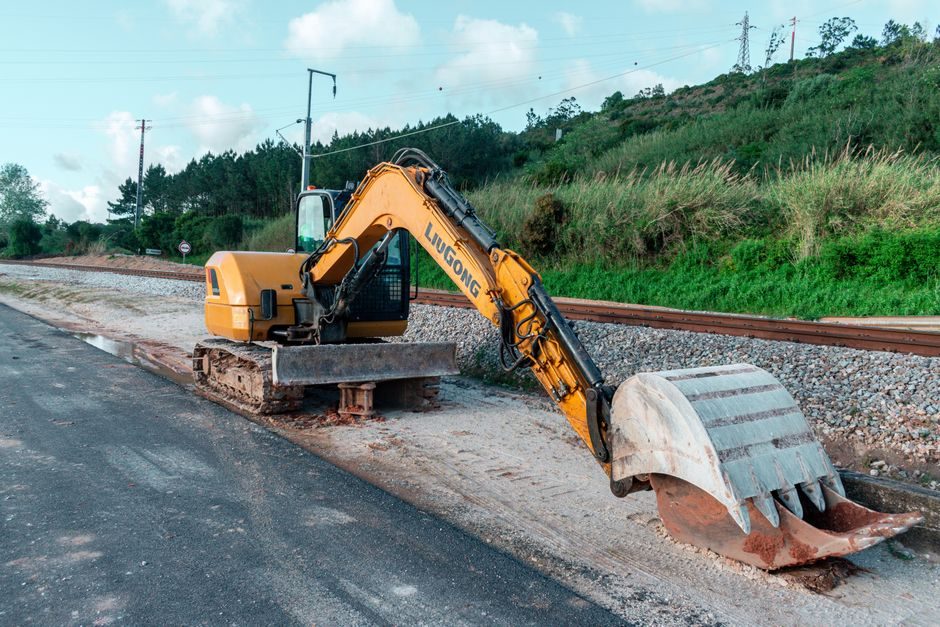
Urban infrastructure work — sewer replacement, utility trenching, road resurfacing, light foundation prep — overwhelmingly runs on three excavator classes: mini (under 6 t operating weight), small (6–10 t), and mid-size (10–45 t), with the long-reach and wheeled variants taking the remaining share [S3][S5].
Selection differs from quarry or pipeline work because the dominant constraints are street width, pavement loading, turning radius on intersections, and noise/emissions compliance inside city limits — not raw breakout force or bucket capacity [S3][S6].
Operating-Weight Class Breakdown
Mini excavators under 6 t operating weight are the default for residential utility work, indoor demolition, and confined sewer laterals; the sub-2.5 t segment can be hauled on a Class 1 or Class 2 truck and, in some jurisdictions, towed without a commercial driver's licence [S3]. SANY's published size guide puts operating weight, not engine kW, as the primary class delimiter across its product line [S3].
Small excavators at 6–10 t bridge the gap between landscaping machines and full road-building units — higher ground clearance, larger buckets, but still trailer-portable. Mid-size machines (the 13 t Komatsu PC130LC-11 sits in this band) gained roughly 20% lift capacity from a longer undercarriage and 12% lower fuel burn versus the PC130-8 it replaced [S4]. Komatsu's mid-size class also includes intelligent (i), super-long-front (SLF), and waste-handling variants for specialised urban scopes [S4].
Tracked vs Wheeled: The Pavement Variable
Wheeled excavators trade undercarriage durability for road speed — they can drive between intersections on street tyres without trailer support, which is why they dominate European municipal rosters where crews move between multiple small sites per shift [S6]. For a project with frequent relocations and no on-site tracked-machine damage clause, wheeled units cut mobilisation cost; for sustained digging on unprepared ground, a tracked undercarriage still wins on stability [S6].
Tracked mini and midi units remain the default for greenfield subdivision work, deep utility trenching, and any site where soft subgrade would destroy rubber-tyred machines; the trade-off is the need for a lowboy or specialised trailer when crossing between non-adjacent sites [S3][S6].
Tail-Swing, Zero-Tail, and Urban Turning Radius
Conventional tail-swing machines swing the counterweight past the track width on each rotation; zero-tail or reduced-radius (RT) variants keep the rear envelope inside the track gauge, which is the only practical option on alleys under 3 m wide and against live traffic lanes [S3][S5]. Finning's type guide explicitly lists space — "tight residential lot vs wide-open mining pit" — as one of the four primary selection axes, alongside terrain, depth, and project duration [S5].
For long-reach applications such as drainage-channel dredging or bridge-pier demolition at height, the long-reach boom (extended arm and stick) sacrifices lift envelope to gain horizontal and vertical reach; these units are a specialty line, not a substitute for the standard 10–45 t urban workhorse [S5].
Selection Criteria Compared
The four primary axes — site access, depth/load, mobility, and emissions — line up against the main classes as follows. Mini (under 6 t): alley access, sub-3 m trenches, trailer-portable, lowest noise footprint; small (6–10 t): mid-depth utility work, residential road patching, still roadable on a lowboy; mid-size (10–45 t): main road and bridge jobs, deeper foundations, requires oversize-load permit on most roads; long-reach: vertical/horizontal reach over water or structures at the cost of lift capacity; wheeled: rapid inter-site moves on paved streets [S3][S4][S5][S6].
For a sewer replacement on a 6 m wide residential street with 2.5 m deep trenches and 200 m of daily production, a 5–8 t zero-tail mini with a steel-track or rubber-track option and a hydraulic breaker circuit typically fits the spec; the same contractor moving to a 12 m arterial-road rebuild should step to a 20–30 t conventional-tail-swing unit with a larger bucket and the option of a tilting bucket for finish grading [S3][S5].
Emissions, Noise, and Regulatory Filters
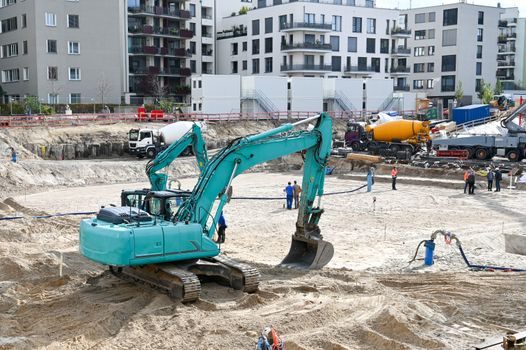
Inside low-emission zones — RDE urban areas in the EU, Class-A city cores in North America — Tier 4 Final / Stage V diesel aftertreatment is increasingly a hard spec rather than a preference, and engine-idle auto-shutdown is now standard on most OEM mini and midi lines [S3].
Noise caps (typically 75–85 dB(A) at 7 m depending on municipality) push contractors toward machines with load-sensing hydraulics, sound-attenuated cabs, and electric or hybrid pilot circuits; spec sheets should list both the rated sound-power level (LwA) and the guaranteed sound-pressure level (LpA) at the operator station, since contractors are commonly fined on LpA, not LwA [S3].
Matching Attachment Hydraulic Circuits
Attachment hydraulics are where urban spec maps diverge most from generic duty-class tables. A mini on a sewer job typically needs auxiliary single- and bidirectional circuits plumbed to the stick for a compactor plate, breaker, and tilt bucket; mid-size machines for road work need hammer/shear lines plus a quick-coupler that meets the OEM-published pin geometry, otherwise the contractor loses hours per shift on swaps [S3][S5].
For deeper guidance on choosing a size class for trenchless pipeline work, see the excavator selection for pipeline construction spec map; for quarry-side baseline weight and breaker-duty parameters, the quarry excavator selection spec map lines the same class structure against rock-density and hammer-energy requirements.
Limitations and Failure Modes
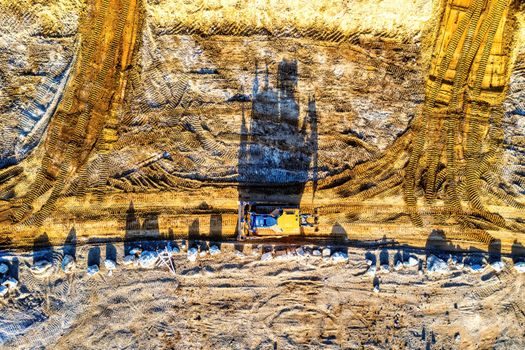
Three spec errors recur in urban tenders: oversized machines that cannot enter through the gate or under the bridge clearance envelope, undersized machines that cannot meet daily trench-meter production targets, and wheeled units dispatched onto unprepared subgrade where they high-centre and tear the road base. Each is preventable with a site-survey sheet listing minimum gate width, maximum gradient, soil class, and required daily output in linear metres or cubic metres [S3][S5].
For a complementary look at power-distribution protection on urban construction sites — the spec often pulled alongside the excavator tender pack — the residual current circuit breaker selection guide for 2026 spec maps walks through the RCCB and RCBO ratings typically called out in the same electrical pack.
Track whether Tier 4 Final / Stage V machines start displacing Tier 4 Interim on mid-size (10–25 t) urban tenders in your region over the next two bid cycles, and whether OEM long-reach offerings (Komatsu, SANY, Caterpillar) converge on a 15–18 m max-reach spec — those are the two decisions likely to shift the urban spec map before the next emissions-tier revision.
Spec-level background on the components involved: excavator, pressure transmitter, and flow meter.