
For dense urban infrastructure jobs, the sweet spot in 2026 sits inside the 14-18 tm loader-crane class: the Kesla Z14 CITY lands at 14 t load with 8,080-10,100 mm working height in a Z-boom package, and the Hiab iX.188 HIDUO reaches 17,949.3 kg at 17.5 m hydraulic outreach in a comparable 1,946-2,786 kg crane body [S2][S3].
At the heavy end, the Liebherr LTC 1050-3.1E shows where telescopic urban-spec is heading: 50 t max load, 48 m working height, 39 m horizontal reach, 85 km/h driving speed, with a switchable electro-hydraulic mode that takes full power from a 125 A site supply and falls back gracefully on 32 A or 63 A [S4].
Working envelope vs. vehicle footprint: the urban selection gate
On a city street, the binding constraint is not crane capacity but envelope-per-axle-length. The Kesla Z14 CITY family is offered with one or two boom extensions and packages a 14 t lift into a boom-truck footprint, with proSTABILITY radio control and top-seat options that include a limited-sector lift without outriggers deployed [S3]. That limited-sector feature matters when the truck is parked against a kerb with one stabilizer obstructed, because the controller caps the moment instead of letting the operator discover the limit by slewing.
The Hiab iX.188 HIDUO takes a different route: it builds on the HIPRO steel structure for stiffness at low tare, then trims the 15,305.7-17,949.3 kg load window into a 1,946-2,786 kg crane body, so the carrier truck absorbs more of the payload budget. Both designs accept that a sub-3 t crane body on a 4-axle carrier is the price of working inside a 12 t kerb-line limit common in EU historic centres [S2].
Stability interlocks are no longer optional on city chassis
Kesla's proSTABILITY package, supplied standard on the City line, monitors truck inclination, ground-contact loss, overload, and stabilizer position, then blocks any motion that would push the lifting torque past the live limit; sensor faults and the fault log are also surfaced to the operator [S3]. Hiab's iX.188 HIDUO approaches the same problem from the energy side: Start/Stop kills the truck engine at idle, and Dynamic RPM trims engine speed to demand, so a light load at low outreach does not waste fuel while the stability controller is doing its real job [S2].
On a 4-axle articulated chassis the additional layer is operator aids: the Palfinger PK 12502 SH ships Soft Stop as standard and offers the optional AOS (Active Oscillation Suppression) for precise load placement, with S-HPLS hydraulics boosting lifting power at the knuckle boom tip. The body weighs 1,160 kg with a 9.7 m working height and a 1,040 kg load rating, targeted at the very-narrow, very-low-noise end of urban work [S5].
Drive concept shifts: zero-emission site power for telescopics
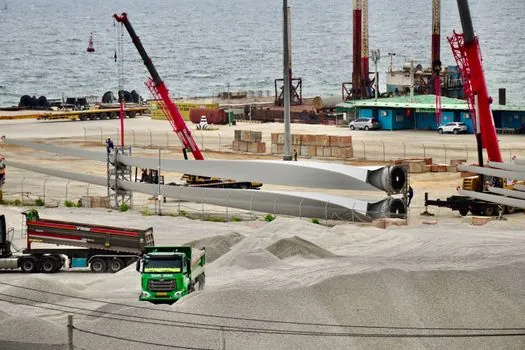
The most consequential 2026 change for urban telescopics is dual-mode drive. The LTC 1050-3.1E retains the diesel-hydraulic performance baseline, but a separate electric motor drives the crane movements when fed from a site supply, so the same 50 t lift and 39 m reach are achievable in electric mode with comparable cycle times at 125 A and reduced performance at 32 A / 63 A; conventional external battery packs are also accepted when the site has no shore power [S4].
The practical selector logic is simple: choose diesel-hydraulic for travel and generator-poor sites, switch to electro-hydraulic for indoor, night-shift, or low-noise urban cores, and accept the duty-cycle derate below 125 A. Effer's iQ.2255 HP extends the same logic to the heavy end: 55 m working height and 39,900 kg total weight are the headline figures, built for sites where the truck must arrive with the crane ready rather than relying on site lift-assist equipment [S1].
Knuckle vs Z-boom vs telescopic: a criteria comparison
For city work, the three architectures trade off differently. Articulated knuckle booms such as the Palfinger PK 12502 SH deliver 9.7 m working height at 1,160 kg body weight and 1,040 kg load, the lowest tail-swing radius in the field, and the easiest packaging onto a 4-axle rigid, but they lose reach quickly as the boom folds [S5]. Z-boom city loaders such as the Kesla Z14 CITY (14 t load, 8,080-10,100 mm working height) keep the link geometry but add a Z-fold for tighter stowage, with the proSTABILITY limiters doing the moment-arithmetic the operator cannot [S3].
Mid-range loader cranes like the Hiab iX.188 HIDUO and Hiab X-CLX 1x8 swing-arm series (10,100-14,200 kg load, 8.7-19.9 m working height) sit between, trading peak outreach against vehicle length [S2][S6]. Full telescopics such as the LTC 1050-3.1E (50 t, 48 m hook height, 39 m radius, 7 t body) buy reach and a straight boom for line picks over obstacles, at the cost of a 3-axle carrier with 243 kW (330 hp) drive and a longer turning radius unsuitable for tight medieval street grids [S4]. For a deeper dive into the knuckle vs telescopic trade specifically on tear-down sites, see Demolition-Ready Truck-Mounted Cranes.
Selection workflow for an urban-infrastructure procurement

Start with the lift chart, not the brochure. Plot every pick on the job: pick weight, radius, height, and whether the truck can park square to the load. If every pick sits under 17 m radius and under 18 t, the 14-18 tm loader-crane class (Z14 CITY, iX.188 HIDUO) is the cost-efficient answer, and a stability-control limiter is non-negotiable on a chassis that will park half on a footway [S2][S3].
If any single pick crosses 18 m radius or 20 t, escalate to a 50 t-class telescopic like the LTC 1050-3.1E and verify the site can deliver 125 A three-phase, otherwise the diesel mode will eat the productivity gain. For forestry-adjacent urban-edge work, the reach and stability logic follows a similar arc and is mapped in forestry truck-mounted crane selection, while for confined underground worksites the chassis geometry flips again, as detailed in truck-mounted crane selection for tunneling.
Surface protection, certification, and lifetime cost
Urban air is harder on a crane than plant-site air: de-icing salt, diesel particulate, and brake dust accelerate coating breakdown on the boom. Palfinger's PK 12502 SH documents a 7-stage automotive-grade coating line, ending with a 115 degrees Celsius cure for 1.5 hours and a water-soluble two-component topcoat, which sets a useful benchmark when comparing OEM paint specifications side by side [S5].
For procurement, require the OEM to publish the load-chart PDF for the exact carrier subframe and stabilizer spread, not a generic family chart, and require the stability controller's certification against the applicable regional standard for mobile cranes. Two trackable signals to watch in the next procurement cycle: wider release of 32 A / 63 A-compatible electro-hydraulic modes on 30-50 t telescopics, and the spread of Z-boom stability limiters into the 10-15 tm segment as standard rather than option.
For the relevant spec sheets and selection criteria, see truck mounted crane, truck mounted concrete pump, and dump truck.