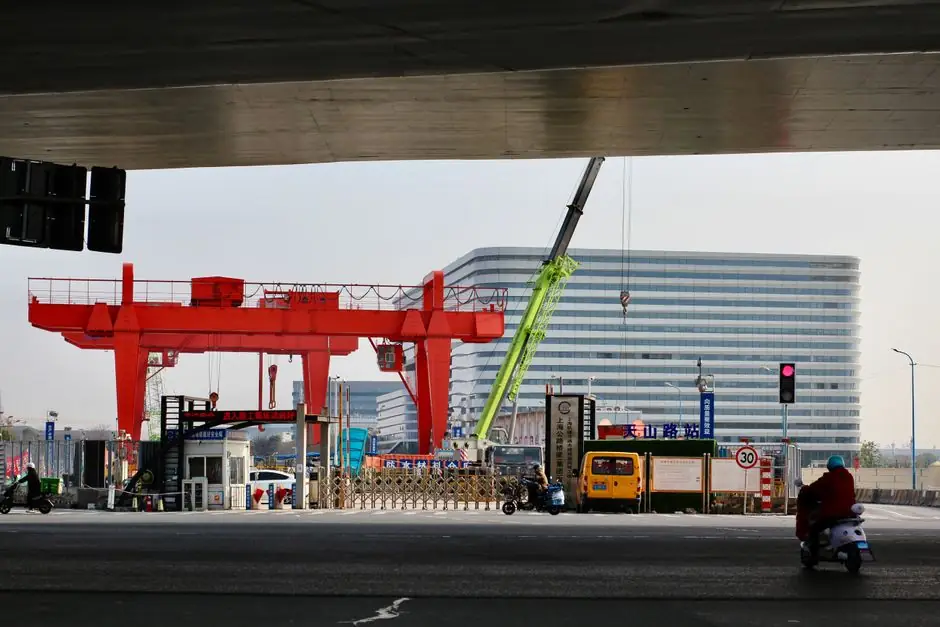
A 50-tonne 3-axle telescopic truck crane with 48 m working height and a switchable diesel/electric powerpack is the current 2026 reference machine for cross-country pipeline construction, and the Liebherr LTC 1050-3.1E documents that exact combination with a 39 m horizontal reach, 243 kW (330 hp) drive engine, 85 km/h road speed and 50 t (55.1 us ton) maximum load [S1].
Pipeline spreads stack requirements that a generic construction crane does not have to meet: long-radius pipe-section lifts from a side-boom stringing truck, low ground-bearing pressure on right-of-way, and quiet operation near populated or environmentally sensitive sections; the electric-mode option on the LTC 1050-3.1E directly answers the last point, with full crane performance available on a 125 A site supply and reduced performance on 32 A / 63 A [S1]. For lighter crews, the Foton-class truck with crane covers 1 t to 16 t lift duties and is widely used in municipal and coal-mine work, but its envelope is too small for mainline pipe lifts [S3].
What "truck-mounted crane" means on a pipeline spread
A truck-mounted crane is a self-propelled carrier with a telescopic boom, outriggers, slewing table and hoist packaged on a commercial-truck chassis, distinct from a crawler crane or a rough-terrain crane in that it can drive between lifts at highway speed without a lowboy. Liebherr lists the LTC 1050-3.1E as a 3-axle telescopic unit on a truck-mounted configuration, with a 48 m working height and a 39 m horizontal reach that lets the operator place pipe joints clear of the trench wall [S1]. For the broader category reference frame, see the truck-mounted crane encyclopedia entry. Where pipe-lift weight stays below roughly 8 t per pick, the SANY SPS17500 platform (8 t / 13.8 m working height) shows the typical small-class geometry used in material handling on compressor-station and valve-skid builds [S2].
Spec gate 1: lift class, reach and chassis count
The first hard gate is the lift-and-reach envelope, not the price. For 36-48 in. mainline steel pipe, single-joint lifts at the 8-15 t range on a 12-18 m radius drive the boom specification; for double-joint or three-joint stringing, the 30-50 t class is standard, and the LTC 1050-3.1E's 50 t (55.1 us ton) maximum load at 39 m horizontal reach maps onto that envelope [S1]. A 3-axle carrier is the most common configuration at this class because it keeps total vehicle weight around Liebherr's stated 7 t crane structure mass while staying inside typical 26-32 t GVW road limits when mated to a sub-25 t chassis [S1]. Below 16 t lift on light municipal or last-mile gas distribution work, a single- or 2-axle Foton-class carrier with a 1-16 t crane package covers most picks, with 360-degree full-rotation, H-type outriggers for slope work and high-strength steel plate booms as standard construction [S3].
Spec gate 2: dual diesel-electric drive and right-of-way noise
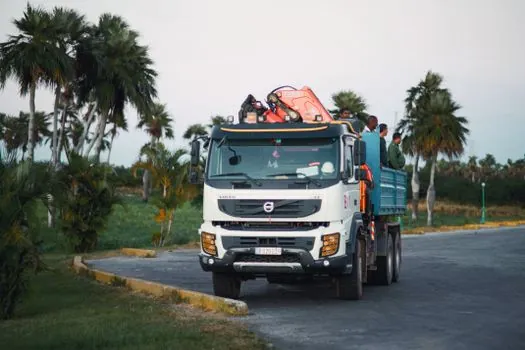
Zero-emission and low-noise job sites are now a documented specification line item, not a marketing line. The LTC 1050-3.1E accepts 125 A three-phase site power for full crane performance and falls back gracefully to reduced performance on 32 A or 63 A supplies, with conventional external battery packs as a third energy source [S1]. For pipeline spreads that cross residential areas, nature reserves or compressor-station sites with restricted diesel hours, that switch is the difference between working the section at night and standing the crane down. Older 2-axle and 3-axle units without an electric-mode pack can still be specified, but they will not pass the noise / emission gate on many European and increasingly Asian urban-adjacent spreads. Drive power on the reference 50 t unit is 243 kW (330 hp) from the diesel engine, and crane function is electro-hydraulically actuated in both diesel and electric modes, so the operator does not relearn controls when switching [S1].
Spec gate 3: outriggers, stability and slope work
Right-of-way is rarely flat, and pipe strings are usually picked off a side-boom tractor to one side of the carrier. Outrigger geometry and pad area set the practical lift capacity on a slope more than any other single factor. The H-type outrigger with extended pads is the documented 2026 baseline for truck-mounted cranes that have to set up on irregular ground, and it is the configuration used on Foton-class 1-16 t units for coal-mine and municipal work [S3]. On the 50 t class the equivalent is a multi-position outrigger with full-span and half-span modes so the crane can work in a narrow right-of-way lane. For comparison context, the dump truck and reach truck encyclopedia entries cover the carrier-side and yard-handling classes that surround crane selection. Always cross-check the duty-cycle table against the boom-radius chart on the OEM data plate; a 50 t maximum load is only true at minimum radius, and pipeline picks almost never happen at minimum radius.
Spec gate 4: who this is for, and who it is not for
A 30-50 t telescopic truck crane is the right answer for mainline pipeline construction contractors, spread operators, and EPC firms running 36-60 in. steel pipe or large-diameter HDPE strings on continuous right-of-way. It is the wrong tool for: indoor pipe fabrication (overhead crane territory), confined compressor-station work where a reach truck and a small electric picker are more efficient, and short-haul last-mile distribution where a Foton-class 1-16 t unit on a 4x2 chassis is the economic floor [S3]. It is also the wrong tool for long-reach pick-and-carry cycles where a truck-mounted concrete pump carrier or a dedicated boom truck is more cost-effective, since truck cranes are designed to set up on outriggers, not to travel loaded at full radius.
Comparison: 8 t class, 16 t class, 50 t class at a glance
The 2026 reference comparison for pipeline work lines up three crane classes on four decision criteria. The 8 t SANY SPS17500 platform gives 13.8 m working height on a compact carrier for material handling and skid work [S2]. The 1-16 t Foton-class truck crane gives 360-degree full rotation, H-type outriggers and high-strength steel booms on a mature second-tier chassis for municipal and coal-mine lifts up to 16 t [S3]. The 50 t Liebherr LTC 1050-3.1E gives 48 m working height, 39 m horizontal reach, 243 kW (330 hp) drive, dual diesel-electric mode and 85 km/h road speed for mainline 36-48 in. pipe work [S1]. On road speed the 50 t unit is the clear leader at 85 km/h, on initial cost the 1-16 t Foton-class unit is the lowest, on reach the 50 t unit is the only option above 14 m, and on noise / emissions the 50 t unit is again the leader because of the electric-mode pack [S1][S2][S3].
Field-failure modes and what the spec sheet does not show
Three failure modes show up repeatedly on pipeline spreads and are worth specifying against up front. First, outrigger pad sinking on soft right-of-way, mitigated by larger timber mats or steel road plates rather than a bigger crane. Second, hoist-line damage from abrasion against pipe-end bevel protectors, mitigated by specifying a swivel hook and a synthetic-round-sling lift plan. Third, hydraulic contamination on machines that sit idle for months between spreads, mitigated by specifying the OEM's extended-storage hydraulic flush at delivery; the SANY SPS17500 platform documentation specifically calls out "robust, reliable, and service friendly design" and a "network of modular components connected through standardized interfaces" as design targets, which is the same language to use in the purchase spec for serviceability [S2]. For a broader process-tooling frame, see the construction tools encyclopedia page.
Relevant adjacent selection maps
Crane selection rarely happens in isolation. For quarry-side and aggregate-handling duty, the quarry truck-mounted crane selection map is a useful cross-check on outrigger and chassis sizing under higher cycle rates. For yard-handling and skid work on a pipeline terminal, the overhead bridge crane duty-class logic sets the indoor counterpart. For forestry-adjacent right-of-way where pipe corridors cross wooded terrain, the forestry truck-mounted crane reach and stability cuts document the soft-ground and long-reach envelope that overlaps with cross-country pipeline work. Where pipeline metering skids include pump and valve assemblies that need foundry input, the pump and valve foundry furnace spec map is the upstream casting-side reference. [S1]
Track three signals over the next two quarters: OEM releases of mid-30 t class 3-axle telescopic truck cranes with switchable electric-mode packs, since that is the most likely gap-filler between the 8-16 t class and the 50 t LTC 1050-3.1E; revisions to right-of-way noise and emissions specifications on Tier-1 cross-country pipeline tenders; and any 2026 update to the Liebherr LTC compact-crane catalogue that adds a 4-axle variant above 50 t for 56-60 in. pipe work [S1].