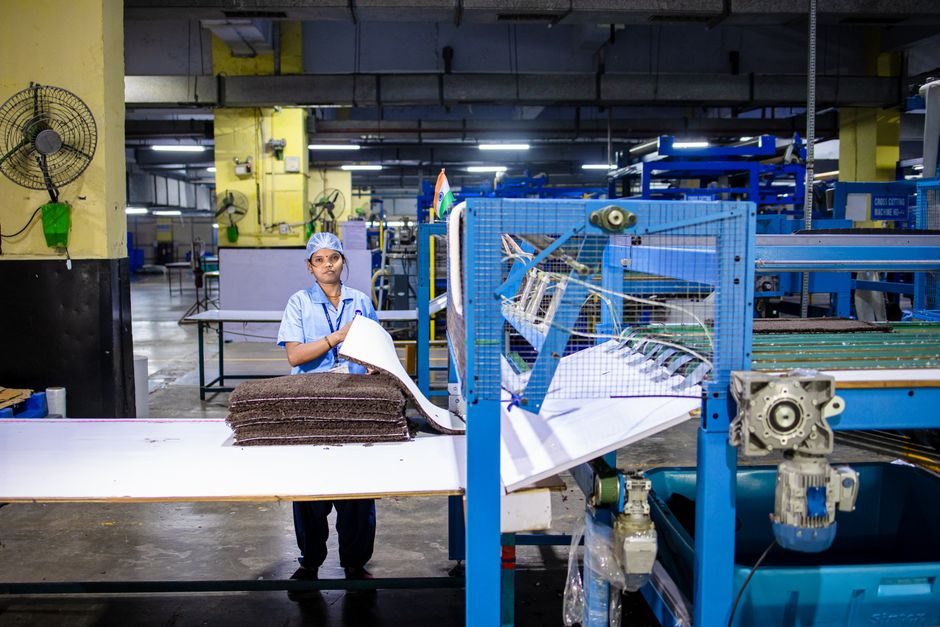
V-Process (vacuum process) molding is a binderless, dry-sand foundry process in which heated EVA film is draped over a pattern or flask, sealed, and evacuated; atmospheric pressure on the outside of the film does the compacting, eliminating chemical binders and cutting dust at source [S1].
Installed equipment spans three subsystems — vacuum stabilization, molding/film handling, and sand reclamation — and the line is automated via an electric control system, with stated sand reclamation at 95% [S1]. For context on how this differs from chemically bonded lines, see the Resin Sand Molding Line selection map.
Operating Principle and Why It Changes the Install
Vacuum holds the mold together, not a chemical reaction: the EVA film is heated, sealed against the flask, and the sand box is evacuated, so the pressure difference between atmosphere and the box cavity (typically on the order of 0.06-0.08 MPa differential) is what rigidizes the sand [S1]. Because there is no water, no binder, and no hardener, the supporting utilities list is short — dry sand, compressed air, electric power for heaters and PLC, and a vacuum source sized to peak leak load.
The process sequence — heat EVA film, cover the pattern, spray a coating of defined Baume, fill and vibrate the box, cover the top film, evacuate, lift, assemble, evacuate the closed mold, pour, then release vacuum and shake out — is fully electric-controlled and runs as a physics-based forming operation rather than a chemical cure [S1]. That physics of vacuum forming is the same principle exploited in vacuum packaging lines, just scaled to foundry flask sizes.
Site Preparation and Foundation
Foundry floors for V-Process must be flat, dry, and vibration-friendly: the molding station relies on a vibrating table to densify the sand before vacuum is applied, so an uneven pad shows up as soft spots in the cured mold [S1]. Provide isolated foundations for the vibrating table and the vacuum pump set; do not co-mount them on a slab shared with the pouring line.
Allow floor space for the listed main equipment — die shoe, automatic laminator, sand molding box, vibrating table, manipulator, die lifter, and the sand bin — plus the vacuum pump, vacuum meter, surge tank, dust removal tank, and steam separator that make up the vacuum stabilization system [S1]. A clean working environment is a stated design goal of the process, so route dust extraction ducting for the sand screen, elevator, and conveyor before installing the reclamation loop [S1].
Vacuum System Sizing and Routing
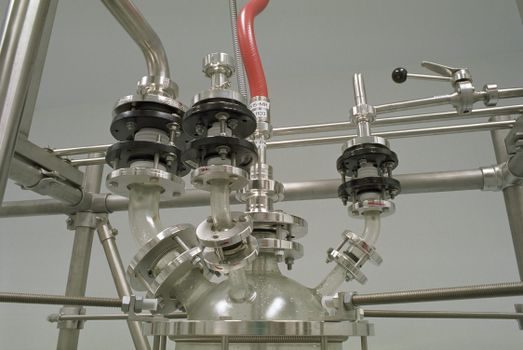
The vacuum stabilization system is the heart of the line: vacuum pump, vacuum meter, surge tank, dust removal tank, and steam separator must be sized for the total flask volume evacuated per cycle plus the steady-state leak rate through film seams and gaskets [S1]. A surge tank is non-optional — peak demand during flask evacuation will starve the pump and collapse the mold if the receiver is too small.
Use rigid vacuum pipework with as few elbows as practical between pump and flask; long flexible hoses leak and flex under cyclic load. Mount the vacuum meter at the flask, not at the pump, so the operator reads the pressure that actually holds the sand. A steam separator ahead of the pump is required because moisture dragged in with returned sand condenses in the pump and destroys vanes; the dust removal tank protects the same pump from fines carried over from the reclamation conveyor [S1].
Film Heating, Drape, and Sealing Quality
The heated EVA film is what converts loose sand into a rigid mold: it must be heated uniformly, draped without wrinkles, and sealed to the flask edge so the leak path is dominated by the sand mass, not the seam [S1]. A coating of a defined Baume is sprayed on the pattern before sand fill; that coating is the only "liquid" stage, and the spray booth must be vented separately.
Install the automatic film-heating and covering machine (often supplied as a movable frame) so the film path from heater to flask is straight and the take-up reel is accessible; wrinkled film produces thin patches in the mold wall, and a hole the size of a pin will locally collapse the sand during pour [S1]. The covering machine is part of the same equipment family that pairs with the laminator and manipulator — keep the three on a common rail or pallet track so hand-off is repeatable.
Sand Reclamation Loop and Material Handling

V-Process reclaims 95% of its sand, which is the single biggest operating-cost lever on the line [S1]. The reclamation train is a sand screen, elevator, and conveyor feeding a sand bin, with the molding station drawing from the bin and the shake-out returning through the same loop. Size the screen aperture to the largest permissible sand grain and check it weekly; a blinded screen returns oversize to the loop and the next flask has hard inclusions.
Because the process uses dry sand with no binder, thermal shock to the sand is the limiting wear mode: hot returned sand plus humid ambient air is the worst case for the steam separator, so route the conveyor return through a cooling section before the screen. Sand moisture above roughly 0.2% by mass will flash at the film interface and produce surface defects; the reclamation loop must drain condensate from the elevator boot.
Commissioning Tests and Acceptance Criteria
Commissioning follows the process sequence as a checklist: heat film to rated temperature (verify with IR spot check, not the heater controller alone), drape and seal, fill, vibrate to density, cover, evacuate to the set vacuum, hold for the rated dwell, lift, clamp, evacuate the closed mold, pour, release vacuum, shake out [S1]. Each step has a pass/fail: film wrinkle or pinhole fails the seal test, vacuum not reached in the rated pump-down time fails the pump/surge-tank sizing, and sand not holding shape after vacuum release fails the vibrating table setup.
Record baseline values for vacuum level at the flask, pump-down time, cycle time, and sand temperature out of the cooler; these are the four numbers that drift first when something is wrong. A drift in pump-down time with steady vacuum reading points to a leak in the piping; a drift in vacuum reading with steady pump-down points to a failing pump or a waterlogged separator. Compared with a shell molding line retrofit, the V-Process commissioning has fewer chemistry checks and more vacuum leak-hunting.
Failure Modes, When to Repair, and When to Replace

The three recurring failure modes on a V-Process line are vacuum leak at the film seam, contaminated or wet sand, and pump overheating from separator overload. All three are field-repairable: re-draping film and re-sealing the flask edge resolves seam leaks; drying the sand through the cooler and dumping the elevator boot resolves wet-sand defects; and servicing the steam separator resolves pump thermal trips. [S1]
Replace, do not repair, when the EVA film roll is end-of-life (more frequent seam failures), when the vacuum pump vanes are below manufacturer wear limit (declining ultimate vacuum that separator service cannot restore), or when the vibrating table springs have taken a permanent set (uneven sand density that no shimming corrects). Wear-part replacement intervals on the laminator, manipulator, and die lifter should follow the OEM cycle count, not a calendar, because duty varies sharply with flask size and pour weight [S1].
Track the next two signals on any installed line: the monthly sand reclamation rate (target 95%) and the trend in vacuum pump-down time at cold start; both predict the maintenance window two to three months ahead [S1]. For a broader look at how a V-Process line fits against other binderless and low-binder molding options, the V-Process molding line reference covers principle and equipment lists, and the automatic molding line page covers the automation overlay common to both. Where the line interfaces with downstream shot blasting, conveyors, or crossed-roller guide tables for flask handling, treat the vacuum stability number as the gating specification.