
Vacuum-assisted die casting (VADC) is a simple upgrade on a conventional HPDC machine with a vacuum valve installed in the die to evacuate cavity air to a moderate vacuum, and the high-vacuum class targets pressures of roughly 50 mbar or less, per the ScienceDirect overview of vacuum die casting [S1].
Process engineers and procurement leads evaluating a vacuum die casting machine for structural aluminium or magnesium chassis parts weigh a single technical decision: do the porosity and heat-treatability gains justify the tighter sealing, lubricant and melt-purity discipline? The two-decade track record in Japan, summarised in the China Foundry review of the vacuum die-casting process [S5], answers yes for safety-critical thin-wall castings, and no for high-volume cosmetic trim.
Vacuum Levels and What They Actually Buy You
The term 'high vacuum die casting' typically refers to the achievement of vacuum pressures in the range of 100 mbar or less, and super-vacuum variants push below 60 mbar, per the ScienceDirect High Vacuum Die Casting chapter [S1]. The ScienceDirect HVDC section places the practical envelope at cavity pressure below roughly 60 mbar during fill, a threshold that decouples the casting from enough trapped gas to blister during T6.
Yu Li et al. demonstrated the mechanical upside: a large-scale AA6061-31%B4C composite produced by stir-vacuum casting reached 340 MPa tensile strength, an improvement of 112.5% versus the AA1100-31%B4C baseline, per the same ScienceDirect overview [S1]. That single data point is the practical justification specifiers lean on: lower porosity translates directly into ductility, weldability and heat-treatability that conventional HPDC cannot deliver.
Conventional HPDC vs VADC vs HVDC: Decision Criteria Compared
Three vacuum tiers separate the field, and each shifts a different cost/risk lever. Conventional HPDC runs no cavity evacuation, VADC adds a vacuum valve for moderate evacuation, and HVDC (or super-vacuum die casting, SVDC) uses advanced vacuum systems to drive cavity pressure below 60 mbar, per the ScienceDirect HVDC table [S1]. Engineers selecting between a die casting machine and a vacuum-augmented one should weight four criteria: achievable cavity pressure, post-cast heat-treat compatibility, required alloy purity, and cycle-time penalty.
The clearest trade-off sits in process window: high-vacuum performance demands that the melt be treated to control hydrogen concentration and inclusion content, that low-iron alloys be used to maximise ductility, that the shot sleeve be carefully filled to minimise turbulence, and that low-reactivity die lubricants that do not significantly volatilize be used, per the ScienceDirect HVDC control list [S1]. Each item shrinks the operating window, which is why sealing on the parting line and around ejector pins becomes non-negotiable.
Where Vacuum Die Casting Pays Off — And Where It Doesn't
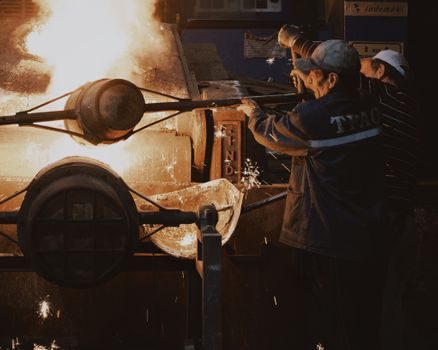
High-vacuum die casting permits the production of highly ductile, heat-treatable and weldable, thin-walled structural chassis components and body parts for automotive and other applications, per the ScienceDirect HVDC chapter [S1]. For structural castings destined for T6 or welding, the vacuum is essentially mandatory rather than optional.
Conversely, a gravity die casting machine or a non-vacuum aluminum die casting machine still wins for cosmetic, non-heat-treated parts where blistering risk is low and cycle time dominates unit cost. For magnesium components, a magnesium die casting machine without vacuum is also acceptable for non-structural housings; the zinc die casting machine segment, with its lower melt temperatures, rarely justifies vacuum augmentation at all. The shot-sleeve filling, gating and lubricant constraints listed in [S1] make VADC uneconomical for high-volume decorative zinc hardware where porosity thresholds are generous.
Equipment Constraints: Sealing, Valves and Auxiliary Systems
A VADC retrofit is mechanically simple — install a vacuum valve in the die — but a high-vacuum system demands a fast-acting vacuum pump train and verified sealing on the parting line and around ejector pins, per the ScienceDirect HVDC control list [S1]. Pumping-model selection and vacuum stop-valve timing dominate cycle-time loss, which is why the Chinese Journal of Mechanical Engineering paper on auxiliary high-vacuum systems dedicates six pages to the pumping model and stop-valve behaviour [S4].
Specifiers should also confirm that the vacuum level claimed by the OEM is residual cavity pressure at the start of fill, not pump inlet pressure at the manifold. The ScienceDirect chapter explicitly warns that not all of the vacuum systems currently commercially available can achieve such a high vacuum level, and that the process window shrinks as the vacuum target tightens [S1]. A supplier that quotes "<100 mbar" without a fill-time curve is asking for a blistering problem at T6.
Failure Modes, Limits and Sourcing Signals

Three failure modes dominate the field: (1) lubricant volatilisation that re-injects gas into the cavity and defeats the vacuum, (2) parting-line leakage that caps achievable vacuum, and (3) shot-sleeve turbulence that entrains air even with a perfect cavity vacuum. The ScienceDirect HVDC list flags all three as the gating control points [S1].
The commercial vacuum die-casting process started roughly 25 years ago in Japan and has since been widely applied, per the China Foundry review [S5], which means the second-generation OEM base is mature, but the auxiliary-system market still has a long tail of low-cost pump packages that cannot hold <60 mbar through fill. A shot sleeve retrofit, paired with a verified vacuum stop-valve and a recorded fill-time-versus-pressure curve, is the most reliable spec gate. Buyers should also compare VADC against a cold-chamber die casting machine quote for the same part: if the VADC premium exceeds the post-T6 machining savings, the order belongs on a conventional cold-chamber line.
Either will reset the cost-per-cast equation for VADC versus conventional HPDC within the next procurement cycle.