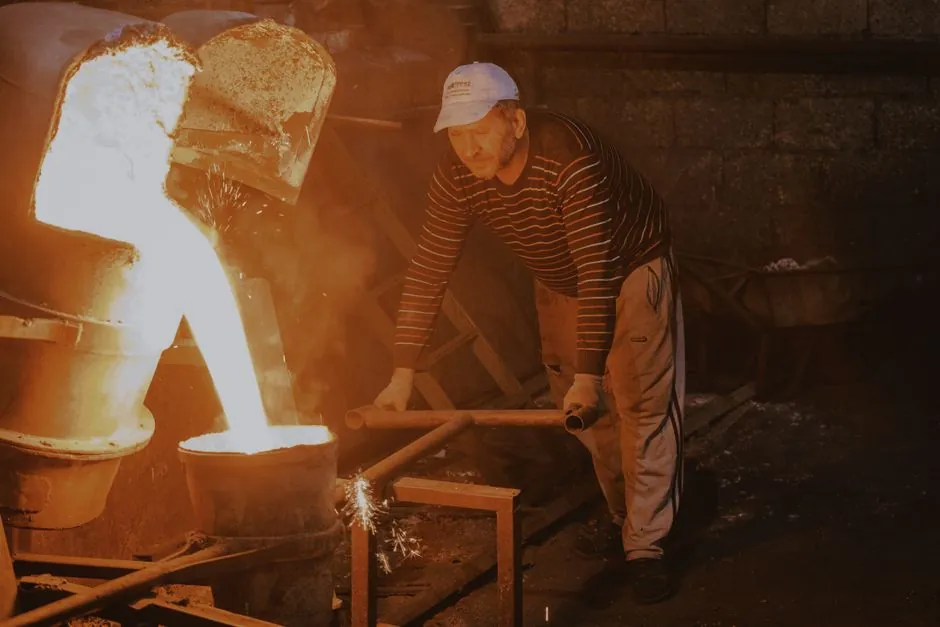
RH circulation degassers handle 20 to 40 heats per day, moving 30 to 60 tons of steel per minute through the vacuum vessel at 0.5 to 5 mbar operating pressure, with hydrogen removal of 60 to 80% in a 15 to 25 minute cycle [S3]. VD tank units from Primetals target smaller heat sizes of 5 to 20 t and are positioned for secondary metallurgy where full circulation infrastructure is not justified [S1].
The two routes are not interchangeable. RH uses two snorkels and a lift gas to drive continuous circulation between ladle and vacuum vessel; VD is a static ladle-in-tank process where argon bubbling through a porous plug stirs the bath under deep vacuum [S2][S4]. For an EAF shop running plate, forging, and sour-service grades, that distinction dictates the vacuum system size, the refractory programme, and the cycle-time budget.
Process Principles and Where Each Unit Fits
RH is a circulation-based vacuum treatment: molten steel rises through the up-leg snorkel into a vacuum vessel, is refined under low pressure, and returns through the down-leg snorkel, forming a continuous loop with high treatment efficiency and stable bath mixing [S2]. VD, by contrast, keeps the ladle itself inside a vacuum tank and relies on argon injection through a porous plug plus an open ladle eye at the surface to expose liquid steel to the vacuum [S4]. The result is a simpler mechanical envelope but a slower kinetic path for nitrogen and hydrogen removal.
Heat size is the first selection gate. Primetals markets its VLD (Vacuum Ladle Degassing) plants specifically for small heats in the 5 to 20 t range, where the capital cost of an RH circulation vessel and dual-snorkel refractory set cannot be amortised [S1]. RH dominates where heat size, throughput, or steel-grade purity pushes the spec toward automotive exposed panels, line pipe, and rail, categories that demand tight carbon, hydrogen, and nitrogen control in high tonnage per day [S3].
Vacuum System, Pump Train, and Pressure Targets
Typical RH units operate at 0.5 to 5 mbar with a vacuum pump train sized for 300 to 800 kg/h water-vapor equivalent, a flow rate chosen to clear the hydrogen and carbon monoxide flashed out of the bath [S3]. Steam ejector or multi-stage dry pump sets are the norm; Leybold lists dry screw (DRYVAC, VARODRY, NOVADRY), claw (CLAWVAC), and Roots (RUVAC) families in its metallurgy portfolio, all of which can be combined into a booster-and-backer train for degasser service [S5]. For process control, the vacuum gauge on the vessel leg has to hold accuracy into the 0.1 to 10 mbar window, the same range that drives the carbon-oxygen reaction in RH-OB.
VD tank pressure targets are similar in absolute terms (deep vacuum below 10 torr in the EERZ model study, roughly 13 mbar or lower) but the vacuum pump train is sized for a much smaller free volume and a much higher argon throughput, because argon bubbling through the porous plug carries the load for both stirring and gas transport [S4][S5]. When sizing the vacuum generator train, a VD cell typically accepts 30 to 50% of the RH pump capacity for the same steel throughput, but requires tighter moisture control on the argon supply because water vapour in the stir gas re-hydrogenates the bath.
Hydrogen, Nitrogen, and Carbon Removal Kinetics

Hydrogen removal is fast and largely pressure-driven: 60 to 80% removal in a single 15 to 25 minute RH cycle, governed by the hydrogen partial pressure differential between liquid steel and the gas phase maintained by the pump train [S3]. For rail steel the spec is hydrogen content below 2 ppm to prevent flaking, and for sour-gas line pipe the limit is also below 2 ppm, both of which RH meets with margin but which VD can meet on small heats if cycle time is extended and argon flow is tuned [S3].
Nitrogen is the slow element. In the VD EERZ model from EVRAZ (2025), denitrogenation is controlled by an Effective Equilibrium Reaction Zone at the argon bubble interface, with efficiency correlated to argon flow rate, vacuum pressure, and the initial nitrogen and sulphur content of the bath; the model was validated under deep vacuum below 10 torr, and it lets the plant predict de-N within a minute instead of a day of CFD runs [S4]. Carbon removal to under 20 ppm needs the RH-OB variant, where submerged oxygen lances drive decarburization at 0.5 to 2.0 ppm per minute once carbon is already below 50 ppm, a kinetic window that VD alone cannot match because it lacks the equivalent oxygen-blow hardware in standard configuration [S3].
Decision Matrix: RH vs VD on Real Selection Criteria
For a steelmaker choosing between the two, the criteria line up as follows. On heat size, VD wins below 20 t and RH wins above; on circulation-driven kinetics, RH delivers 30 to 60 t/min through the vessel while VD relies on 50 to 200 NL/min argon through a single porous plug; on decarburization depth, RH-OB reaches under 20 ppm C and VD typically stops at 30 to 50 ppm C; on capex, a VD tank is roughly 40 to 60% of an RH installation of the same nominal heat size; and on refractory cost, the RH snorkel set is the dominant wear part and the limiting factor on campaign life, while VD wear is concentrated in the porous plug zone and the ladle slag line [S1][S2][S3][S4].
For automotive exposed-panel and IF steel, RH or RH-OB is the only realistic route because of the under 20 ppm carbon requirement and the high daily heat count; for EAF plate, forging, and sour-service grades under 20 t heat size, VD is the economic pick and still meets the under 2 ppm hydrogen target with sufficient argon stirring and vacuum holding time [S1][S3][S4]. The degassing unit spec must therefore be matched to the steel-grade portfolio, not the other way around.
Refractory Programme and Maintenance Hot Spots
RH is a severe refractory service: high temperature, steel flow erosion at the snorkels, slag attack at the vessel bottom, and thermal cycling every cycle [S2]. The snorkels are the most wear-prone part, and the vacuum vessel bottom sees a 5 to 15°C heat loss per cycle that compounds into refractory fatigue. A well-run RH campaign typically targets 200 to 400 heats between snorkel changes, depending on steel grade and slag chemistry.
VD refractories are concentrated on the ladle slag line, the porous plug block, and the tank lid seal. Because the ladle itself is the vacuum vessel, the porous plug zone becomes the single-point wear item and dictates the maintenance schedule. For shops running killed steel with high-alumina slag practice, a comparison of deoxidation routes in killed vs semi-killed vs rimmed carbon steel maps directly to the slag chemistry the VD refractories will see, and the choice of deoxidation practice can swing porous-plug life by 20 to 40%.
Process Control, Sensors, and 2026 Optimization Layer
The 2025 to 2026 control layer for both routes is converging on real-time hydrogen and nitrogen kinetic models. Industrial iFactory-class optimizers claim 12 to 22% cycle-time reduction, 10 to 20% improvement in hydrogen removal, under 15 ppm carbon consistency in RH-OB, and 18 to 30% vacuum pump energy reduction through sequenced pressure setpoints, all from on-premise edge processing with read-only PLC connectivity [S3]. The MDPI 2025 work on the EERZ model adds a dynamic ladle-eye surface exposure zone to the denitrogenation prediction, validated by Python-based video analysis of the open eye during deep-vacuum stirring [S4].
For the process engineer, the practical takeaway is that the bottleneck has moved from raw vacuum level to control-loop latency. A 0.5 mbar vessel pressure is reachable with any modern dry pump train; the differentiator is how fast the control system can detect a hydrogen rebound from wet ladle slag, or a nitrogen pickup from a sulphur spike in the incoming heat, and adjust argon flow, pump sequencing, and (in RH-OB) oxygen lance rate before the heat is locked in. The same edge-AI pattern is now hitting adjacent ladle metallurgy, and a process engineer choosing a casting ladle for a new VD cell should specify the porous-plug instrumentation and the PLC tag map with the optimizer vendor at the design stage, not as a retrofit.
Limitations, Failure Modes, and What Each Unit Cannot Do
VD cannot match RH-OB on decarburization below 30 ppm C without an oxygen lance retrofit, and that retrofit is non-trivial because VD lacks the snorkel-mounted lance geometry RH uses; the workaround is to do deep decarburization in the EAF or BOF and use VD only as a polish step. VD also struggles to hold under 1.5 ppm hydrogen on heats above 20 t because the open-eye surface area scales with ladle diameter, not heat size, and the vacuum generator train hits a pumping-speed ceiling on large baths. [S3]
RH, conversely, cannot be justified under 5 to 10 t heat size because the snorkel diameter and refractory cost per ton rise sharply, and the lift-gas argon consumption becomes uneconomic. RH also has a hard floor on minimum treatment time: 12 to 15 minutes for a short cycle, which on a low-throughput caster can leave the unit idle and erode the ROI case. For shops running a mix of small and large heats, the practical pattern in 2026 is a VD cell for the 5 to 20 t grades and an RH-OB for the 30 t+ automotive and line-pipe heats, with the alloy-steel and gear-steel grades split between them based on the carbon and hydrogen target, a decision matrix that mirrors the alloy-selection logic in AISI 9310 vs 8620 for carburized gears.
Two trackable signals to watch: first, the publication and field deployment of integrated EERZ + ladle-eye image models on production VD cells, where the next paper cycle should land plant-scale results on heats below 10 mbar; second, the spread of RH-OB oxygen-lance packages into mid-size EAF shops as the under 20 ppm carbon spec for cold-rolled exposed panel continues to tighten, a process that has historically taken 5 to 7 years from automotive-grade spec to EAF commodity supply.