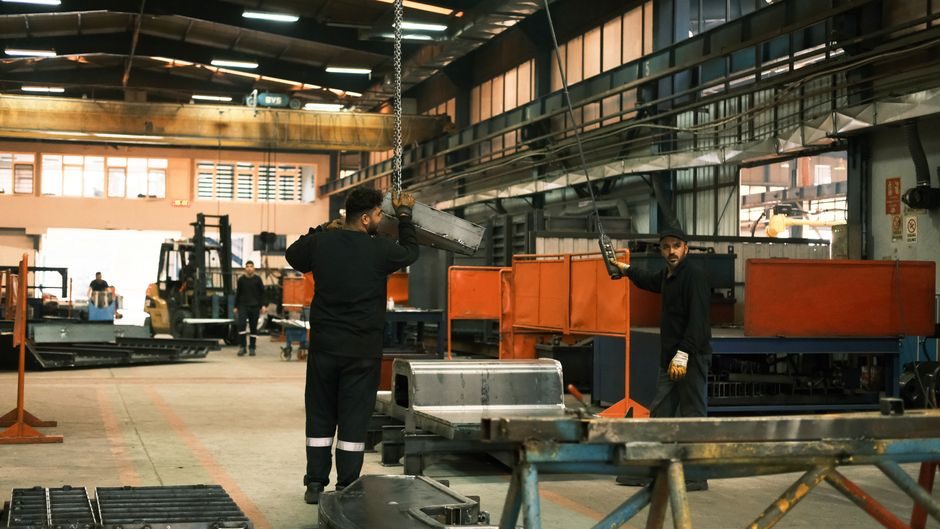
Two supplier clusters now compete for the VLM line item: European-originated storage-automation OEMs (Modula, Kardex, SSI Schaefer) shipping tray-based VLMs with WMS/WCS and AMR integration, and Chinese lifting-platform manufacturers (e.g. ETERLIFT, founded 1999) scaling scissor, mast and freight-lift variants that are also bid into VLM-adjacent applications [S1][S2][S3][S4][S5].
The market context for 2026 sourcing is concrete: the vertical lift module segment was valued at US$ 950.19 million in 2024 and is forecast to reach US$ 1,766.08 million by 2031, a 9.7% CAGR over 2025–2031, with e-commerce, omnichannel retail and floor-space optimisation cited as the demand drivers.
Main VLM supplier profiles and product positioning
Modula positions the Modula Lift as its "most popular" VLM, advertising a wide size range, thousands of tray/configuration combinations and a target market spanning spare-parts storage, production-side kitting and distribution [S4]. Modula also markets a Modula MiR (autonomous mobile robot) integration, a packaged VLM + AGV + software cell that has been deployed at the Amer facility [S1]. Kardex sells the Kardex Shuttle as a closed, rack-based VLM with modular construction, goods-to-person tray delivery and a vertical-lift module product family positioning [S5]. SSI SCHAEFER offers WAMAS Lift & Store, software that runs one or more VLMs and is positioned from "simple to complex" installations, sold across more than 20 country entities [S3].
On the Chinese side, Qingdao Eterlift Machinery Co., Ltd. — founded 1999 and integrating R&D, production and sales — lists scissor lifts, mobile scissor lifts, vertical mast lifts, cargo lifts and freight lifts as its main product family, indicating the overlap between industrial lift tables and the VLM-adjacent storage category [S2]. Eterlift represents the broader pattern visible on B2B portals: a long tail of Chinese makers competing on lead-time, configurability and price rather than on WMS integration depth [S2].
Selection criteria engineers should weight in 2026
Tray payload and tray footprint are the first hard filters: VLM units are specced around net tray load (typically tens to low hundreds of kilograms per tray), tray width/depth and the resulting overall unit height, with the OEM's published matrix driving the configuration code [S4][S5]. System height, ceiling-clearance and seismic anchoring are the next pass — European OEMs publish multiple height variants for high-bay and standard-bay ceilings, and Chinese freight-lift makers such as Eterlift publish vertical travel and platform size as the equivalent headline numbers [S2][S4][S5].
Integration depth separates the two clusters. Modula, Kardex and SSI SCHAEFER sell their VLMs as part of a stack: SSI SCHAEFER's WAMAS Lift & Store software is explicitly described as "the software solution for one or more vertical lift modules" with deployment patterns from simple to complex [S3]. Modula's MiR cell is a turnkey VLM + AGV + software package [S1]. Chinese lift-table makers usually deliver the mechanical unit plus a standalone controller, with WMS/ERP integration left to a system integrator [S2]. A spec-driven comparison follows:
Selection criteria — European VLM OEMs vs Chinese lift-platform makers:
1) Tray/load spec granularity: European OEMs publish per-tray payload, tray size matrix and total unit height options; Chinese lift makers publish platform size and vertical travel [S2][S4][S5].
2) WMS/WCS software: included (WAMAS, Modula WMS) vs third-party integration [S3][S1].
3) AMR/AGV integration: packaged cells (Modula MiR) vs bolt-on [S1].
4) After-sales network: multi-country direct (Kardex, SSI SCHAEFER, Modula) vs regional distributor + integrator for Chinese makers [S2][S3][S5].
5) Compliance/documentation: CE-marked machinery with EN 280-style risk assessment for European OEMs; Chinese makers typically ship with GB/CE dual documentation on request [S2].
Who a VLM is for — and who it is not for

A VLM is the right pick when SKUs run into the thousands, pick faces are dense, floor area is constrained (typically a 1:10 or better floor-space reduction vs shelving is achievable in a goods-to-person VLM cell) and order lines are small but frequent, the same profile Modula and Kardex publish as their reference use cases [S4][S5]. The economics also work for spare-parts stores attached to production lines, where the VLM is treated as an automated issuing point rather than a warehouse.
It is the wrong pick for low-SKU, high-pallet-volume operations (drive-in racking or stacker-crane ASRS will land cheaper per pallet position), for very heavy single items outside the OEM's published per-tray limit, and for sites where a CE-marked, fully enclosed storage system is not procedurally acceptable (e.g. some ATEX zoned areas require additional certification beyond the standard VLM build) [S2][S4][S5]. A VLM is also a poor substitute for a freight lift — the scissor and vertical-mast lift tables Eterlift sells solve a different problem (moving goods between floor levels) and should not be specced as a storage VLM [S2].
Real use cases and integration patterns from 2026 references
The Modula MiR reference deployment is documented as a Modula VLM + AGV robots + integrated software cell that delivered an end-customer objective at Amer; this is a concrete example of the VLM-as-pick-station pattern where trays are delivered to an operator or to an AMR handoff point rather than walked to [S1]. Kardex positions the Shuttle as a goods-to-person system, a deployment pattern that removes operator travel between aisles [S5].
SSI SCHAEFER's WAMAS Lift & Store is described as a software solution that scales from a single VLM to multi-VLM cells, which is the typical scaling path in a greenfield distribution centre — start with one unit feeding a single pick station, then add VLMs and upstream conveyors as order volume grows [S3]. For lift-platform buyers, Eterlift's cargo-lift and freight-lift lines are documented as production-line and warehouse inter-floor transfer use cases rather than storage-VLM use cases; treat them as adjacent, not equivalent, equipment [S2]. For buyers evaluating AMR integration alongside VLMs, the AMR suppliers 2026 maker map covers the payload tiers and integration levers that pair with cells like the Modula MiR reference.
Standards, certifications and engineering constraints
European VLM OEMs ship CE-marked machinery with machinery-safety risk assessments under the Machinery Directive, and most publish EN 280-style declarations for the lift mechanism integrated into the storage unit; the Kardex Shuttle page explicitly describes a modular, rack-based, goods-to-person construction with a CE-conformant build [S5]. Chinese freight- and scissor-lift makers such as Eterlift advertise compliance with both Chinese GB standards and CE on request, with the company founded 1999 and operating an integrated R&D and production model — useful context when buyers are reconciling documentation across two regimes [S2].
For VLM buyers, the documentation that has to land in the technical file before sign-off is: a machinery-safety risk assessment for the VLM cell including the operator pick-station interface, a separate risk assessment for any AMR/AGV coupled to the VLM (Modula MiR is one such packaged cell), a structural/seismic anchoring calculation against the building's slab and ceiling, and a controls/electrical file covering safety category on the access doors [S1][S3][S5]. Where the VLM sits in an industrial cell with conveyors, controls and safety relays, the architecture aligns with the relay module and remote io module building blocks covered in the encyclopedia, which standardise the I/O and safety-coupling layer between the VLM controller and upstream line equipment.
Limitations, failure modes and what to watch in sourcing
The dominant failure modes to spec against are: tray-presentation misalignment causing pick-station jams, hoist-rope/cable wear on units running multi-shift, and software-version drift between the VLM controller and the host WMS. SSI SCHAEFER's WAMAS Lift & Store positioning — "from simple to complex" — is itself an admission that the same software stack has to be configured and validated per site, which is where integration cost hides [S3]. A practical limiter on Chinese freight/scissor-lift makers is that the headline spec is platform size and vertical travel, not tray granularity, so a buyer who needs a VLM with defined tray payload matrix is buying the wrong product family [S2].
Market-side risk for 2026 buyers: the 9.7% CAGR forecast to 2031 implies continued capacity expansion by incumbents and continued entry by Chinese makers, which historically compresses VLM unit prices but extends lead times on European OEM multi-unit cells. Track two signals: (1) Modula/Kardex/SSI SCHAEFER software-suite version notes, which signal the pace of WMS/WCS feature release and AMR coupling; (2) Chinese maker certification updates, where dual GB/CE documentation materially shortens the European site-acceptance path. For a related reference on the storage-class equipment adjacent to VLMs, the vertical lift module encyclopedia page consolidates the operating envelope — tray size, payload, hoist speed and footprint — that any supplier comparison should be re-checked against.