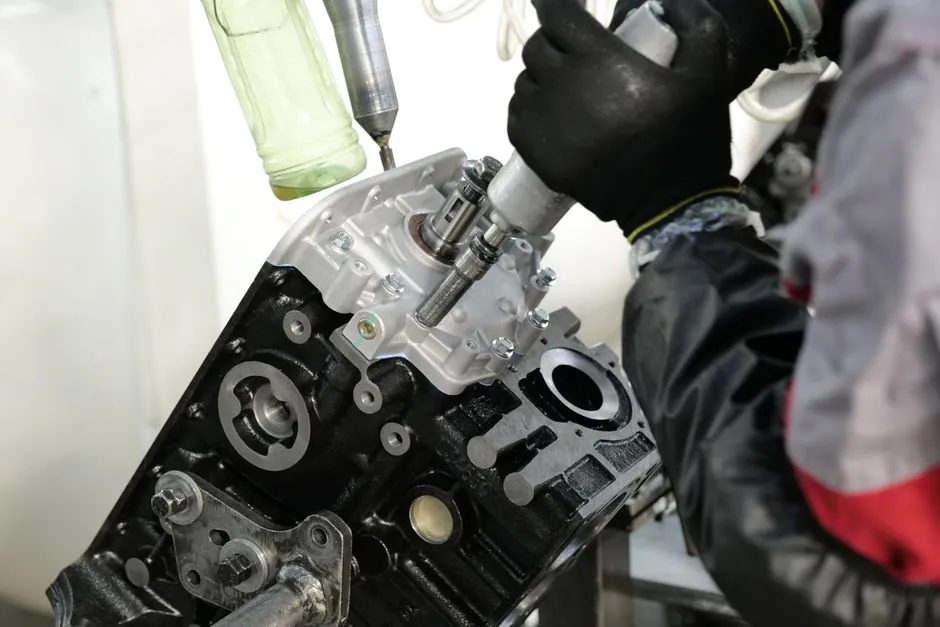
For automotive parts logistics, vibrating conveyors cover a working envelope of trough widths 200-600 mm, amplitudes 2-8 mm, and vibration frequencies typically 10-50 Hz, with linear drives for gentle orientation and circular drives for higher tonnage on robust stampings [S1].
Selection pivots on three constraints unique to tier-1 and tier-2 auto logistics: part fragility (no surface marring on painted bodies-in-white), cleanliness (no oil seepage onto electronics subassemblies), and footprint (tight aisles between AS/RS aisles and assembly cells). A vibrating conveyor is specified when the part mass per metre, part geometry, and ambient conditions all fall inside the equipment's published envelope; outside that envelope, a belt conveyor or chain conveyor is normally the lower-risk path.
Where the Vibrating Conveyor Actually Wins in a Parts-Logistics Line
Small, dry, free-flowing components are the sweet spot: M6-M16 fasteners, spring clips, small stampings, plastic retainer clips, and washer stacks. The equipment moves those parts without lubricant contamination, an advantage over a powered belt conveyor which can shed talc or fabric lint onto sensor-housing subassemblies [S1].
Footprint matters in a tier-1 stamping hall. A trough-style vibrating unit can be built at trough widths as low as 200 mm, with deck lengths commonly 2-6 m, fitting between press cells where a belt conveyor would need a return-idler structure. The trough is fully enclosed, so the part sees no sliding contact, only micro-lifts of 2-8 mm at the drive frequency, and surfaces are usually polished stainless (304 or 316) for body-in-white and paint-shop infeed [S1].
Energy per tonne moved is competitive at modest feed rates. Drives are typically unbalanced-motor or electromagnetic exciters sized 0.4-7.5 kW per trough, sized to the deck length and part bulk density, and they idle cleanly when no parts are on the trough, which is a useful profile for a line running shift patterns of 6-8 hours with frequent stop-start windows.
Linear vs Circular Drive: How to Choose
Linear (two-mass) drives produce a straight-line oscillation, amplitudes 2-8 mm, frequencies 10-25 Hz, and are the right pick for fragile, oddly shaped, or oriented parts where you cannot afford a component lifting off the trough and re-impacting on each cycle.
Circular (single-mass, eccentric-rotating-mass) drives produce a helical trace, amplitudes up to 10-15 mm, frequencies 15-50 Hz, and push much higher tonnage per metre of trough on robust parts. For an automotive press scrap return or a forging-bin discharge, the circular drive wins; for finished-trim infeed to a paint deck, the linear drive is the safer spec.
Drive sizing maps to trough width, part bulk density, and required feed rate. For a 400 mm trough handling fasteners at 200 kg/m^3, an unbalanced-motor drive in the 0.75-1.5 kW range is typical, while a 600 mm trough handling small stampings at 500 kg/m^3 will trend toward 2.2-4.0 kW. The trough amplitude is set by the spring-pack stiffness and counterweight geometry, not by VFD speed alone, so any field adjustment must hold the resonant band of the spring set.
Selection Criteria for an Auto-Parts Logistics Spec
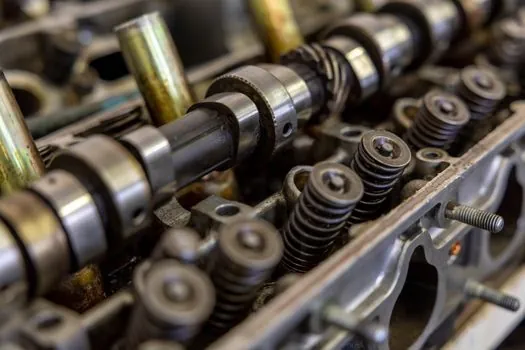
Five criteria decide whether a vibrating conveyor is even the right tool, and in what order they should be screened: (1) part size and mass per metre, (2) part fragility and surface finish requirement, (3) ambient temperature and contamination exposure, (4) required feed rate in kg/min or parts/min, (5) available footprint and elevation change. [S1]
For a quantitative pass/fail on a candidate trough: required feed rate Q (kg/min) divided by trough cross-section A (m^2) and bulk density rho (kg/m^3) yields a transport velocity target. Most trough-type vibrating conveyors operate at 0.05-0.4 m/s on the part bed; outside that band the drive either stalls (too slow, parts sit still) or launches parts off the trough (too fast, surface damage). Use this velocity band as the first gate, before you commit to drive power or spring set.
For corrosion and hygiene, specify 304 stainless for body-in-white infeed, 316 stainless where coolants or washer fluids are nearby, and mild-steel rubber-lined only for dry scrap lines where surface finish does not matter. Elastomer liners (food-grade EPDM, nitrile, polyurethane) on the trough floor can add 1-3 dB of noise damping and reduce part-on-metal contact, useful when the line runs next to a vision-inspection station.
Comparison: Vibrating, Belt, and Chain for the Same Part-Handling Slot
Side-by-side on the four criteria that drive an auto-parts spec:
Footprint: a trough vibrating conveyor at 200-600 mm width and 2-6 m length slots into the tightest press-cell aisle, narrower than a belt conveyor of equivalent capacity, and far narrower than a chain conveyor carrying the same load.
Part compatibility: vibrating wins for small dry parts and rejects; belt wins for formed sheet or body panels where the part rests on a flat surface and needs orientation control; chain wins for heavy, hot, or oily parts (forgings, castings) up to several hundred kilograms per part.
Cleanliness: the vibrating trough is enclosed and has no belt-to-roller contact shedding fibres, an advantage for any zone feeding electronics or sensor subassemblies. Belt conveyors are the worst on this criterion unless the belt is a sealed modular plastic type, in which case the cost premium reverses the trade-off.
Maintenance and life: a vibrating unit has fewer wear parts (springs, exciter bearings, trough liners) than a belt or chain conveyor, but the exciter bearings run at resonance and are a 10,000-20,000 hour planned-replacement item. A standard belt conveyor with quality rubber belt and crowned pulleys will commonly run 30,000-50,000 hours before belt replacement, so total cost of ownership favours the belt in a heavy-tonnage, three-shift application and favours the vibrating unit in a low-tonnage, intermittent-shift application.
Limits, Failure Modes, and What Vibrating Conveyors Should Not Be Specified For

Vibrating conveyors are not specified for hot parts above roughly 150 deg C, because the spring packs lose temper and the trough elastomer (if fitted) degrades. A pneumatic conveyor or an apron conveyor is the right pick above that temperature, not a vibrating unit. [S1]
Sticky, oily, or agglomerating parts will build up on the trough floor and change the resonance of the system. For oily stampings direct from a press, route through a drain station and then onto a belt, or specify a heated trough and scraper chain, not a bare vibrating deck.
Large, heavy parts (each above roughly 25-30 kg) impose dynamic loads that most unbalanced-motor drives cannot sustain without oversized exciter bearings, and the spring set must be retuned to a much lower natural frequency, which then conflicts with the higher throughput target. For those parts, a chain conveyor or an overhead conveyor is the structurally correct choice.
Noise is a real constraint. A trough vibrating at 30 Hz with a 4 mm amplitude typically emits 80-90 dB(A) at 1 m, which exceeds the 85 dB(A) action level in most EU automotive plants. Enclosure, spring-isolated base frame, and elastomer liners are not optional accessories, they are how the equipment meets the noise spec without rewelding the deck.
Relevant Adjacent Specs and Cross-Reference
For magnesium or aluminum die-castings moving downstream of the vibrating unit to a trim press, the magnesium die-cast spec map (magnesium die casting machine selection for automotive parts 2026 spec map) sets the upstream machine envelope the conveyor must match, including shot weight, cycle time, and trimmed-part temperature. A vibrating conveyor rated for parts dropping at 80-120 deg C is the practical upper limit on that interface. [S1]
For heavier material movement in the same plant, such as scrap bales or empty returnable racks, a bucket elevator or a chain conveyor is the right call; the bucket-elevator discharge-type and capacity map (bucket elevator selection map for retail distribution capacity discharge type and) is the relevant reference if the spec is part of a larger returnable-pack loop.
Track the following two signals through 2026 Q4: (1) revised ISO 5049 and CEMA set updates for vibrating conveyors, which historically drove spring-pack and exciter-bearing spec lines, and (2) tier-1 OEM body-shop noise-emission disclosures, which set the dB(A) ceiling any new vibrating unit must meet inside the paint-shop envelope. Both will tighten the spec gates for the next auto-parts logistics refresh.